Er-Reguyeg Yosra, Boudry Christophe, Mouriaux Frederic
Faculté de Médecine. Université Laval, Québec, Canada.
Normandie Univ, UNICAEN, Média Normandie, Caen, France.
Heliyon. 2024 Jul 30;10(15):e35460. doi: 10.1016/j.heliyon.2024.e35460. eCollection 2024 Aug 15.
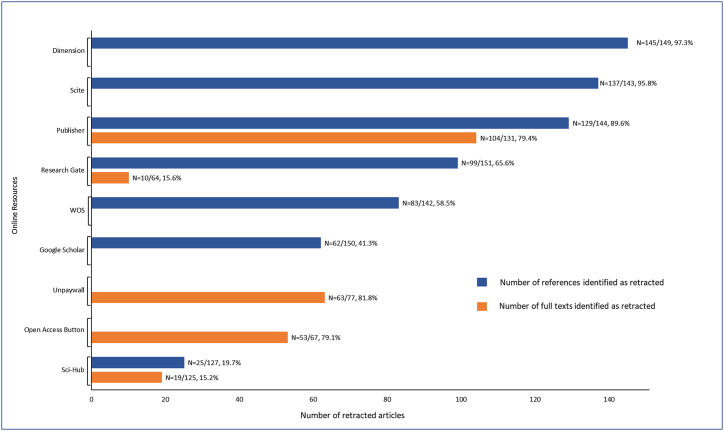
The retraction of publications is a crucial aspect of scientific integrity; it aims to correct the literature and alert scholars and the general public by identifying and labelling articles that contain erroneous data, unreliable findings, or flawed conclusions. Identifying and characterizing retracted articles within the scientific literature is thus very important. The aims of this article were to characterize retracted articles in the ophthalmological literature. One hundred and fifty-one retracted articles published between 1966 and 2023 were retrieved. The number of retracted articles showed an upward trend from 2020 onwards. Ocular oncology (n = 37, 24.5 %) was the most frequently represented subspeciality in the retracted articles, despite retina and uveitis being the most published. The most frequent reason for retraction was fake data (n = 62, 38 %). The labelling of retracted articles on some websites was unsatisfactory, especially on the free-access illegal platform Sci-Hub. On the other hand, platforms such as Dimensions, Scite and Retraction Watch exhibit promising accuracy. Improving the labelling of retractions is needed to reduce the citation of articles after they have been retracted. Solutions to reach this goal are discussed in this article.
论文撤稿是科学诚信的一个关键方面;其目的是通过识别和标记包含错误数据、不可靠研究结果或有缺陷结论的文章来纠正文献,并提醒学者和公众。因此,在科学文献中识别和描述撤稿文章非常重要。本文的目的是描述眼科文献中的撤稿文章。检索到了1966年至2023年期间发表的151篇撤稿文章。撤稿文章的数量从2020年起呈上升趋势。眼部肿瘤学(n = 37,24.5%)是撤稿文章中最常出现的亚专业,尽管视网膜和葡萄膜炎是发表文章最多的领域。撤稿的最常见原因是伪造数据(n = 62,38%)。一些网站上撤稿文章的标记情况不尽人意,尤其是在免费访问的非法平台Sci-Hub上。另一方面,Dimensions、Scite和Retraction Watch等平台显示出较高的准确性。需要改进撤稿标记,以减少文章被撤稿后的引用。本文讨论了实现这一目标的解决方案。