Division of Physiotherapy, Department of Neurobiology, Care Sciences and Society, Karolinska Institutet, Stockholm, Sweden.
Women's Health and Allied Health Professionals Theme, Medical unit Occupational Therapy & Physiotherapy, Karolinska University Hospital, Stockholm, Sweden.
Mov Disord Clin Pract. 2024 Nov;11(11):1410-1420. doi: 10.1002/mdc3.14194. Epub 2024 Aug 21.
Exercise potentially improves gait, balance, and habitual physical activity in Parkinson's disease (PD). However, given the heterogeneous nature of the disease, it is likely that people respond differently to exercise interventions. Factors determining responsiveness to exercise interventions remain unclear.
To address this uncertainty, we explored the responsiveness to our highly challenging balance and gait intervention (HiBalance) in people with PD.
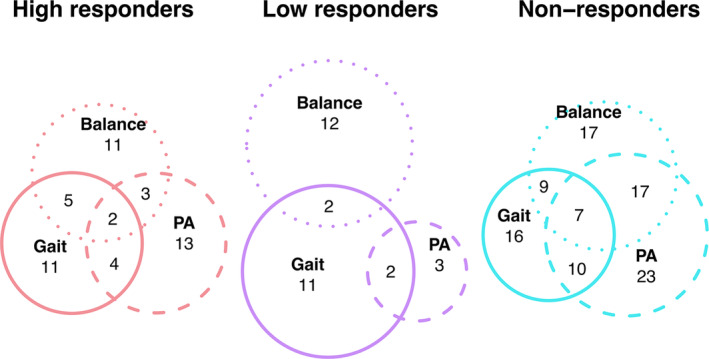
Thirty-nine participants with mild-moderate PD who underwent the HiBalance intervention from our randomized controlled trial were included. We defined response in three domains: (1) balance based on Mini-BESTest, (2) gait based on gait velocity, and (3) physical activity based on accelerometry-derived steps per day. In each domain, we explored three responsiveness levels: high, low, or non-responders according to the change from pre- to post-intervention. Separate Random Forests for each responder domain classified these responsiveness levels and identified variable importance.
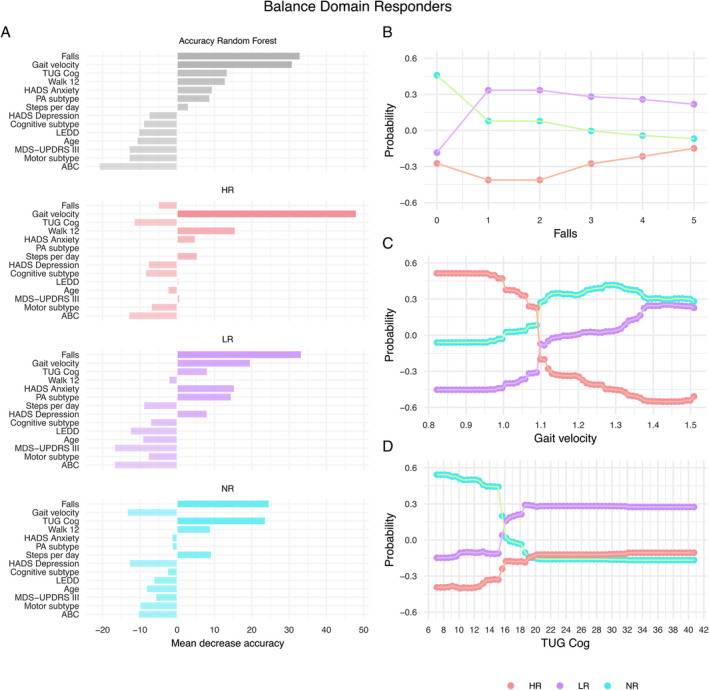
Only the Random Forest for the balance domain classified all responsiveness levels above the chance level indicated by a Cohen's kappa of "slight" agreement. Variable importance differed among the responsiveness levels. Slow gait velocity indicated high responders in the balance domain but showed low probabilities for low and non-responders. For low and non-responders, fall history or no falls, respectively, were more important.
Among three responder domains and responsiveness levels, we could moderately classify responders in the balance domain, but not for the gait or physical activity domain. This can guide inclusion criteria for balance-targeted, personalized intervention studies in people with PD.
运动可能会改善帕金森病(PD)患者的步态、平衡和习惯性体力活动。然而,鉴于该疾病的异质性,人们对运动干预的反应可能不同。决定对运动干预反应的因素尚不清楚。
为了解决这一不确定性,我们探讨了 PD 患者对我们极具挑战性的平衡和步态干预(HiBalance)的反应。
39 名轻度至中度 PD 患者参加了我们的随机对照试验中的 HiBalance 干预。我们根据 Mini-BESTest 定义了平衡方面的反应,根据步态速度定义了步态方面的反应,根据加速度计测量的每天步数定义了体力活动方面的反应。在每个领域,我们根据干预前后的变化,探索了三种反应水平:高、低或无反应者。针对每个反应者领域的单独随机森林对这些反应水平进行分类,并确定了变量的重要性。
只有平衡领域的随机森林将所有反应水平都分类为高于“Cohen's kappa 表示轻度一致”的机会水平。变量的重要性在反应水平之间有所不同。步态速度较慢表明在平衡领域是高反应者,但对于低反应者和无反应者的概率较低。对于低反应者和无反应者,分别是有跌倒史或无跌倒史更为重要。
在三个反应者领域和反应水平中,我们可以适度地对平衡领域的反应者进行分类,但不能对步态或体力活动领域进行分类。这可以为 PD 患者的平衡靶向、个性化干预研究提供纳入标准。