Department of Oncology and Hematology, Azienda Socio-Sanitaria Territoriale Papa Giovanni XXIII, Bergamo, Italy.
SSD Trapianto Cellule Staminali, AOU Città della Salute e della Scienza, Torino, Italy.
Blood Cancer J. 2024 Aug 21;14(1):141. doi: 10.1038/s41408-024-01116-5.
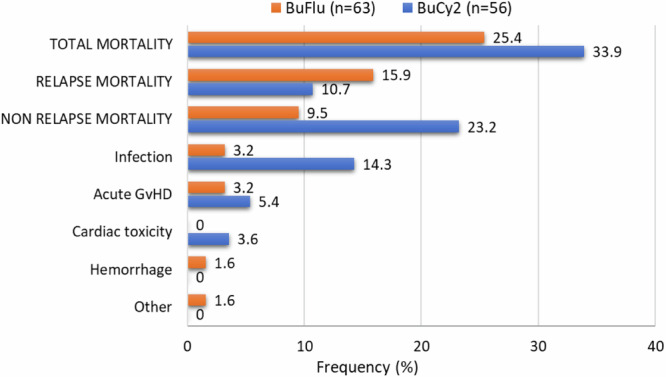
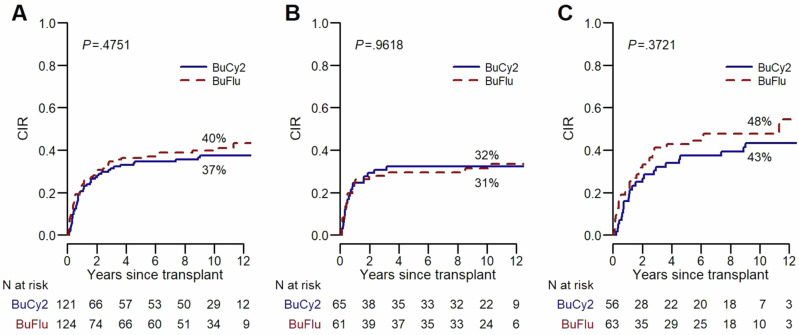
We report the long-term results of a randomized trial (GITMO, AML-R2), comparing 1:1 the combination of busulfan and cyclophosphamide (BuCy2, n = 125) and the combination of busulfan and fludarabine (BuFlu, n = 127) as conditioning regimen in acute myeloid leukemia patients (median age 51 years, range 40-65) undergoing allogeneic hematopoietic stem cell transplantation. With a median follow-up of 6 years, significantly better non-relapse mortality (NRM) was confirmed in BuFlu recipients, which is sustained up to 4 years after transplant (10% vs. 20%, p = 0.0388). This difference was higher in patients older than 51 years (11% in BuFlu vs. 27% in BuCy2, p = 0.0262). The cumulative incidence of relapse, which was the first cause of death in the entire study population, did not differ between the two randomized arms. Similarly, the leukemia-free survival (LFS) and overall survival (OS) were not different in the two cohorts, even when stratifying patients per median age. Graft-and relapse-free survival (GRFS) in BuFlu arm vs. the BuCy2 arm was 25% vs. 20% at 4 years and 20% vs. 17% at 10 years. Hence, the benefit gained by NRM reduction is not offsets by an increased relapse. Leukemia relapse remains a major concern, urging the development of new therapeutic approaches.
我们报告了一项随机试验(GITMO、AML-R2)的长期结果,比较了 1:1 组合的白消安和环磷酰胺(BuCy2,n=125)和白消安和氟达拉滨(BuFlu,n=127)作为急性髓系白血病患者(中位年龄 51 岁,范围 40-65 岁)异基因造血干细胞移植的预处理方案。中位随访 6 年后,BuFlu 组的非复发死亡率(NRM)显著降低得到证实,这一差异在移植后 4 年内持续存在(10%比 20%,p=0.0388)。在年龄大于 51 岁的患者中,这种差异更高(BuFlu 组为 11%,BuCy2 组为 27%,p=0.0262)。在整个研究人群中,复发是导致死亡的首要原因,两个随机治疗组之间的累积复发率没有差异。同样,两组患者的无白血病生存率(LFS)和总生存率(OS)也没有差异,即使按中位年龄分层。BuFlu 组与 BuCy2 组的移植物抗白血病复发生存率(GRFS)在 4 年时分别为 25%和 20%,在 10 年时分别为 20%和 17%。因此,NRM 降低带来的益处并未被复发增加所抵消。白血病复发仍然是一个主要问题,这促使人们开发新的治疗方法。