Ministry of Education Key Laboratory of Protein Sciences, Tsinghua-Peking Joint Center for Life Sciences, Beijing Frontier Research Center for Biological Structures, Beijing Advanced Innovation Center for Structural Biology, School of Life Sciences, Tsinghua University, Beijing, China.
School of Life Sciences, Southern University of Science and Technology, Shenzhen, China.
Nat Commun. 2024 Aug 22;15(1):7201. doi: 10.1038/s41467-024-51460-0.
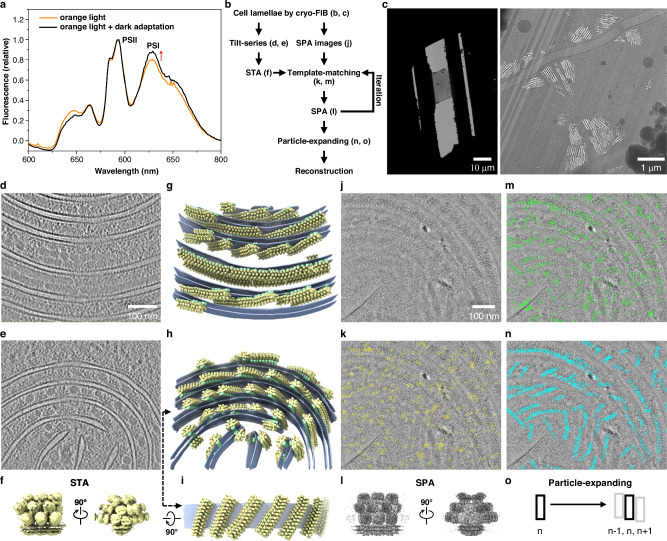
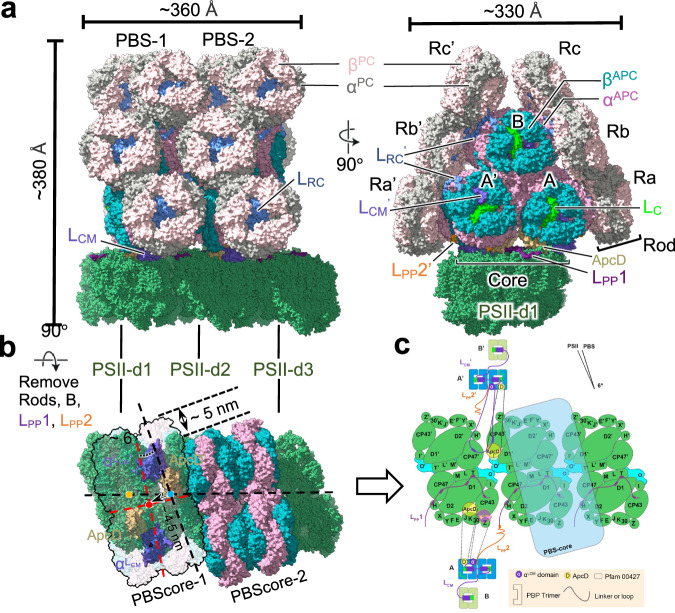
Photosynthesis converting solar energy to chemical energy is one of the most important chemical reactions on earth. In cyanobacteria, light energy is captured by antenna system phycobilisomes (PBSs) and transferred to photosynthetic reaction centers of photosystem II (PSII) and photosystem I (PSI). While most of the protein complexes involved in photosynthesis have been characterized by in vitro structural analyses, how these protein complexes function together in vivo is not well understood. Here we implemented STAgSPA, an in situ structural analysis strategy, to solve the native structure of PBS-PSII supercomplex from the cyanobacteria Arthrospira sp. FACHB439 at resolution of ~3.5 Å. The structure reveals coupling details among adjacent PBSs and PSII dimers, and the collaborative energy transfer mechanism mediated by multiple super-PBS in cyanobacteria. Our results provide insights into the diversity of photosynthesis-related systems between prokaryotic cyanobacteria and eukaryotic red algae but are also a methodological demonstration for high-resolution structural analysis in cellular or tissue samples.
光合作用将太阳能转化为化学能,是地球上最重要的化学反应之一。在蓝藻中,光能被天线系统藻胆体(PBS)捕获,并传递到光系统 II(PSII)和光系统 I(PSI)的光合作用反应中心。虽然参与光合作用的大多数蛋白质复合物已经通过体外结构分析进行了表征,但这些蛋白质复合物如何在体内协同作用尚不清楚。在这里,我们实施了 STAgSPA,一种原位结构分析策略,以解决来自蓝藻 Arthrospira sp. FACHB439 的 PBS-PSII 超复合物的天然结构,分辨率约为~3.5 Å。该结构揭示了相邻 PBS 和 PSII 二聚体之间的耦合细节,以及由多个超级 PBS 在蓝藻中介导的协同能量转移机制。我们的结果提供了关于原核蓝藻和真核红藻之间光合作用相关系统多样性的见解,但也是在细胞或组织样品中进行高分辨率结构分析的方法论证。