School of Biological Sciences, National Institute of Science Education and Research, Room No. 204, PO: Jatani, Khurda, Bhubaneswar, Odisha, 752050, India.
Homi Bhabha National Institute, Training School Complex, Anushakti Nagar, Mumbai, 400094, India.
Sci Rep. 2024 Aug 21;14(1):19371. doi: 10.1038/s41598-024-70368-9.
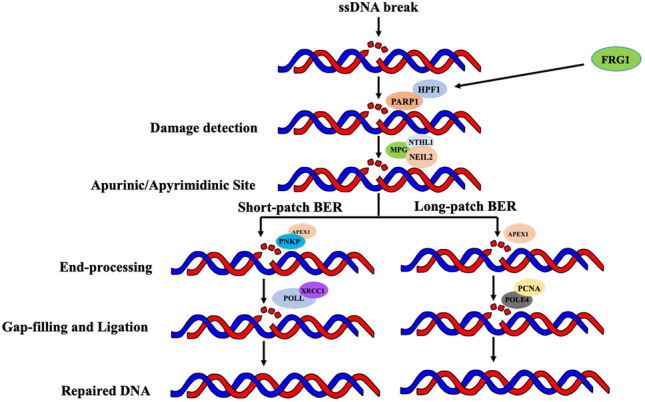
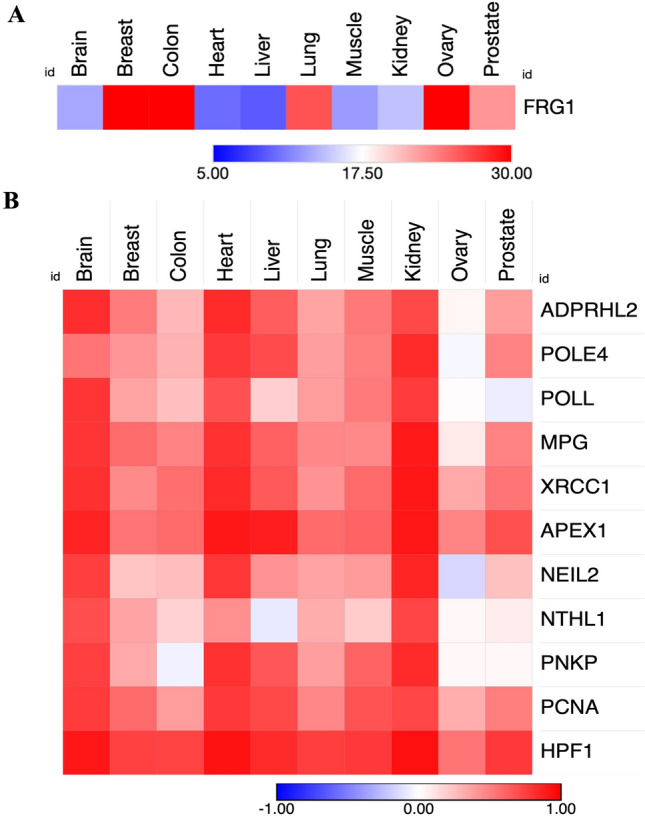
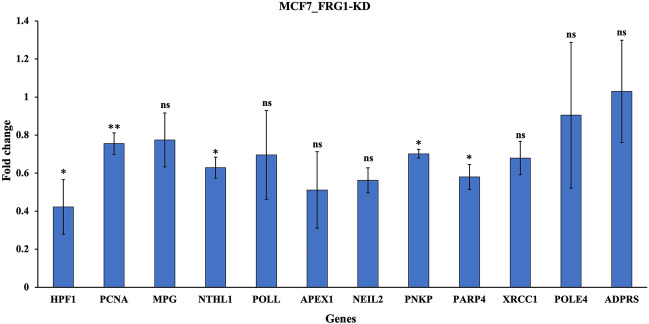
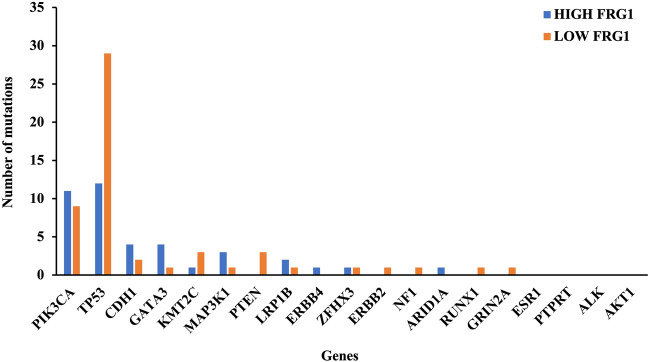
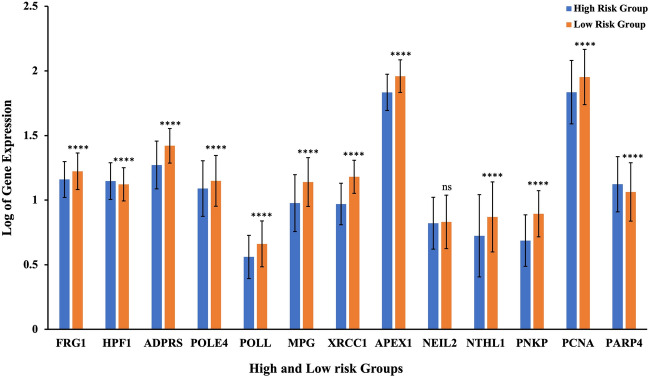
The FRG1(FSHD region gene 1) gene has emerged as a pivotal tumor suppressor in both breast and prostate cancer. HPF1 (Histone PARylation Factor 1), a gene crucial in the base excision repair (BER) mechanism for single-stranded DNA (ssDNA) lesions, showcases a robust correlation with FRG1. This implies that FRG1 might have the capacity to influence BER via HPF1, potentially playing a role in tumorigenesis. Using a comprehensive approach that integrates in-silico analyses involving differential gene expression, KEGG (Kyoto Encyclopedia of Genes and Genomes), GO (Gene Ontology), and STRING (Search Tool for the Retrieval of Interacting Genes/Proteins) databases, we unravelled the intricate network of genes and pathways influenced by FRG1, which includes BER. Our linear regression analysis unveiled a positive relationship between FRG1 and key genes crucial for BER. Notably, breast cancer patients with low FRG1 expression exhibited a significantly higher frequency of mutation in TP53. To enhance the accuracy of our analysis, we conducted qRT-PCR assays, which demonstrated that FRG1 affects the transcription of DNA base excision repair genes, showing differential expression in breast cancer cells. Moreover, through the Alkaline Comet Assay, a technique that quantifies DNA damage at the single-cell level, we observed diminished DNA repair capabilities when FRG1 levels are low. Risk scores were calculated using the Cox regression coefficients, and we found notable differences in Overall Survival (OS) and mRNA expression of DEGs in the low and high-risk groups. In summary, our findings shed light on the pivotal role of FRG1 in maintaining DNA repair efficiency within breast cancer cells.
FRG1(FSHD 区基因 1)基因已成为乳腺癌和前列腺癌中重要的肿瘤抑制因子。HPF1(组蛋白 PAR 化因子 1)是单链 DNA(ssDNA)损伤碱基切除修复(BER)机制中至关重要的基因,与 FRG1 表现出很强的相关性。这表明 FRG1 可能通过 HPF1 影响 BER,从而在肿瘤发生中发挥作用。我们采用综合方法,整合了差异基因表达的计算机分析、KEGG(京都基因与基因组百科全书)、GO(基因本体论)和 STRING(检索相互作用基因/蛋白质的工具)数据库,揭示了 FRG1 影响的基因和途径的复杂网络,包括 BER。我们的线性回归分析揭示了 FRG1 与 BER 关键基因之间存在正相关关系。值得注意的是,FRG1 表达水平低的乳腺癌患者,TP53 突变的频率明显更高。为了提高我们分析的准确性,我们进行了 qRT-PCR 检测,结果表明 FRG1 影响 DNA 碱基切除修复基因的转录,在乳腺癌细胞中表现出差异表达。此外,通过碱性彗星试验,一种在单细胞水平上定量 DNA 损伤的技术,我们观察到 FRG1 水平较低时 DNA 修复能力下降。我们使用 Cox 回归系数计算风险评分,并发现低风险和高风险组之间在总生存期(OS)和差异表达基因的 mRNA 表达方面存在显著差异。总之,我们的研究结果揭示了 FRG1 在维持乳腺癌细胞中 DNA 修复效率方面的关键作用。