Department of General Surgery, Yichun People's Hospital, No. 1061 Jinxiu Avenue, Yiyang New District, Yichun, jiangxi, 336000, China.
BMC Cancer. 2024 Aug 21;24(1):1031. doi: 10.1186/s12885-024-12782-w.
Does incorporating Cyclin-dependent kinase 4/6 (CDK4/6) inhibitors into endocrine therapy (ET) effectively enhance survival outcomes, notably overall survival (OS), among individuals with hormone receptor-positive (HR+), human epidermal growth factor receptor 2-negative (HER2-) advanced breast cancer? This remains a clinical controversy. We compared the antitumor efficacy and adverse effects (AEs) between CDK4/6 inhibitors + ET (CET) and placebo + ET (PET) by conducting a phase III randomized controlled trials (RCTs) based meta-analysis.
Seven databases were searched to identify eligible studies, comprising Phase III RCTs comparing CET to PET. The primary endpoints were OS and progression-free survival (PFS), with secondary endpoints including responses and adverse events (AEs).
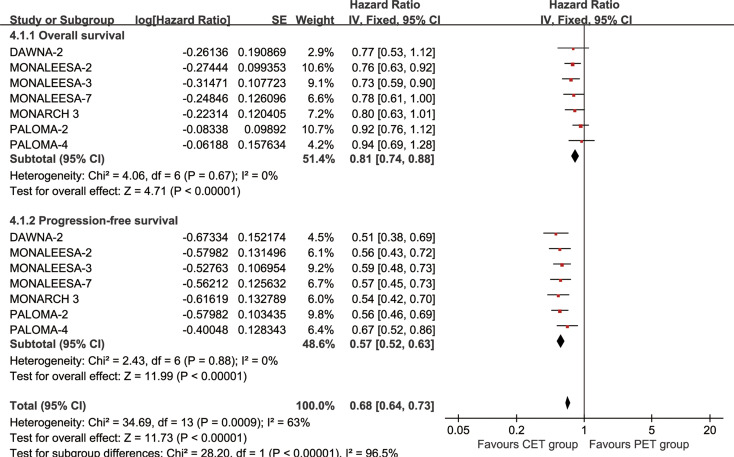
Seven RCTs (DAWNA-2, MONALEESA-2, MONALEESA-3, MONALEESA-7, MONARCH-3, PALOMA-2, and PALOMA-4) were included. The CET group exhibited significantly improved OS (HR: 0.81 [0.74, 0.88]), PFS (HR: 0.57 [0.52, 0.63]), objective response rate (RR: 1.31 [1.20, 1.43]), and clinical benefit rate (RR: 1.11 [1.07, 1.15]). These benefits were consistent across almost all subgroups. Additionally, the CET group showed better overall survival rates (OSR) from 24 to 60 months (OSR 24-60 m) and progression-free survival rates (PFSR) from 6 to 60 months (PFSR 6-60 m). However, more total AEs, grade 3-5 AEs, and serious AEs were found in CET group. The top 5 grade 3-5 AEs in the CET group were neutropenia (59.39%), leukopenia (24.11%), decreased white blood cell count (12.99%), hypertension (7.03%), and increased alanine aminotransferase (5.91%).
The superiority of CET over PET in HR+/HER2- advanced breast cancer is evident, showing improved survival and responses. Nonetheless, the higher incidence of AEs, specifically hematologic AEs, requires cautious attention.
在激素受体阳性(HR+)、人表皮生长因子受体 2 阴性(HER2-)晚期乳腺癌患者中,将细胞周期蛋白依赖性激酶 4/6(CDK4/6)抑制剂与内分泌治疗(ET)联合使用是否能有效提高生存结局,尤其是总生存(OS),这仍然存在临床争议。我们通过开展 III 期随机对照试验(RCT)的荟萃分析,比较了 CDK4/6 抑制剂+ET(CET)与安慰剂+ET(PET)的抗肿瘤疗效和不良反应(AEs)。
我们在七个数据库中检索了符合条件的研究,包括比较 CET 与 PET 的 III 期 RCT。主要终点是 OS 和无进展生存期(PFS),次要终点包括反应和不良反应(AEs)。
纳入了 7 项 RCT(DAWNA-2、MONALEESA-2、MONALEESA-3、MONALEESA-7、MONARCH-3、PALOMA-2 和 PALOMA-4)。CET 组 OS(HR:0.81 [0.74,0.88])、PFS(HR:0.57 [0.52,0.63])、客观缓解率(RR:1.31 [1.20,1.43])和临床获益率(RR:1.11 [1.07,1.15])均显著改善。这些获益在几乎所有亚组中均一致。此外,CET 组在 24 至 60 个月的总生存率(OSR 24-60 m)和 6 至 60 个月的无进展生存率(PFSR 6-60 m)方面表现更好。然而,CET 组出现更多的总不良反应(AEs)、3-5 级 AEs 和严重 AEs。CET 组的前 5 大 3-5 级 AEs 是中性粒细胞减少症(59.39%)、白细胞减少症(24.11%)、白细胞计数减少(12.99%)、高血压(7.03%)和丙氨酸氨基转移酶升高(5.91%)。
在 HR+/HER2-晚期乳腺癌中,CET 优于 PET,表现为生存和反应改善。然而,更高的不良反应发生率,特别是血液学不良反应,需要谨慎关注。