Department of Anatomy, Pusan National University School of Medicine, Yangsan 50612, Republic of Korea; Department of Convergence Medical Science, Pusan National University School of Medicine, Yangsan 50612, Republic of Korea.
Department of Anatomy, Pusan National University School of Medicine, Yangsan 50612, Republic of Korea; Department of Convergence Medical Science, Pusan National University School of Medicine, Yangsan 50612, Republic of Korea; PNU GRAND Convergence Medical Science Education Research Center, Pusan National University School of Medicine, Yangsan 50612, Republic of Korea.
Mol Ther. 2024 Nov 6;32(11):3879-3894. doi: 10.1016/j.ymthe.2024.08.019. Epub 2024 Aug 22.
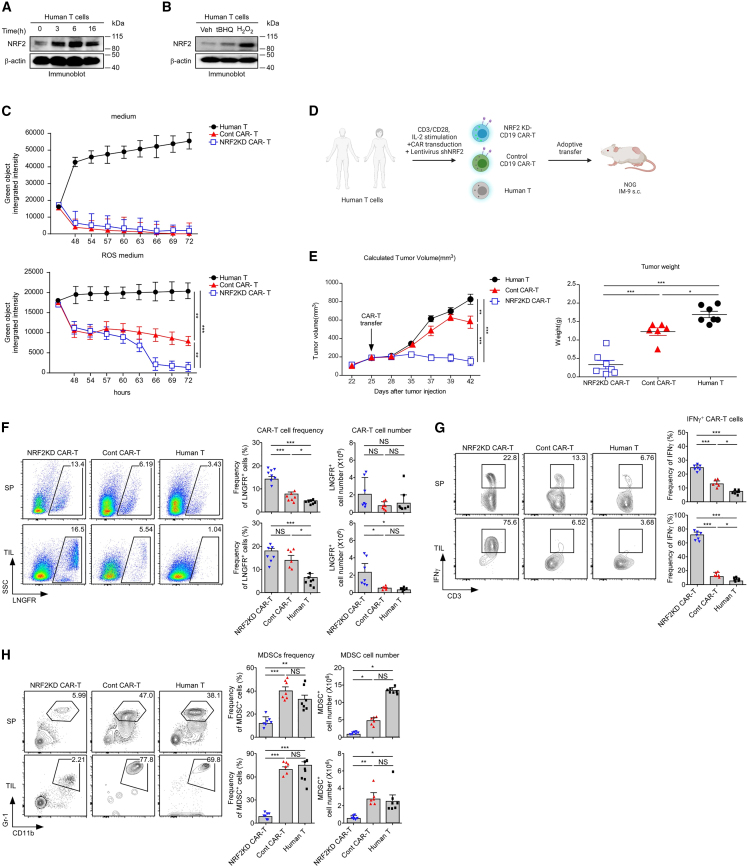
Cytotoxic T lymphocytes (CTLs) play a crucial role in cancer rejection. However, CTLs encounter dysfunction and exhaustion in the immunosuppressive tumor microenvironment (TME). Although the reactive oxygen species (ROS)-rich TME attenuates CTL function, the underlying molecular mechanism remains poorly understood. The nuclear factor erythroid 2-related 2 (Nrf2) is the ROS-responsible factor implicated in increasing susceptibility to cancer progression. Therefore, we examined how Nrf2 is involved in anti-tumor responses of CD8 T and chimeric antigen receptor (CAR) T cells in the ROS-rich TME. Here, we demonstrated that tumor growth in Nrf2 mice was significantly controlled and was reversed by T cell depletion and further confirmed that Nrf2 deficiency in T cells promotes anti-tumor responses using an adoptive transfer model of antigen-specific CD8 T cells. Nrf2-deficient CTLs are resistant to ROS, and their effector functions are sustained in the TME. Furthermore, Nrf2 knockdown in human CAR-T cells enhanced the survival and function of intratumoral CAR-T cells in a solid tumor xenograft model and effectively controlled tumor growth. ROS-sensing Nrf2 inhibits the anti-tumor T cell responses, indicating that Nrf2 may be a potential target for T cell immunotherapy strategies against solid tumors.
细胞毒性 T 淋巴细胞(CTLs)在癌症排斥中起着至关重要的作用。然而,CTLs 在免疫抑制性肿瘤微环境(TME)中会遇到功能障碍和衰竭。尽管富含活性氧物种(ROS)的 TME 会减弱 CTL 的功能,但其中的潜在分子机制仍知之甚少。核因子红细胞 2 相关因子 2(Nrf2)是 ROS 负责的因子,与增加癌症进展的易感性有关。因此,我们研究了 Nrf2 如何参与富含 ROS 的 TME 中 CD8 T 细胞和嵌合抗原受体(CAR)T 细胞的抗肿瘤反应。在这里,我们证明了 Nrf2 缺失会显著控制肿瘤生长,并通过 T 细胞耗竭逆转肿瘤生长,进一步证实了 Nrf2 在 T 细胞中的缺失通过抗原特异性 CD8 T 细胞的过继转移模型促进了抗肿瘤反应。Nrf2 缺陷型 CTLs 对 ROS 具有抗性,并且它们的效应功能在 TME 中得以维持。此外,在实体瘤异种移植模型中,Nrf2 敲低可增强人源 CAR-T 细胞的存活和功能,并有效控制肿瘤生长。ROS 感应 Nrf2 抑制抗肿瘤 T 细胞反应,表明 Nrf2 可能是针对实体瘤的 T 细胞免疫治疗策略的潜在靶点。