Liu Suping
Puyang Vocational and Technical College, Puyang, 467000, Henan Province, China.
Heliyon. 2024 Aug 3;10(15):e35756. doi: 10.1016/j.heliyon.2024.e35756. eCollection 2024 Aug 15.
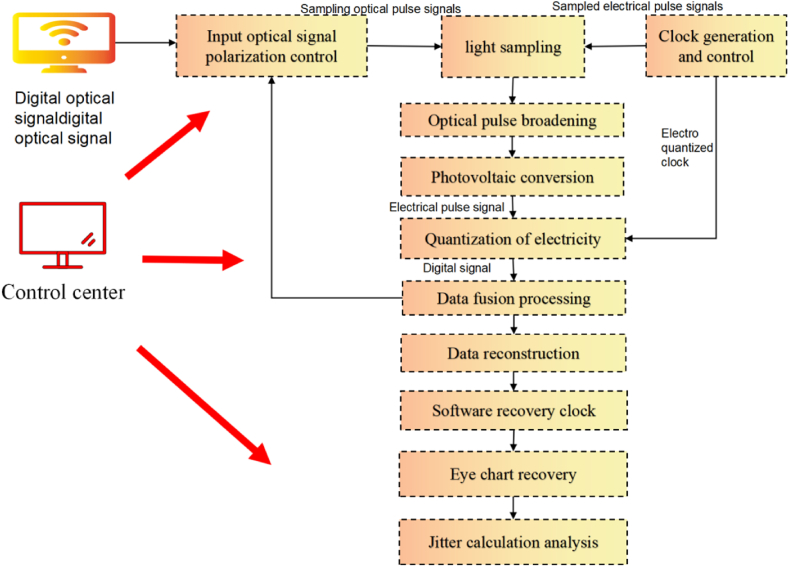
With the rapid development of information technology, high-speed digital optical signal transmission technology has become the core of modern communication networks. However, the increase in transmission rates brings challenges such as noise, distortion, and interference, which affect the accuracy of clock recovery. To address these issues, this study proposes a clock recovery algorithm based on the eye diagram opening area to improve the accuracy and efficiency of high-speed digital optical signal jitter measurement. The proposed method extracts clock information from the signal using the opening area and curvature characteristics of the eye diagram for jitter measurement. Experimental results demonstrate that the clock recovery algorithm based on the eye diagram opening area can stably reconstruct the signal eye diagram and obtain jitter parameters under different optical power conditions. At optical powers of -7.2 dBm, -12.2 dBm, and -17.2 dBm, the Q-factors were 8.8, 7.6, and 4.3, respectively, and the RMS jitter values were 12.2 ps, 13.4 ps, and 21.2 ps, respectively. At optical powers of -2.3 dBm, 0.1 dBm, 2.4 dBm, 4.6 dBm, and 6.0 dBm, the Q-factors were 9.1, 9.3, 9.5, 9.7, and 10.0, respectively, and the average jitter values were 8.9 ps, 8.5 ps, 8.0 ps, 7.5 ps, and 7.0 ps. These results indicate that the proposed algorithm performs excellently under low optical power conditions and maintains high recovery accuracy even when jitter increases at higher optical powers. The clock recovery algorithm based on the eye diagram opening area significantly improves the accuracy and stability of high-speed digital optical signal jitter measurement, enriches the theoretical research of clock recovery algorithms, and shows significant advantages in improving signal transmission quality, reducing bit error rate, and enhancing communication link reliability. The research outcomes provide key technical support for the optimization of modern high-speed optical communication systems.
随着信息技术的飞速发展,高速数字光信号传输技术已成为现代通信网络的核心。然而,传输速率的提高带来了噪声、失真和干扰等挑战,这些都会影响时钟恢复的准确性。为了解决这些问题,本研究提出了一种基于眼图开口面积的时钟恢复算法,以提高高速数字光信号抖动测量的准确性和效率。该方法利用眼图的开口面积和曲率特性从信号中提取时钟信息进行抖动测量。实验结果表明,基于眼图开口面积的时钟恢复算法能够在不同光功率条件下稳定地重建信号眼图并获得抖动参数。在光功率为-7.2dBm、-12.2dBm和-17.2dBm时,Q因子分别为8.8、7.6和4.3,均方根抖动值分别为12.2ps、13.4ps和21.2ps。在光功率为-2.3dBm、0.1dBm、2.4dBm、4.6dBm和6.0dBm时,Q因子分别为9.1、9.3、9.5、9.7和10.0,平均抖动值分别为8.9ps、8.5ps、8.0ps、7.5ps和7.0ps。这些结果表明,所提算法在低光功率条件下表现出色,即使在高光功率下抖动增加时也能保持较高的恢复精度。基于眼图开口面积的时钟恢复算法显著提高了高速数字光信号抖动测量的准确性和稳定性,丰富了时钟恢复算法的理论研究,在提高信号传输质量、降低误码率和增强通信链路可靠性方面具有显著优势。研究成果为现代高速光通信系统的优化提供了关键技术支持。