Chu Jinyan, Yuan Chenyue, Zhou Lin, Zhao Yong, Wu Xingli, Yan Yuting, Liu Yi, Liu Xiangjun, Jing Lin, Dong Tiangeng, Ren Jianlin
Department of Oncology, Shanghai Municipal Hospital of Traditional Chinese Medicine, Shanghai University of Traditional Chinese Medicine, 274 Middle Zhijiang Road, Shanghai, 200071, China.
Department of Emergency, Shanghai Municipal Hospital of Traditional Chinese Medicine, Shanghai University of Traditional Chinese Medicine, 274 Middle Zhijiang Road, Shanghai, 200071, China.
Heliyon. 2024 Jul 31;10(15):e35490. doi: 10.1016/j.heliyon.2024.e35490. eCollection 2024 Aug 15.
JianPiTongLuo Recipe (JPTL Recipe) is a traditional Chinese medicine formula commonly used in the clinical treatment of colorectal cancer. Clinical studies have found that it can significantly improve the prognosis of patients with colorectal cancer. However, its mechanisms of action are not well understood, which has limited its further clinical application.
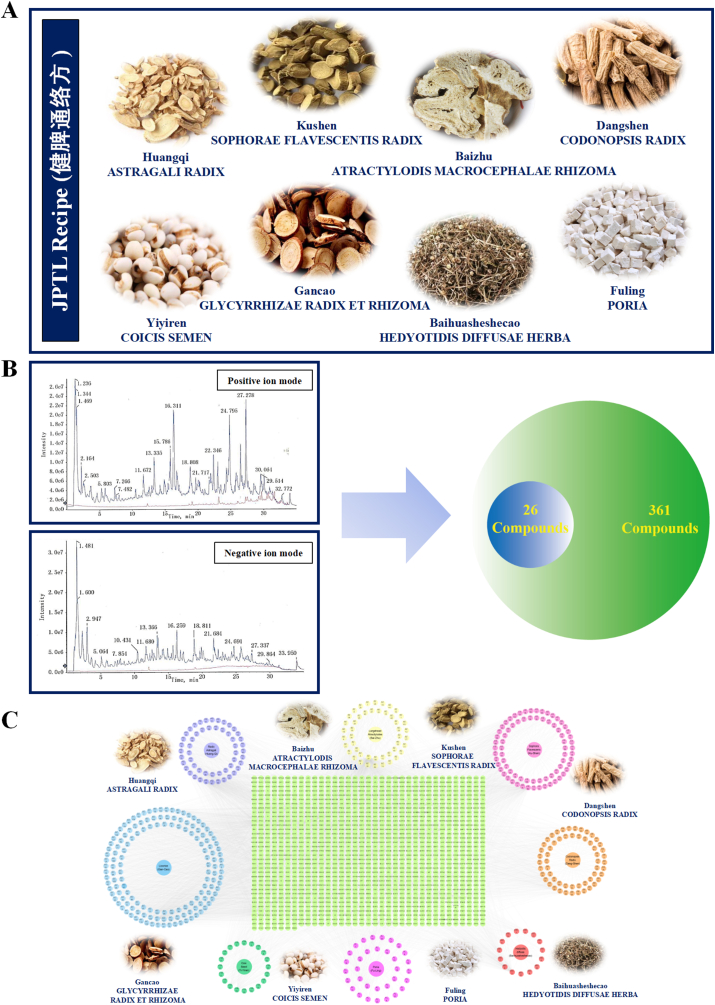
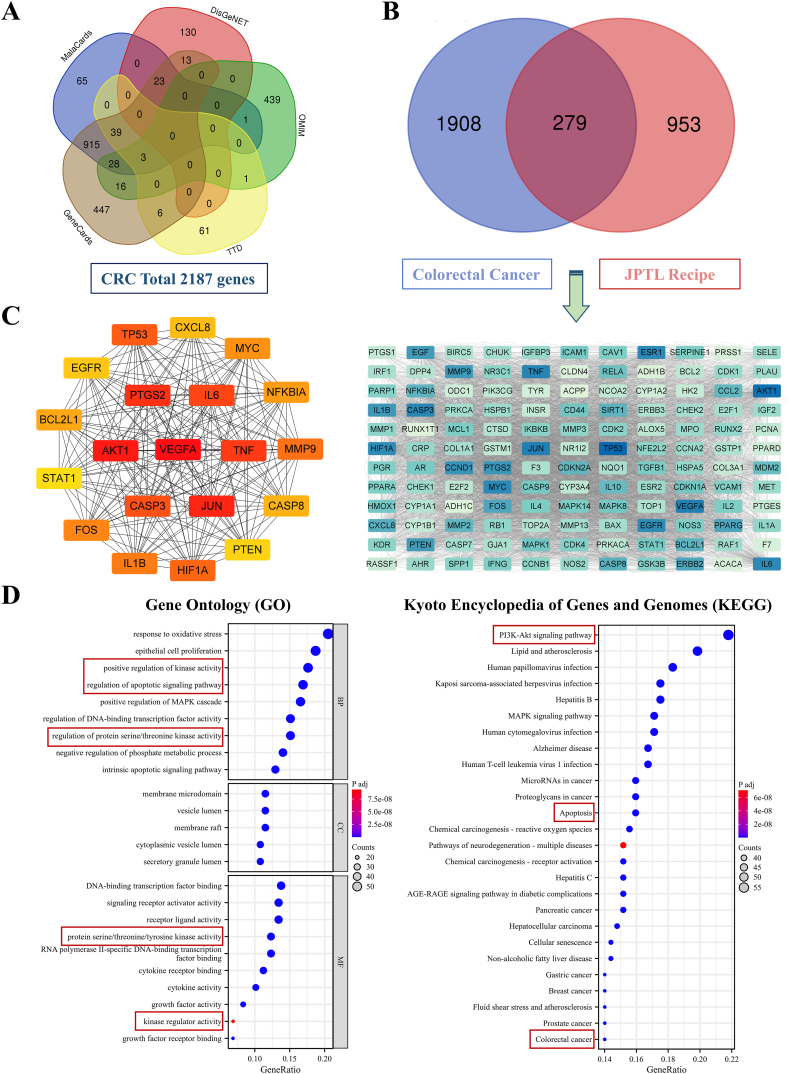
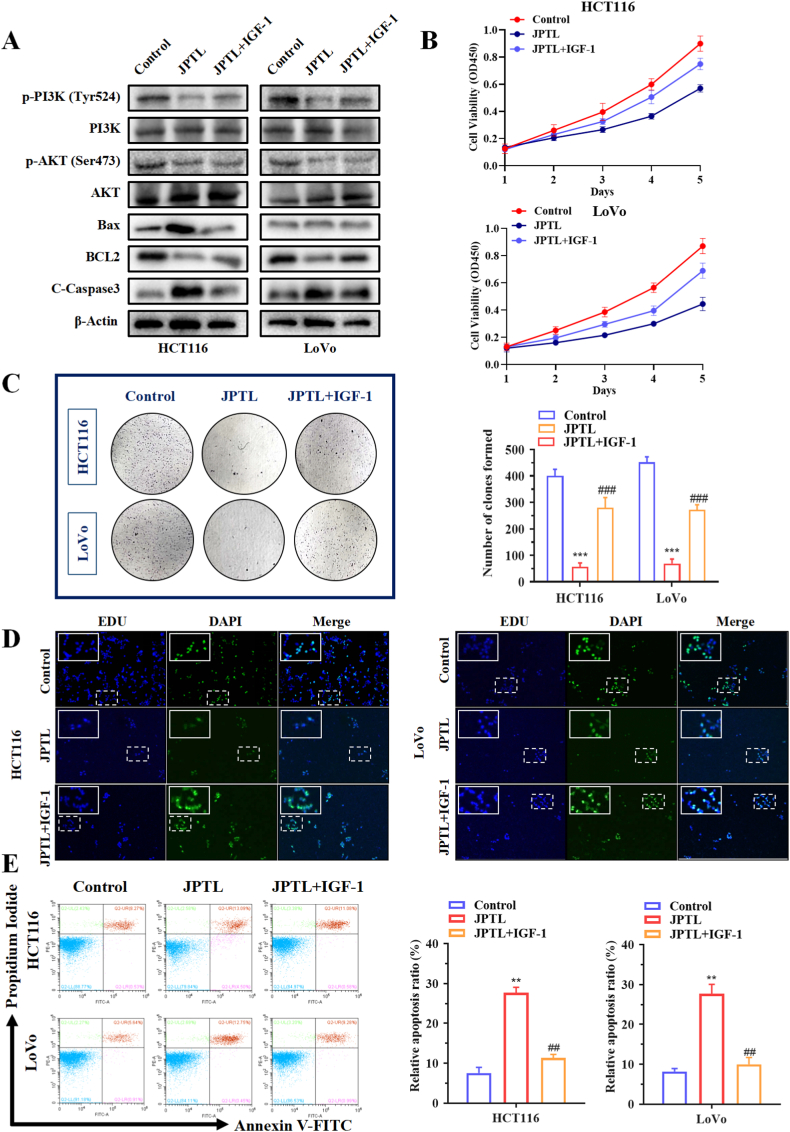
We investigated the potential mechanisms of action of the JianPiTongLuo (JPTL) Recipe on colorectal cancer (CRC) using a multi-step approach. Initially, network pharmacology and bioinformatics analyses were conducted using databases such as TCMSP, HERB, BATMAN-TCM, and STRING to identify active components of JPTL Recipe and predict their therapeutic targets. Interaction networks and functional enrichment analyses were constructed to hypothesize relevant biological processes and pathways. In vitro studies involved treating human CRC cell lines HCT116, LoVo and SW480 with varying concentrations of JPTL Recipe extract, measuring cell viability with the CCK-8 assay, assessing apoptosis via flow cytometry, and analyzing signaling pathways through Western blotting. To corroborate these findings, in vivo experiments were performed on BALB/c nude mice implanted with HCT116 cells, divided into control, JPTL Recipe-treated, 5-fluorouracil (5-FU)-treated, and JPTL Recipe combined with 5-FU groups, with tumor growth and histological changes monitored. Mechanistic studies focused on the PI3K/AKT signaling pathway, examining the phosphorylation status of key pathway proteins using immunofluorescence and Western blot analyses to elucidate JPTL Recipe 's interaction with pathway activity.
We demonstrated that JPTL Recipe effectively inhibits colorectal cancer cell proliferation, anti-apoptotic ability, and exerts synergistic therapeutic effects with fluorouracil. Further analysis revealed that JPTL Recipe affects the activity of colorectal cancer cells by inhibiting the phosphorylation of the PI3K/AKT signaling pathway.
In summary, we have discovered and confirmed that the traditional Chinese medicine compound JPTL Recipe can serve as a novel adjuvant therapy for colorectal cancer, offering a new treatment approach for the integration of traditional Chinese and Western medicine in the treatment of colorectal cancer.
健脾通络方是临床治疗结直肠癌常用的中药方剂。临床研究发现,它能显著改善结直肠癌患者的预后。然而,其作用机制尚不清楚,这限制了它在临床上的进一步应用。
我们采用多步骤方法研究健脾通络方对结直肠癌的潜在作用机制。首先,利用中药系统药理学数据库与分析平台(TCMSP)、中药综合数据库(HERB)、中药系统药理学数据库(BATMAN-TCM)和搜索工具检索相互作用基因/蛋白质数据库(STRING)等数据库进行网络药理学和生物信息学分析,以鉴定健脾通络方的活性成分并预测其治疗靶点。构建相互作用网络和功能富集分析,以推测相关的生物学过程和途径。体外研究包括用不同浓度的健脾通络方提取物处理人结直肠癌细胞系HCT116、LoVo和SW480,用CCK-8法检测细胞活力,通过流式细胞术评估细胞凋亡,并通过蛋白质免疫印迹法分析信号通路。为了证实这些发现,对植入HCT116细胞的BALB/c裸鼠进行体内实验,分为对照组、健脾通络方治疗组、5-氟尿嘧啶(5-FU)治疗组和健脾通络方联合5-FU组,监测肿瘤生长和组织学变化。机制研究聚焦于PI3K/AKT信号通路,使用免疫荧光和蛋白质免疫印迹分析检查关键通路蛋白的磷酸化状态,以阐明健脾通络方与通路活性的相互作用。
我们证明健脾通络方有效抑制结直肠癌细胞增殖、抗凋亡能力,并与氟尿嘧啶发挥协同治疗作用。进一步分析表明,健脾通络方通过抑制PI3K/AKT信号通路的磷酸化来影响结直肠癌细胞的活性。
总之,我们发现并证实中药复方健脾通络方可作为结直肠癌的一种新型辅助治疗方法,为中西医结合治疗结直肠癌提供了一种新的治疗途径。