
MAF bZIP 转录因子 B 的表达通过抑制 NF-κB 通路来保护溃疡性结肠炎。
Expression of MAF bZIP transcription factor B protects against ulcerative colitis through the inhibition of the NF-κB pathway.
机构信息
Department of Gastroenterology, Shandong Provincial Hospital Affiliated to Shandong First Medical University, Jinan, Shandong, China.
Department of General Practice, Shandong Provincial Hospital Affiliated to Shandong First Medical University, Jinan, Shandong, China.
出版信息
Immun Inflamm Dis. 2024 Aug;12(8):e1372. doi: 10.1002/iid3.1372.
PURPOSE
The aim of this study was to explore whether MAF bZIP transcription factor B (MAFB) might alleviate ulcerative colitis (UC) in dextran sulfate sodium (DSS)-induced mice and LPS-induced IEC-6 cells.
METHODS
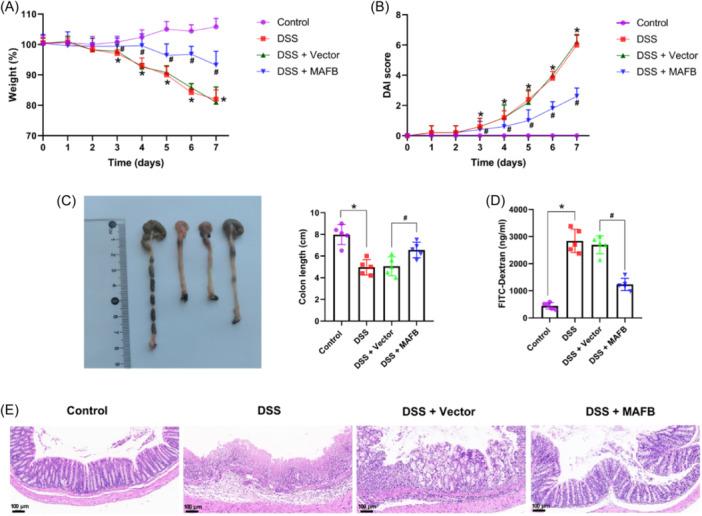
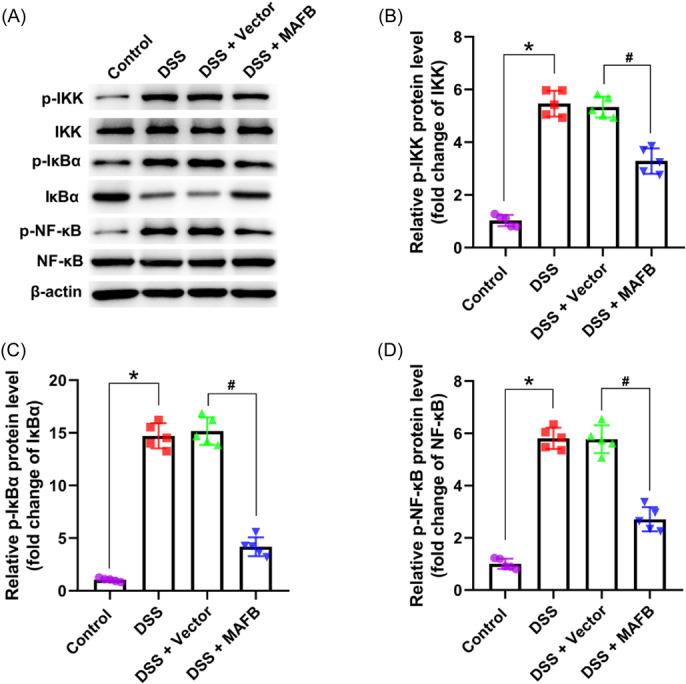
UC in vivo and in vitro model was established by using DSS and LPS, respectively. The mice body weight and disease activity index (DAI) score were recorded daily, and colon length was measured. Moreover, the permeability was evaluated utilizing a fluorescein isothiocyanate dextran (FITC-Dextran) probe. Histopathological changes of DSS-induced colitis mice was assessed utilizing H&E staining. Next, qRT-PCR was performed to detect IL-1β, IL-6, TNF-α, and IL-10 level in in vivo and in vitro. Furthermore, the level of MDA, SOD, CAT, and GSH were evaluated in colon tissues. Besides, the expressions of tight junction proteins and NF-κB pathway relative proteins were examined in colitis mice and IEC-6 cells using western blot, immunohistochemistry and immunofluorescence.
RESULTS
MAFB level was downregulated in DSS-induced colitis mice. Moreover, the upregulation of MAFB protected mice from DSS-induced colitis by suppressing DSS-induced inflammation, oxidative stress, and intestinal barrier impairment. We also demonstrated that the upregulation of MAFB inactivated NF-κB pathway in DSS-caused colitis mice. Subsequently, we observed that MAFB upregulation could inhibit LPS-caused epithelial barrier impairment and inflammation in IEC-6 cells. Additionally, MAFB overexpression could suppress the activation of NF-κB pathway in IEC-6 cells.
CONCLUSION
The upregulation of MAFB could protect against UC via the suppression of inflammation and the intestinal barrier impairment through inhibiting the NF-κB pathway.
目的
本研究旨在探讨 MAFF 碱性亮氨酸拉链转录因子 B(MAFB)是否可以缓解葡聚糖硫酸钠(DSS)诱导的小鼠和脂多糖(LPS)诱导的 IEC-6 细胞中的溃疡性结肠炎(UC)。
方法
分别采用 DSS 和 LPS 建立 UC 体内和体外模型。每天记录小鼠体重和疾病活动指数(DAI)评分,并测量结肠长度。此外,利用荧光素异硫氰酸酯葡聚糖(FITC-Dextran)探针评估通透性。采用 H&E 染色评估 DSS 诱导结肠炎小鼠的组织病理学变化。接下来,采用 qRT-PCR 检测体内和体外的 IL-1β、IL-6、TNF-α 和 IL-10 水平。此外,还评估了结肠组织中的 MDA、SOD、CAT 和 GSH 水平。此外,采用 Western blot、免疫组化和免疫荧光法检测结肠炎小鼠和 IEC-6 细胞中紧密连接蛋白和 NF-κB 通路相关蛋白的表达。
结果
在 DSS 诱导的结肠炎小鼠中,MAFB 水平下调。此外,MAFB 的上调通过抑制 DSS 诱导的炎症、氧化应激和肠道屏障损伤,保护小鼠免受 DSS 诱导的结肠炎。我们还表明,在 DSS 引起的结肠炎小鼠中,MAFB 的上调使 NF-κB 通路失活。随后,我们观察到 MAFB 的上调可以抑制 LPS 引起的 IEC-6 细胞上皮屏障损伤和炎症。此外,MAFB 过表达可以抑制 IEC-6 细胞中 NF-κB 通路的激活。
结论
MAFB 的上调可以通过抑制 NF-κB 通路来抑制炎症和肠道屏障损伤,从而保护 UC。




 Zotero 插件