Population Genetics, Department of Life Science Systems, School of Life Sciences, Technical University of Munich, Freising 85354Germany.
Center for Genomics and Systems Biology, New York University, New York, NY 10003, USA.
Mol Biol Evol. 2024 Sep 4;41(9). doi: 10.1093/molbev/msae176.
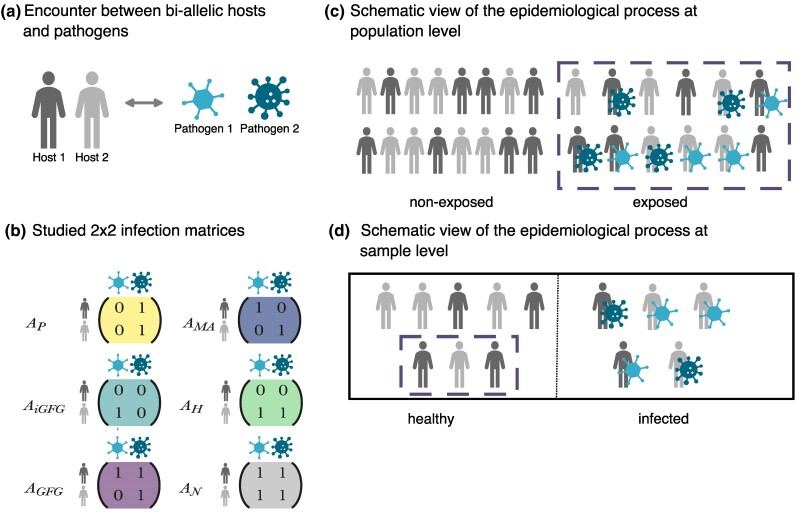
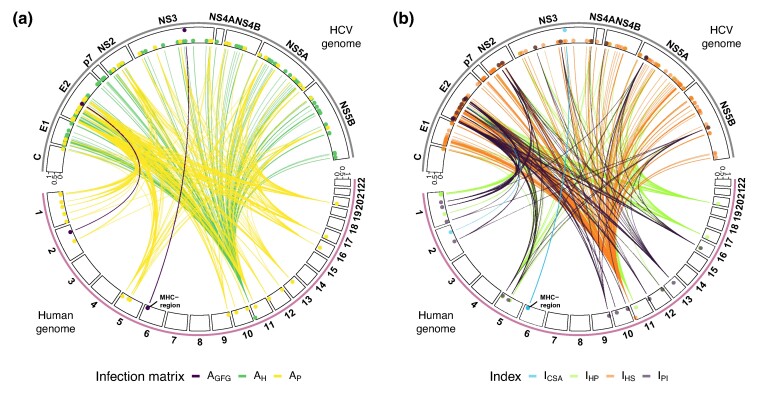
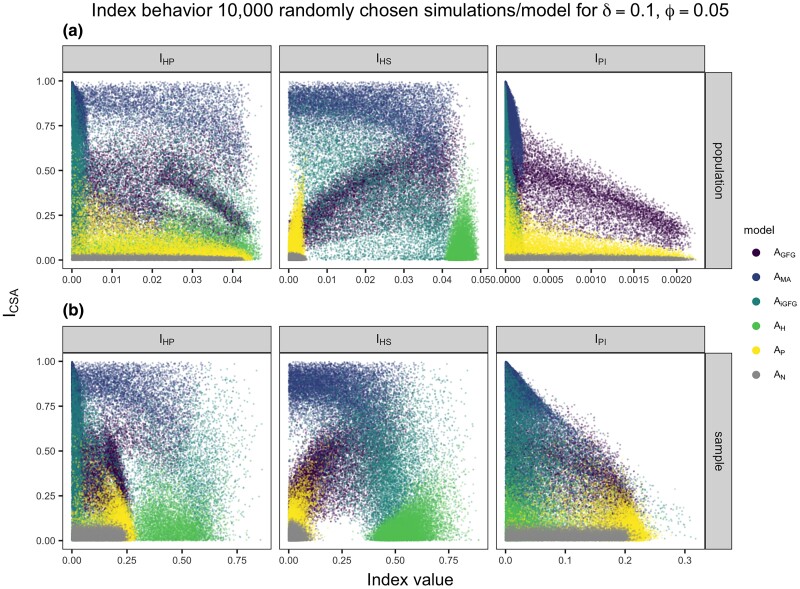
Host-pathogen coevolution is defined as the reciprocal evolutionary changes in both species due to genotype × genotype (G×G) interactions at the genetic level determining the outcome and severity of infection. While co-analyses of hosts and pathogen genomes (co-genome-wide association studies) allow us to pinpoint the interacting genes, these do not reveal which host genotype(s) is/are resistant to which pathogen genotype(s). The knowledge of this so-called infection matrix is important for agriculture and medicine. Building on established theories of host-pathogen interactions, we here derive four novel indices capturing the characteristics of the infection matrix. These indices can be computed from full genome polymorphism data of randomly sampled uninfected hosts, as well as infected hosts and their pathogen strains. We use these indices in an approximate Bayesian computation method to pinpoint loci with relevant G×G interactions and to infer their underlying interaction matrix. In a combined single nucleotide polymorphism dataset of 451 European humans and their infecting hepatitis C virus (HCV) strains and 503 uninfected individuals, we reveal a new human candidate gene for resistance to HCV and new virus mutations matching human genes. For two groups of significant human-HCV (G×G) associations, we infer a gene-for-gene infection matrix, which is commonly assumed to be typical of plant-pathogen interactions. Our model-based inference framework bridges theoretical models of G×G interactions with host and pathogen genomic data. It, therefore, paves the way for understanding the evolution of key G×G interactions underpinning HCV adaptation to the European human population after a recent expansion.
宿主-病原体协同进化是指由于基因型×基因型(G×G)相互作用在遗传水平上决定感染的结果和严重程度,两个物种之间的相互进化变化。虽然宿主和病原体基因组的共同分析(共同全基因组关联研究)允许我们确定相互作用的基因,但这些并不能揭示哪种宿主基因型对哪种病原体基因型具有抗性。了解这种所谓的感染矩阵对于农业和医学非常重要。基于宿主-病原体相互作用的既定理论,我们在这里推导出四个新的指数,这些指数可以捕捉感染矩阵的特征。这些指数可以从随机采样的未感染宿主的全基因组多态性数据以及感染宿主及其病原体株中计算得出。我们使用这些指数在近似贝叶斯计算方法中找出具有相关 G×G 相互作用的基因座,并推断它们的潜在相互作用矩阵。在对 451 名欧洲人类及其感染的丙型肝炎病毒(HCV)株和 503 名未感染个体的单个核苷酸多态性数据集的联合分析中,我们揭示了一种新的人类候选基因,该基因对 HCV 具有抗性,并且出现了与人类基因匹配的新病毒突变。对于两组具有显著人类-HCV(G×G)关联的个体,我们推断出一种基因对基因的感染矩阵,这通常被认为是植物-病原体相互作用的典型特征。我们基于模型的推断框架将 G×G 相互作用的理论模型与宿主和病原体基因组数据联系起来。因此,它为理解 HCV 适应欧洲人类群体后最近扩张的关键 G×G 相互作用的进化铺平了道路。