Department of Biology, Lund University, Sweden.
PLoS Genet. 2023 Apr 6;19(4):e1010685. doi: 10.1371/journal.pgen.1010685. eCollection 2023 Apr.
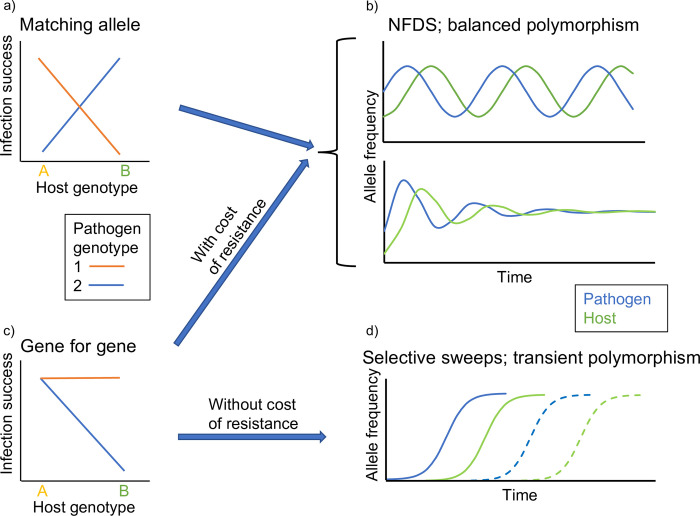
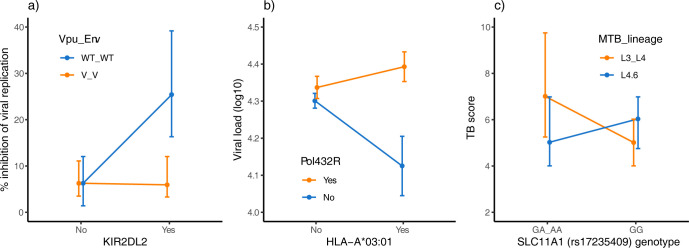
Antagonistic coevolution (i.e., reciprocal adaptation and counter-adaptation) between hosts and pathogens has long been considered an important driver of genetic variation. However, direct evidence for this is still scarce, especially in vertebrates. The wealth of data on genetics of susceptibility to infectious disease in humans provides an important resource for understanding host-pathogen coevolution, but studies of humans are rarely framed in coevolutionary theory. Here, I review data from human host-pathogen systems to critically assess the evidence for a key assumption of models of host-pathogen coevolution-the presence of host genotype-by-pathogen genotype interactions (G×G). I also attempt to infer whether observed G×G fit best with "gene-for-gene" or "matching allele" models of coevolution. I find that there are several examples of G×G in humans (involving, e.g., ABO, HBB, FUT2, SLC11A1, and HLA genes) that fit assumptions of either gene-for-gene or matching allele models. This means that there is potential for coevolution to drive polymorphism also in humans (and presumably other vertebrates), but further studies are required to investigate how widespread this process is.
宿主与病原体之间的拮抗协同进化(即相互适应和反向适应)长期以来一直被认为是遗传变异的重要驱动因素。然而,这方面的直接证据仍然很少,特别是在脊椎动物中。人类对传染病易感性的遗传学数据丰富,为理解宿主-病原体协同进化提供了重要资源,但对人类的研究很少用协同进化理论来解释。在这里,我回顾了人类宿主-病原体系统的数据,批判性地评估了宿主-病原体协同进化模型的一个关键假设的证据——宿主基因型与病原体基因型相互作用(G×G)的存在。我还试图推断观察到的 G×G 是否与“基因对基因”或“匹配等位基因”协同进化模型最吻合。我发现,人类中存在几种 G×G 的例子(涉及 ABO、HBB、FUT2、SLC11A1 和 HLA 基因等),这些例子符合基因对基因或匹配等位基因模型的假设。这意味着协同进化有可能也会在人类(大概还有其他脊椎动物)中驱动多态性,但需要进一步的研究来调查这一过程的广泛程度。