Physician and Provider Services Division, Ministry of Health, Toronto, Ontario, Canada.
Department of Health Research Methods, Evidence, and Impact, McMaster University, Hamilton, Ontario, Canada.
PLoS One. 2024 Aug 22;19(8):e0307611. doi: 10.1371/journal.pone.0307611. eCollection 2024.
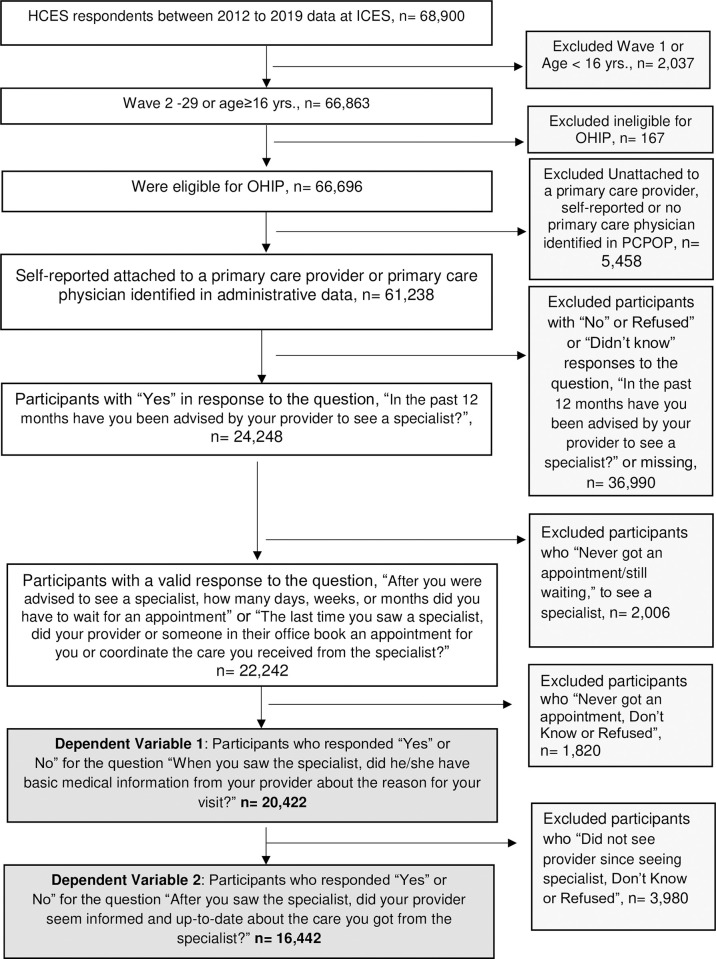
Our study aimed to describe patient experience of information coordination between their primary care physician and specialists and to examine the associations between their experience and their personal and primary care characteristics. We conducted a cross-sectional study of Ontario residents rostered to a primary care physician and visited a specialist physician in the previous 12 months by linking population-based health administrative data to the Health Care Experience Survey collected between 2013 and 2020. We described respondents' sociodemographic and health care utilization characteristics and their experience of information coordination between their primary care physician and specialists. We measured the adjusted association between patient-reported measures of information coordination before and after respondents received care from a specialist physician and their type of primary care model. 1,460 out 20,422 (weighted 7.5%) of the respondents reported that their specialist physician did not have basic medical information about their visit from their primary care physician in the previous 12 months. 2,298 out of 16,442 (weighted 14.9%) of the respondents reported that their primary care physician seemed uninformed about the care they received from the specialist. Females, younger individuals, those with a college or undergraduate level of education, and users of walk-in clinics had a higher likelihood of reporting a lack of information coordination between the primary care and specialist physicians. Only respondents rostered to an enhanced fee-for-service model had a higher odds of reporting that the specialist physician did not have basic medical information about their visit compared to those rostered to a Family Health Team (OR 1.22, 95% Cl 1.12-1.40). We found no significant association between respondent's type of primary care model and that their primary care physician was uninformed about the care received from the specialist physician. In this population-based health study, respondents reported high information coordination between their primary care physician and specialists. Except for respondents rostered to an enhanced fee-for-service model of care, we did not find any difference in information coordination across other primary care models.
我们的研究旨在描述患者在初级保健医生和专科医生之间的信息协调体验,并研究其体验与个人和初级保健特征之间的关联。我们通过将基于人群的健康管理数据与 2013 年至 2020 年期间收集的医疗保健体验调查相链接,对过去 12 个月内登记在初级保健医生处并就诊过专科医生的安大略省居民进行了一项横断面研究。我们描述了受访者的社会人口统计学和医疗保健利用特征,以及他们在初级保健医生和专科医生之间的信息协调体验。我们测量了患者报告的在接受专科医生治疗前后的信息协调情况与他们所接受的初级保健模式类型之间的调整关联。在过去 12 个月中,有 1460 名(加权 7.5%)受访者报告称,他们的专科医生没有收到初级保健医生关于他们就诊的基本医疗信息。在 16442 名受访者中,有 2298 名(加权 14.9%)报告称,他们的初级保健医生对他们从专科医生那里接受的护理似乎不知情。女性、年轻人、具有大学或本科教育程度的人和使用免下车诊所的人更有可能报告初级保健医生和专科医生之间缺乏信息协调。只有登记在增强按服务收费模式下的受访者报告专科医生没有收到他们就诊的基本医疗信息的可能性更高,与登记在家庭健康团队的受访者相比(OR 1.22,95%Cl 1.12-1.40)。我们没有发现受访者的初级保健模式类型与其初级保健医生对专科医生提供的护理不知情之间存在显著关联。在这项基于人群的健康研究中,受访者报告称他们在初级保健医生和专科医生之间的信息协调良好。除了登记在增强按服务收费模式下的受访者外,我们没有发现其他初级保健模式之间在信息协调方面存在差异。