Key Laboratory of Tropical Marine Bio-resources and Ecology, Guangdong Key Laboratory of Marine Materia Medica, Innovation Academy of South China Sea Ecology and Environmental Engineering, South China Sea Institute of Oceanology, Chinese Academy of Sciences, Guangzhou, China.
Southern Marine Science and Engineering Guangdong Laboratory (Guangzhou), Guangzhou, China.
Nat Commun. 2024 Aug 23;15(1):7244. doi: 10.1038/s41467-024-51617-x.
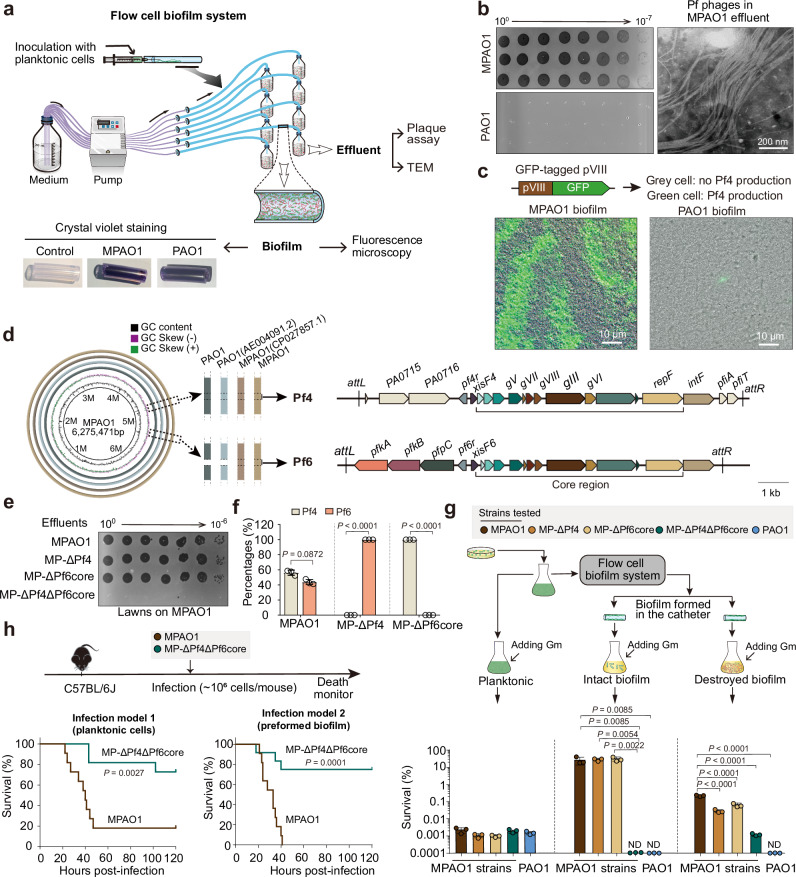
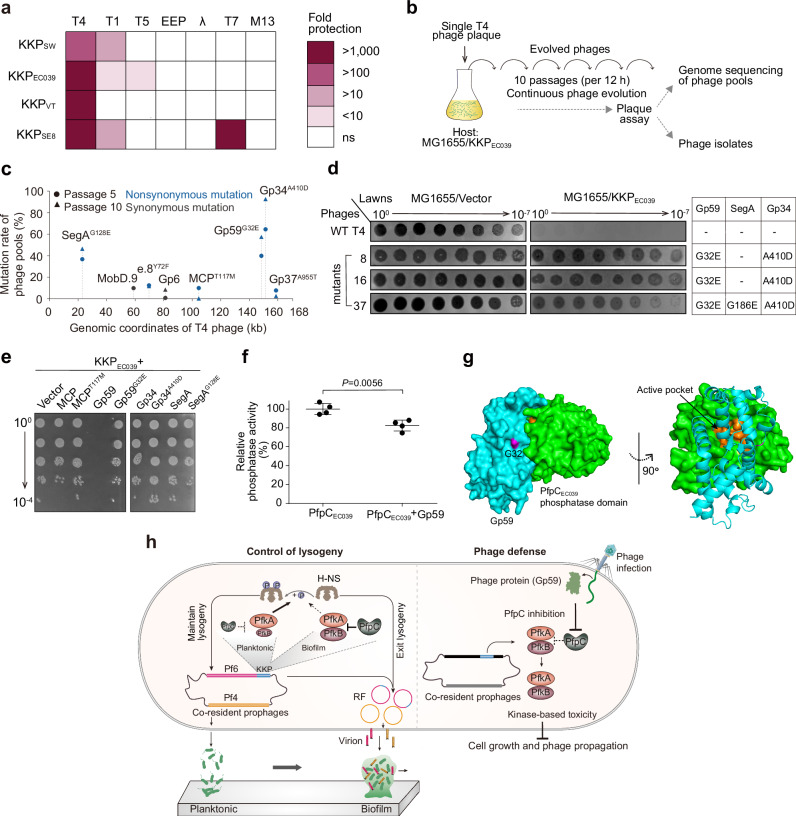
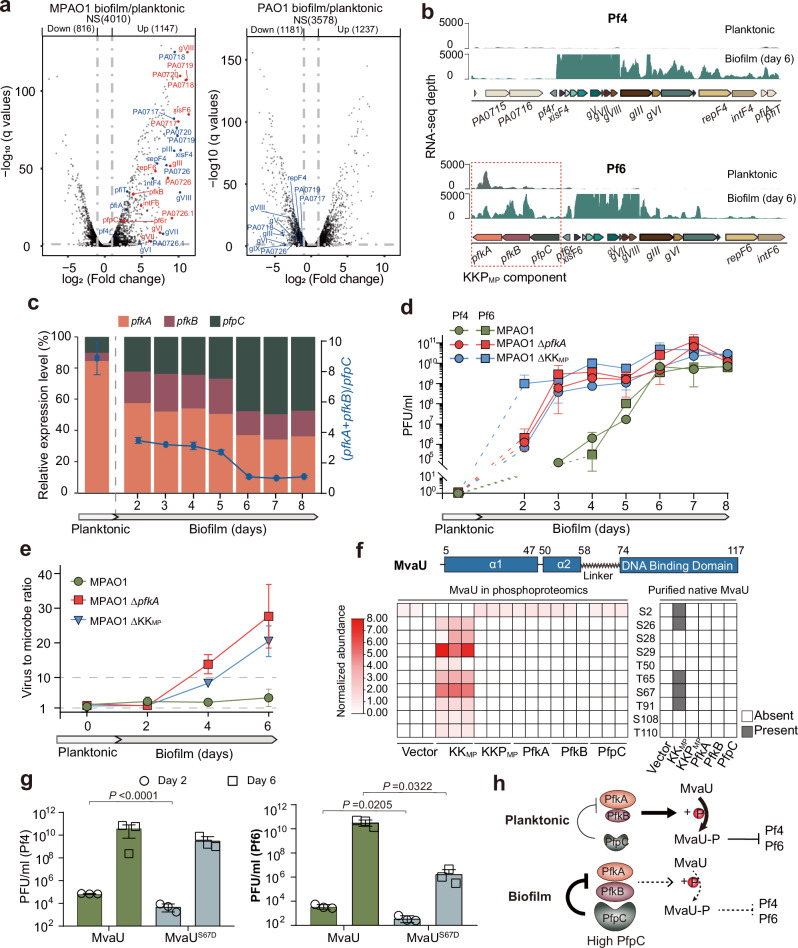
The filamentous 'Pf' bacteriophages of Pseudomonas aeruginosa play roles in biofilm formation and virulence, but mechanisms governing Pf prophage activation in biofilms are unclear. Here, we identify a prophage regulatory module, KKP (kinase-kinase-phosphatase), that controls virion production of co-resident Pf prophages and mediates host defense against diverse lytic phages. KKP consists of Ser/Thr kinases PfkA and PfkB, and phosphatase PfpC. The kinases have multiple host targets, one of which is MvaU, a host nucleoid-binding protein and known prophage-silencing factor. Characterization of KKP deletion and overexpression strains with transcriptional, protein-level and prophage-based approaches indicates that shifts in the balance between kinase and phosphatase activities regulate phage production by controlling MvaU phosphorylation. In addition, KKP acts as a tripartite toxin-antitoxin system that provides defense against some lytic phages. A conserved lytic phage replication protein inhibits the KKP phosphatase PfpC, stimulating toxic kinase activity and blocking lytic phage production. Thus, KKP represents a phosphorylation-based mechanism for prophage regulation and antiphage defense. The conservation of KKP gene clusters in >1000 diverse temperate prophages suggests that integrated control of temperate and lytic phage infection by KKP-like regulatory modules may play a widespread role in shaping host cell physiology.
铜绿假单胞菌丝状 'Pf' 噬菌体在生物膜形成和毒力中发挥作用,但控制生物膜中 Pf 噬菌体原噬菌体激活的机制尚不清楚。在这里,我们鉴定了一个噬菌体调节模块 KKP(激酶-激酶-磷酸酶),它控制共驻 Pf 噬菌体的病毒粒子产生,并介导宿主对多种裂解噬菌体的防御。KKP 由丝氨酸/苏氨酸激酶 PfkA 和 PfkB 以及磷酸酶 PfpC 组成。激酶有多个宿主靶标,其中之一是 MvaU,一种宿主核小体结合蛋白和已知的噬菌体沉默因子。通过转录、蛋白水平和噬菌体为基础的方法对 KKP 缺失和过表达菌株的特征进行了描述,表明激酶和磷酸酶活性之间平衡的变化通过控制 MvaU 磷酸化来调节噬菌体的产生。此外,KKP 作为一种三方毒素-抗毒素系统,为宿主提供了针对某些裂解噬菌体的防御。保守的裂解噬菌体复制蛋白抑制 KKP 磷酸酶 PfpC,刺激毒性激酶活性并阻止裂解噬菌体的产生。因此,KKP 代表了一种基于磷酸化的原噬菌体调节和抗噬菌体防御机制。超过 1000 种不同的温和噬菌体中 KKP 基因簇的保守性表明,KKP 样调节模块对温和和裂解噬菌体感染的综合控制可能在塑造宿主细胞生理学方面发挥着广泛的作用。