Papp Eszter, Vattay Gábor
Department of Physics of Complex Systems, Eötvös Loránd University, Egyetem tér 1-3., Budapest, 1053, Hungary.
Sci Rep. 2024 Aug 23;14(1):19571. doi: 10.1038/s41598-024-70348-z.
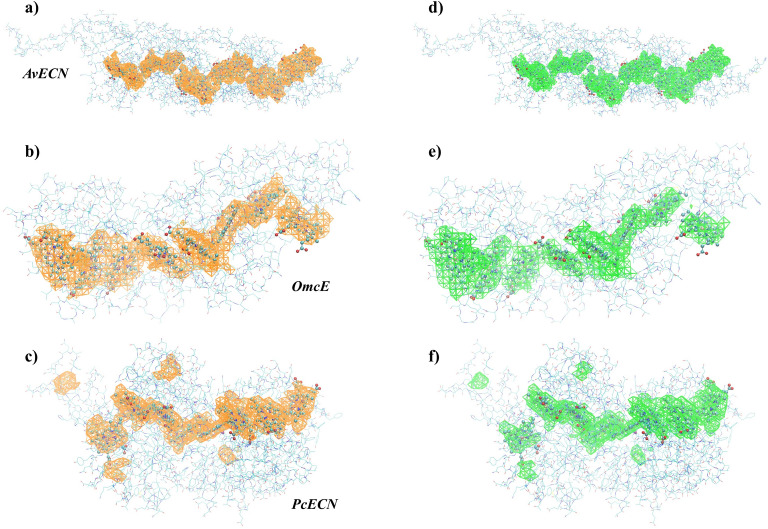
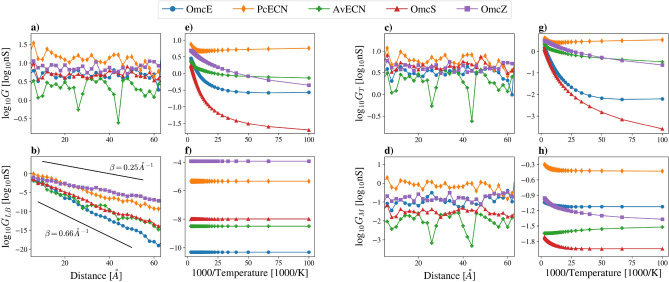
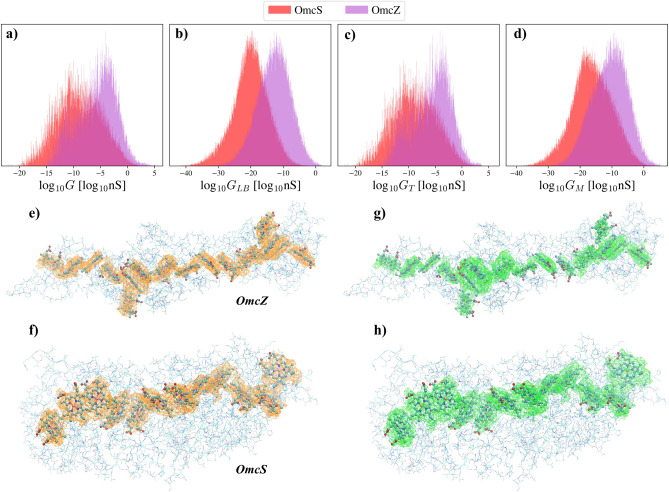
Recent experiments have revealed that single proteins can display high conductivity, which stays finite for low temperatures, decays slowly with distance, and exhibits a rich spatial structure featuring highly conducting and strongly insulating domains. Here, we intruduce a new formula by combining the density matrix of the Liouville-Master Equation simulating quantum transport in nanoscale devices, and the phenomenological model of electronic conductance through molecules, that can account for the observed distance- and temperature dependence of conductance in proteins. We demonstrate its efficacy on experimentally highly conductive extracellular cytochrome nanowires, which are good candidates to illustrate our new approach by calculating and visualizing their electronic wiring, given the interest in the arrangement of their conducting and insulating parts. As proteins and protein nanowires exhibit significant potential for diverse applications, including energy production and sensing, our computational technique can accelerate the design of nano-bioelectronic devices.
最近的实验表明,单个蛋白质可呈现高导电性,这种导电性在低温下保持有限值,随距离缓慢衰减,并展现出具有高导电域和强绝缘域的丰富空间结构。在此,我们通过结合用于模拟纳米级器件中量子输运的刘维尔 - 主方程的密度矩阵与分子电子传导的唯象模型,引入了一个新公式,该公式能够解释蛋白质中观察到的电导率与距离和温度的依赖关系。鉴于对其导电和绝缘部分排列的兴趣,我们通过计算和可视化实验中高导电的细胞外细胞色素纳米线的电子布线,证明了该公式在这些纳米线上的有效性,这些纳米线是阐释我们新方法的良好候选对象。由于蛋白质和蛋白质纳米线在包括能量产生和传感在内的各种应用中展现出巨大潜力,我们的计算技术可加速纳米生物电子器件的设计。