Gao Zhenhai, Yang Yang, Hu Xingjun, Wang Jingyu, Guo Peng, Wang Luwei
College of Automotive Engineering, Jilin University, Chang Chun, 130000, China.
Sci Rep. 2024 Aug 22;14(1):19472. doi: 10.1038/s41598-024-70521-4.
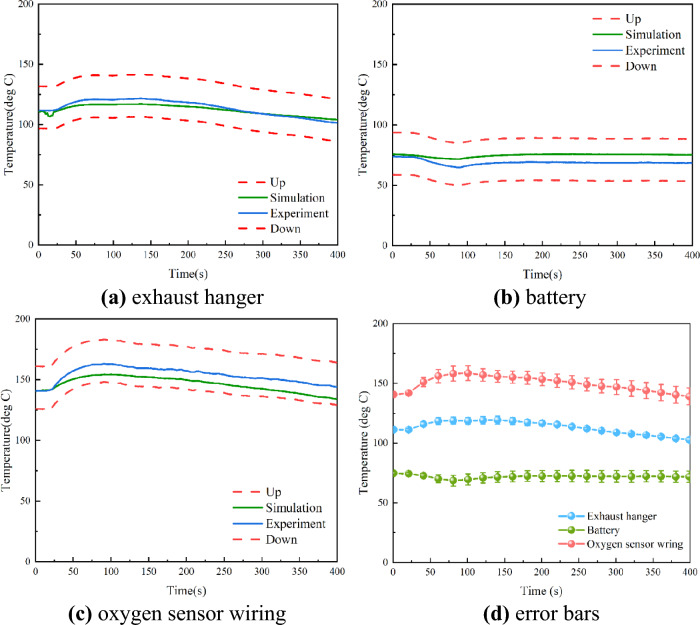
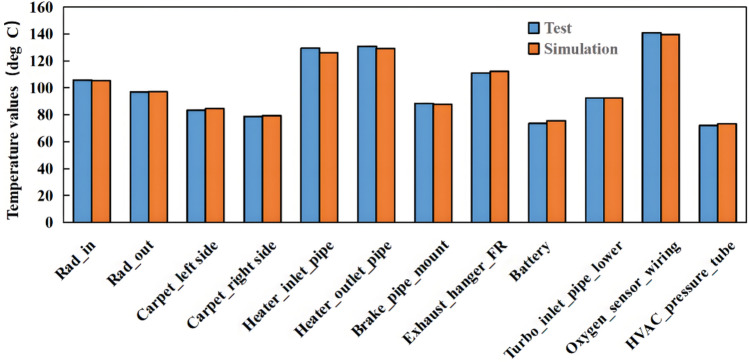
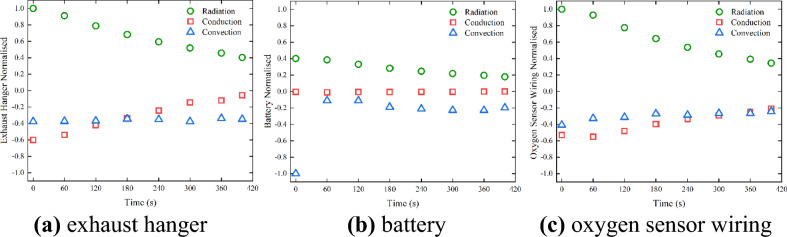
A large amount of heat accumulates in the engine bay for a short time after the engine runs at high load and shuts down, that will lead to thermal damage and thermal fatigue caused by the temperature rise of some heat sensitive components. This paper uses an aero-thermal coupling approach to study the heat transfer problem in the engine bay of an SUV model under thermal soak conditions. Due to the transient characteristics of the heat transfer process, the natural transient CFD software developed based on the LBM method is used to study the engine bay heat transfer during the 400 s key-off soak process. The analysis reveals that convection and radiation are the main heat transfer modes in the early stage of hot immersion (0-120 s), and conduction only makes a significant contribution in contact with high temperature sources. The radiation and convection are the key contributors to heat transfer processes of engine bay during soak, but the efficiency of radiation heat transfer decreases with the increase of time, whereas the efficiency of convection heat transfer is not always reduced, it will increase and then decrease with the increase of time. The coupling method established can predict the thermal state in the engine bay well, and is in good agreement with the experimental results. The results show that the error in the engine coolant temperature is less than 1 °C, and the error in the temperature of the heat-sensitive components is less than 5 °C. Finally, the potential risks of thermal damage and thermal fatigue states were assessed, providing an important reference for the control design of cooling fan running time after key-off.
发动机在高负荷运行并关闭后,短时间内大量热量会积聚在发动机舱内,这将导致一些热敏感部件因温度升高而产生热损伤和热疲劳。本文采用气热耦合方法研究了一款SUV车型发动机舱在热浸泡条件下的传热问题。由于传热过程具有瞬态特性,基于格子玻尔兹曼方法(LBM)开发的自然瞬态计算流体力学(CFD)软件被用于研究发动机舱在熄火后400秒浸泡过程中的传热情况。分析表明,在热浸泡初期(0 - 120秒),对流和辐射是主要的传热方式,传导仅在与高温源接触时起显著作用。在浸泡过程中,辐射和对流是发动机舱传热过程的关键贡献因素,但辐射传热效率随时间增加而降低,而对流传热效率并非一直降低,它会随时间增加先升高后降低。所建立的耦合方法能够很好地预测发动机舱内的热状态,与实验结果吻合良好。结果表明,发动机冷却液温度的误差小于1℃,热敏感部件温度的误差小于5℃。最后,对热损伤和热疲劳状态的潜在风险进行了评估,为熄火后冷却风扇运行时间的控制设计提供了重要参考。