Crop Health Research and Development, Corteva Agriscience™, Mogi Mirim, SP, Brazil. Postgraduate Group of Crop Protection, School of Agriculture Sciences, São Paulo State University-UNESP, Botucatu, SP, Brazil.
Crop Protection Department, School of Agriculture Sciences, São Paulo State University-UNESP, Botucatu, SP, Brazil.
Sci Rep. 2024 Aug 22;14(1):19536. doi: 10.1038/s41598-024-70153-8.
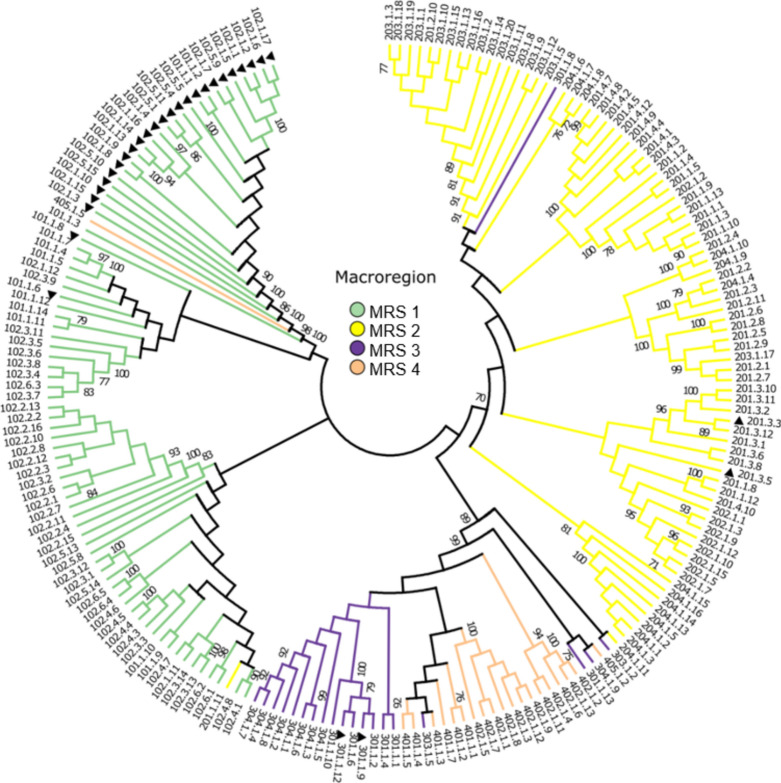
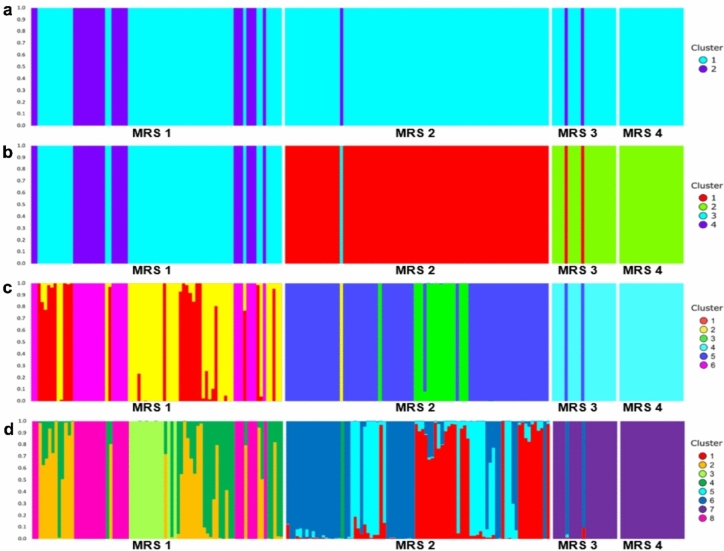
Herbicide-resistant Conyza spp. are a threat to many crops. These widespread weeds are closely related species and often cooccur. To characterize the origins of their resistance and the mechanisms underlying their spread, we assessed the genomic variation in glyphosate-resistant Conyza spp. in Brazil. Twenty populations were sampled from soybean fields across four macroregions (MRSs). A genotyping-by-sequencing study resulted in 2,998 single-nucleotide polymorphisms (SNPs) obtained for C. bonariensis (L.) and the closely related C. sumatrensis (Retz) E. Walker. Higher genomic diversity (π) and heterozygosity (H/H) and lower inbreeding coefficient (F) values were detected in populations of Conyza spp. from MRS 1 (southern) than in those from other MRSs. Strong genomic structure clustered individuals into three groups (F = 0.22; p value = 0.000) associated with the MRSs. Thus, resistance to glyphosate originated from independent selection in different MRSs across Brazil. Our dataset supports the occurrence of intraspecific gene flow in Brazil and identified individuals of C. bonariensis that did not group within species. These findings suggest that allelic introgressions within and among species have impacted the evolution and spread of resistance to glyphosate in Conyza spp. We discuss how to mitigate new resistance cases, particularly for the released stacked traits herbicide tolerance in soybeans.
具有抗除草剂特性的 Conyza spp. 对许多作物构成威胁。这些广泛分布的杂草是密切相关的物种,通常共同出现。为了描述它们的抗性起源和传播机制,我们评估了巴西抗草甘膦 Conyza spp. 的基因组变异。从四个大区(MRS)的大豆田中采集了 20 个种群。基于测序的基因分型研究导致获得了 2998 个单核苷酸多态性(SNP),用于 C. bonariensis (L.) 和密切相关的 C. sumatrensis (Retz) E. Walker。在来自 MRS 1(南部)的 Conyza spp. 种群中检测到更高的基因组多样性(π)和杂合度(H/H)以及更低的近交系数(F)值,而来自其他 MRS 的种群则较低。强烈的基因组结构将个体聚类为三个组(F=0.22;p 值=0.000),与 MRS 相关。因此,对草甘膦的抗性源于巴西不同 MRS 中的独立选择。我们的数据集支持巴西种内基因流的发生,并鉴定了未分组的 C. bonariensis 个体。这些发现表明,种内和种间的等位基因渗入影响了 Conyza spp. 对草甘膦抗性的进化和传播。我们讨论了如何减轻新的抗性案例,特别是对大豆中释放的抗除草剂耐性叠加特性。