• 文献检索
  • 文档翻译
  • 深度研究
  • 学术资讯
  • Suppr Zotero 插件Zotero 插件
  • 邀请有礼
  • 套餐&价格
  • 历史记录
应用&插件
Suppr Zotero 插件Zotero 插件浏览器插件Mac 客户端Windows 客户端微信小程序
定价
高级版会员购买积分包购买API积分包
服务
文献检索文档翻译深度研究API 文档MCP 服务
关于我们
关于 Suppr公司介绍联系我们用户协议隐私条款
关注我们

Suppr 超能文献

核心技术专利:CN118964589B侵权必究
粤ICP备2023148730 号-1Suppr @ 2026

文献检索

告别复杂PubMed语法,用中文像聊天一样搜索,搜遍4000万医学文献。AI智能推荐,让科研检索更轻松。

立即免费搜索

文件翻译

保留排版,准确专业,支持PDF/Word/PPT等文件格式,支持 12+语言互译。

免费翻译文档

深度研究

AI帮你快速写综述,25分钟生成高质量综述,智能提取关键信息,辅助科研写作。

立即免费体验

评价 COVID-19 患者的循环微囊泡及其促凝活性。

Evaluation of circulating microvesicles and their procoagulant activity in patients with COVID-19.

机构信息

Research Center for Noncommunicable Diseases, Jahrom University of Medical Sciences, Jahrom, Iran.

Student Research Committee, Jahrom University of Medical Sciences, Jahrom, Iran.

出版信息

BMC Res Notes. 2024 Aug 22;17(1):233. doi: 10.1186/s13104-024-06875-9.

DOI:10.1186/s13104-024-06875-9
PMID:39175048
原文链接:https://pmc.ncbi.nlm.nih.gov/articles/PMC11342662/
Abstract

OBJECTIVE

Several pathological conditions trigger the formation of microvesicles (MVs), including infectious diseases such as COVID-19. The shedding of MVs increases the levels of inflammatory factors (e.g., interleukin-6; IL-6) and ultimately leads to an inflammatory cascade response, while also increasing the procoagulant response. The current study aimed to evaluate the level of circulating MVs and their procoagulant activity as well as the serum level of IL-6 in patients with COVID-19 and healthy controls. In this case-control study, 65 patients with COVID-19 and 30 healthy individuals were sampled after obtaining written informed consent. MVs counting was measured using conjugated CD61, CD45, CD235a, and Annexin-V antibodies. Additionally, the procoagulant activity of MVs and the IL-6 level were estimated using enzyme-linked immunosorbent assay (ELISA).

RESULTS

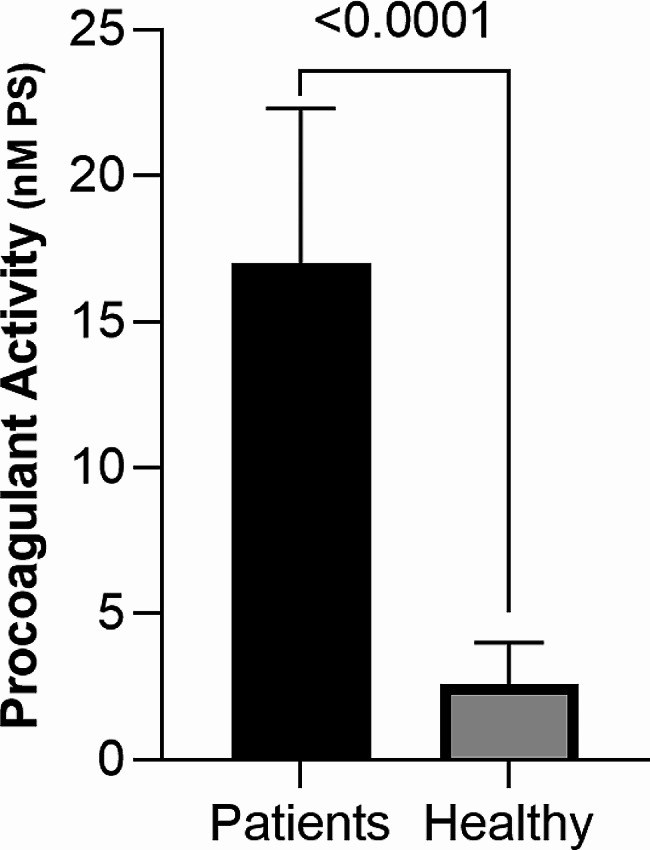
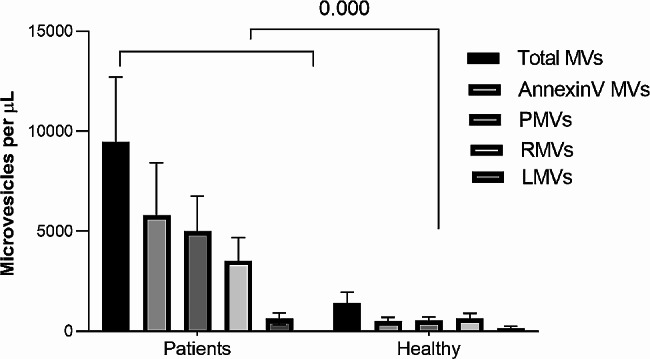
The majority of MVs were platelet-derived MVs (PMVs). Patients with COVID-19 had significantly higher levels of MVs, procoagulant MVs, and IL-6 compared to healthy controls (p < 0.001). MVs were significantly correlated with procoagulant MVs, D-Dimer levels, fibrinogen, and IL-6, but not with platelet, lymphocyte, and neutrophil counts.

CONCLUSION

Elevated levels of procoagulant MVs and their association with inflammatory and coagulation markers in patients with COVID-19 are suggested as a novel circulatory biomarker to evaluate and predict the procoagulant activity and severity of COVID-19.

摘要

目的

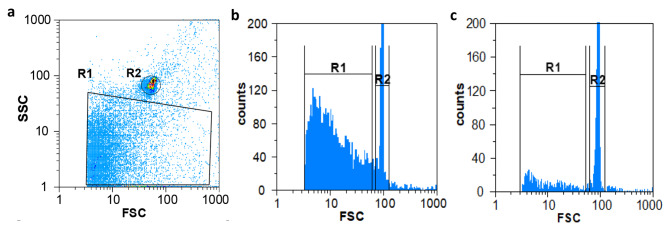
几种病理情况会触发微泡(MVs)的形成,包括 COVID-19 等传染病。MVs 的释放会增加炎症因子(例如白细胞介素 6;IL-6)的水平,最终导致炎症级联反应,并增加促凝反应。本研究旨在评估 COVID-19 患者和健康对照者循环 MVs 及其促凝活性以及血清 IL-6 水平。在这项病例对照研究中,在获得书面知情同意后,采集了 65 例 COVID-19 患者和 30 名健康个体的样本。使用结合 CD61、CD45、CD235a 和 Annexin-V 抗体测量 MVs 计数。此外,使用酶联免疫吸附测定(ELISA)评估 MVs 的促凝活性和 IL-6 水平。

结果

大多数 MVs 是血小板衍生的 MVs(PMVs)。与健康对照组相比,COVID-19 患者的 MVs、促凝性 MVs 和 IL-6 水平显著升高(p<0.001)。MVs 与促凝性 MVs、D-二聚体水平、纤维蛋白原和 IL-6 显著相关,但与血小板、淋巴细胞和中性粒细胞计数无关。

结论

COVID-19 患者中促凝性 MVs 水平升高及其与炎症和凝血标志物的关联提示,作为一种新型循环生物标志物,可用于评估和预测 COVID-19 的促凝活性和严重程度。
https://cdn.ncbi.nlm.nih.gov/pmc/blobs/51ed/11342662/f84ad6ad104f/13104_2024_6875_Fig4_HTML.jpg
https://cdn.ncbi.nlm.nih.gov/pmc/blobs/51ed/11342662/37881e150c83/13104_2024_6875_Fig1_HTML.jpg
https://cdn.ncbi.nlm.nih.gov/pmc/blobs/51ed/11342662/ddf304b515b1/13104_2024_6875_Fig2_HTML.jpg
https://cdn.ncbi.nlm.nih.gov/pmc/blobs/51ed/11342662/a149a0a36163/13104_2024_6875_Fig3_HTML.jpg
https://cdn.ncbi.nlm.nih.gov/pmc/blobs/51ed/11342662/f84ad6ad104f/13104_2024_6875_Fig4_HTML.jpg
https://cdn.ncbi.nlm.nih.gov/pmc/blobs/51ed/11342662/37881e150c83/13104_2024_6875_Fig1_HTML.jpg
https://cdn.ncbi.nlm.nih.gov/pmc/blobs/51ed/11342662/ddf304b515b1/13104_2024_6875_Fig2_HTML.jpg
https://cdn.ncbi.nlm.nih.gov/pmc/blobs/51ed/11342662/a149a0a36163/13104_2024_6875_Fig3_HTML.jpg
https://cdn.ncbi.nlm.nih.gov/pmc/blobs/51ed/11342662/f84ad6ad104f/13104_2024_6875_Fig4_HTML.jpg

相似文献

1
Evaluation of circulating microvesicles and their procoagulant activity in patients with COVID-19.评价 COVID-19 患者的循环微囊泡及其促凝活性。
BMC Res Notes. 2024 Aug 22;17(1):233. doi: 10.1186/s13104-024-06875-9.
2
Procoagulant Microvesicles in COVID-19 Patients: Possible Modulators of Inflammation and Prothrombotic Tendency.新冠病毒肺炎患者中的促凝微泡:炎症和血栓形成倾向的潜在调节因子
Infect Drug Resist. 2022 Apr 29;15:2359-2368. doi: 10.2147/IDR.S355395. eCollection 2022.
3
Platelet and Monocyte Microvesicles as Potential Biomarkers of COVID-19 Severity: A Cross-Sectional Analysis.血小板和单核细胞微囊泡作为 COVID-19 严重程度的潜在生物标志物:一项横断面分析。
Ann Lab Med. 2024 Sep 1;44(5):392-400. doi: 10.3343/alm.2023.0395. Epub 2024 Mar 12.
4
Association of platelet-derived microvesicles and their phenotypes with carotid atherosclerosis and recurrent vascular events in patients after ischemic stroke.血小板衍生微囊泡及其表型与缺血性脑卒中后患者颈动脉粥样硬化及再发血管事件的关系。
Thromb Res. 2019 Apr;176:18-26. doi: 10.1016/j.thromres.2019.01.014. Epub 2019 Feb 2.
5
Association of Circulating Procoagulant Microvesicles with Painful Vaso-Occlusive Crisis in Sickle Cell Disease.循环促凝微泡与镰状细胞病疼痛性血管闭塞危象的关联
Transfus Med Hemother. 2023 Mar 30;50(5):448-455. doi: 10.1159/000525640. eCollection 2023 Oct.
6
Serotonin enhances platelet procoagulant properties and their activation induced during platelet tissue factor uptake.血清素可增强血小板促凝特性及其在血小板摄取组织因子过程中诱导的激活作用。
Cardiovasc Res. 2009 Nov 1;84(2):309-16. doi: 10.1093/cvr/cvp205. Epub 2009 Jun 18.
7
Elevated Levels of Procoagulant Microvesicles and Tissue-Factor Bearing Microvesicles in Malaria Patients.疟疾患者中促凝血微泡和携带组织因子微泡水平升高。
Int J Gen Med. 2023 Apr 5;16:1205-1215. doi: 10.2147/IJGM.S402212. eCollection 2023.
8
Malignant transformation in melanocytes is associated with increased production of procoagulant microvesicles.黑素细胞的恶性转化与促凝微囊泡的产生增加有关。
Thromb Haemost. 2011 Oct;106(4):712-23. doi: 10.1160/TH11-03-0143. Epub 2011 Jul 28.
9
Human pancreatic tumors grown in mice release tissue factor-positive microvesicles that increase venous clot size.在小鼠体内生长的人类胰腺肿瘤释放组织因子阳性的微囊泡,增加静脉血栓的大小。
J Thromb Haemost. 2017 Nov;15(11):2208-2217. doi: 10.1111/jth.13809. Epub 2017 Sep 20.
10
IL-33 stimulates the release of procoagulant microvesicles from human monocytes and differentially increases tissue factor in human monocyte subsets.IL-33 刺激人单核细胞释放促凝微囊泡,并以不同方式增加人单核细胞亚群中的组织因子。
Thromb Haemost. 2017 Jun 28;117(7):1379-1390. doi: 10.1160/TH16-10-0784. Epub 2017 May 11.

本文引用的文献

1
Association of Circulating Procoagulant Microvesicles with Painful Vaso-Occlusive Crisis in Sickle Cell Disease.循环促凝微泡与镰状细胞病疼痛性血管闭塞危象的关联
Transfus Med Hemother. 2023 Mar 30;50(5):448-455. doi: 10.1159/000525640. eCollection 2023 Oct.
2
Microvascular Thrombosis as a Critical Factor in Severe COVID-19.微血管血栓形成是重症 COVID-19 的关键因素。
Int J Mol Sci. 2023 Jan 27;24(3):2492. doi: 10.3390/ijms24032492.
3
Increased circulating microparticles contribute to severe infection and adverse outcomes of COVID-19 in patients with diabetes.
循环中增加的微颗粒导致糖尿病患者 COVID-19 的严重感染和不良结局。
Am J Physiol Heart Circ Physiol. 2022 Dec 1;323(6):H1176-H1193. doi: 10.1152/ajpheart.00409.2022. Epub 2022 Oct 21.
4
Laboratory Biomarkers for Diagnosis and Prognosis in COVID-19.用于 COVID-19 诊断和预后的实验室生物标志物。
Front Immunol. 2022 Apr 27;13:857573. doi: 10.3389/fimmu.2022.857573. eCollection 2022.
5
Procoagulant Microvesicles in COVID-19 Patients: Possible Modulators of Inflammation and Prothrombotic Tendency.新冠病毒肺炎患者中的促凝微泡:炎症和血栓形成倾向的潜在调节因子
Infect Drug Resist. 2022 Apr 29;15:2359-2368. doi: 10.2147/IDR.S355395. eCollection 2022.
6
Organ manifestations of COVID-19: what have we learned so far (not only) from autopsies?COVID-19 的器官表现:迄今为止(不仅)从尸检中学到了什么?
Virchows Arch. 2022 Aug;481(2):139-159. doi: 10.1007/s00428-022-03319-2. Epub 2022 Apr 1.
7
Plasma microparticles of intubated COVID-19 patients cause endothelial cell death, neutrophil adhesion and netosis, in a phosphatidylserine-dependent manner.气管插管的 COVID-19 患者的血浆微颗粒以依赖磷脂酰丝氨酸的方式引起内皮细胞死亡、中性粒细胞黏附和 NETosis。
Br J Haematol. 2022 Mar;196(5):1159-1169. doi: 10.1111/bjh.18019. Epub 2022 Jan 6.
8
Virchow's Triad and the Role of Thrombosis in COVID-Related Stroke.魏尔啸三联征及血栓形成在新冠相关卒中中的作用。
Front Physiol. 2021 Nov 10;12:769254. doi: 10.3389/fphys.2021.769254. eCollection 2021.
9
COVID-19 Infection and Circulating Microparticles-Reviewing Evidence as Microthrombogenic Risk Factor for Cerebral Small Vessel Disease.COVID-19 感染与循环微颗粒——作为小血管疾病的微血栓形成风险因素的证据回顾。
Mol Neurobiol. 2021 Aug;58(8):4188-4215. doi: 10.1007/s12035-021-02457-z. Epub 2021 Jun 26.
10
Microparticles in COVID-19 as a link between lung injury extension and thrombosis.新冠病毒肺炎中的微粒作为肺损伤扩展与血栓形成之间的联系。
ERJ Open Res. 2021 Jun 21;7(2). doi: 10.1183/23120541.00954-2020. eCollection 2021 Apr.