Biotechnology of Animal and Human Reproduction (TechnoSperm), Institute of Food and Agricultural Technology, University of Girona, Girona, ES-17003, Spain.
Unit of Cell Biology, Department of Biology, Faculty of Sciences, University of Girona, Girona, ES-17003, Spain.
Biol Res. 2024 Aug 23;57(1):57. doi: 10.1186/s40659-024-00535-9.
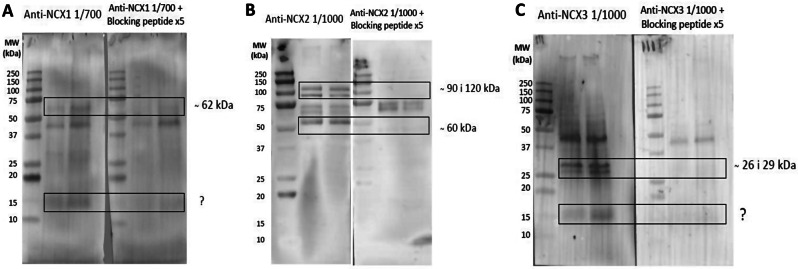
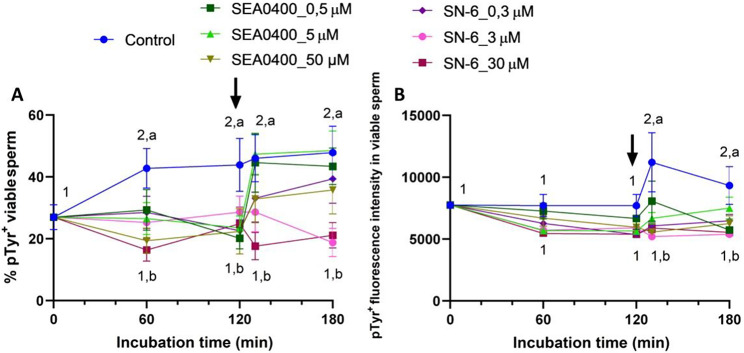
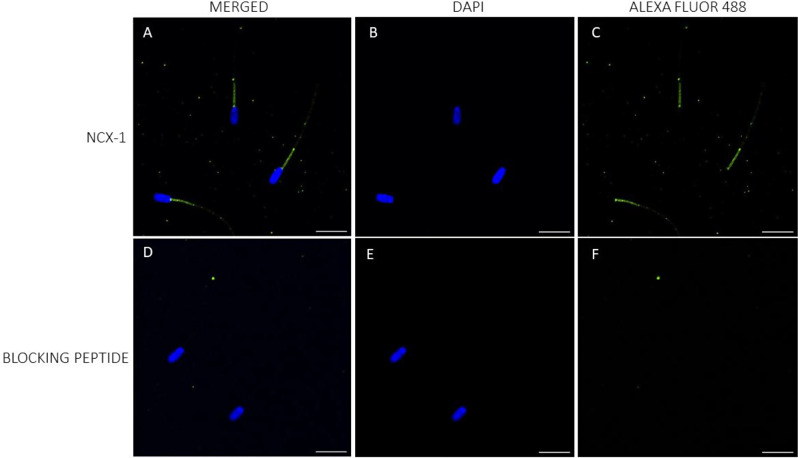
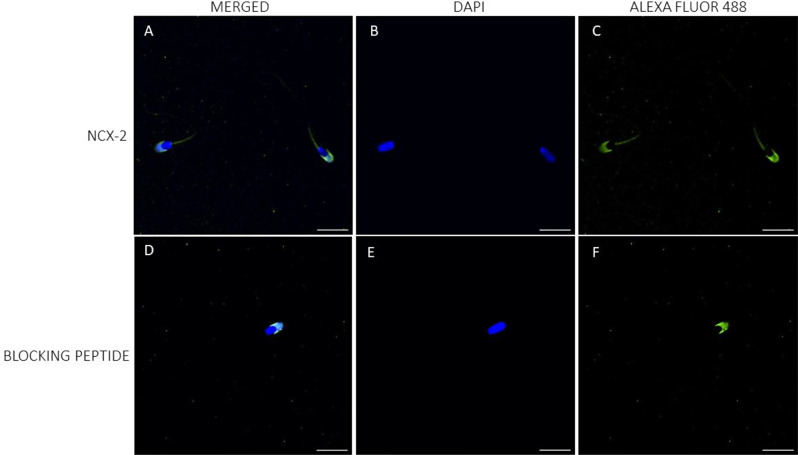
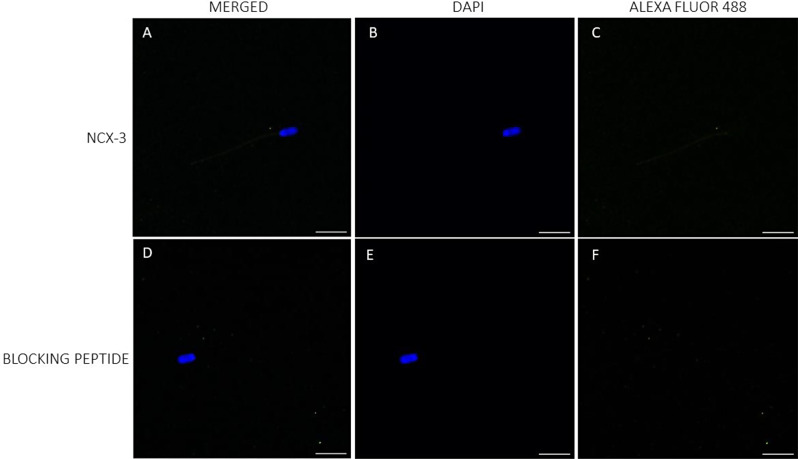
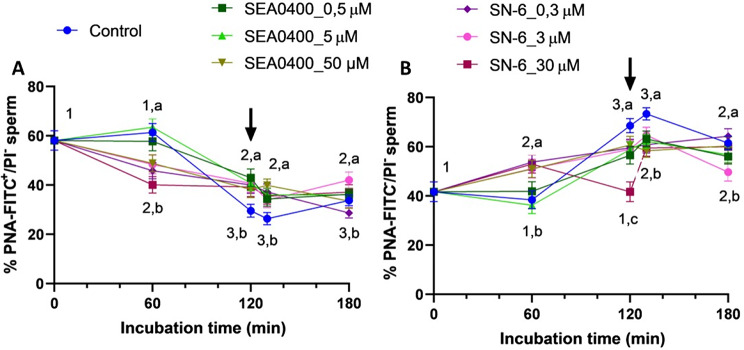
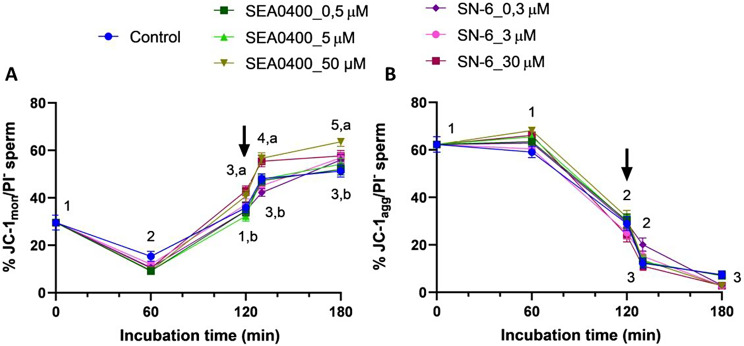
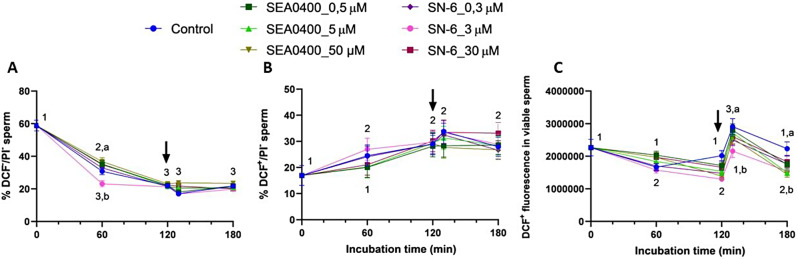
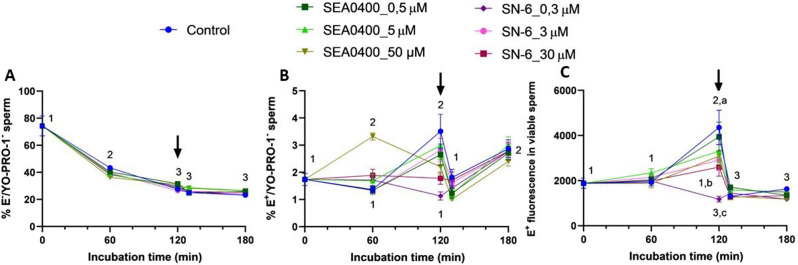
While calcium is known to play a crucial role in mammalian sperm physiology, how it flows in and out of the male gamete is not completely understood. Herein, we investigated the involvement of Na/Ca exchangers (NCX) in mammalian sperm capacitation. Using the pig as an animal model, we first confirmed the presence of NCX1 and NCX2 isoforms in the sperm midpiece. Next, we partially or totally blocked Ca outflux (forward transport) via NCX1/NCX2 with different concentrations of SEA0400 (2-[4-[(2,5-difluorophenyl)methoxy]phenoxy]-5-ethoxyaniline; 0, 0.5, 5 and 50 µM) and Ca influx (reverse transport) with SN6 (ethyl 2-[[4-[(4-nitrophenyl)methoxy]phenyl]methyl]-1,3-thiazolidine-4-carboxylate; 0, 0.3, 3 or 30 µM). Sperm were incubated under capacitating conditions for 180 min; after 120 min, progesterone was added to induce the acrosome reaction. At 0, 60, 120, 130, and 180 min, sperm motility, membrane lipid disorder, acrosome integrity, mitochondrial membrane potential (MMP), tyrosine phosphorylation of sperm proteins, and intracellular levels of Ca, reactive oxygen species (ROS) and superoxides were evaluated.
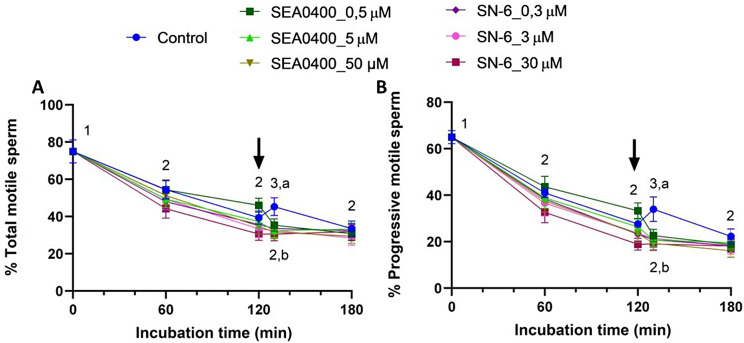
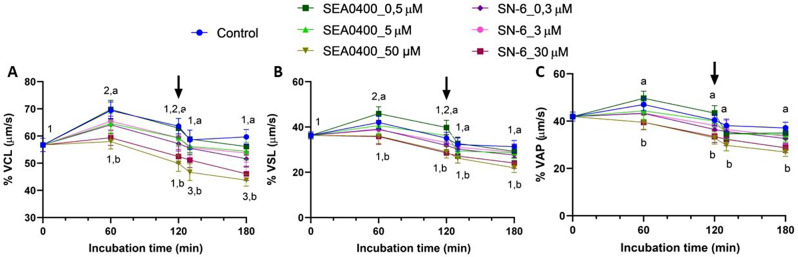
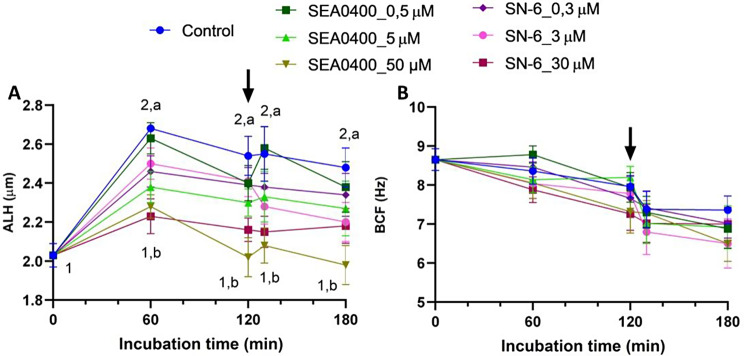
Partial and complete blockage of Ca outflux and influx via NCX induced a significant reduction of sperm motility after progesterone addition. Early alterations on sperm kinematics were also observed, the effects being more obvious in totally blocked than in partially blocked samples. Decreased sperm motility and kinematics were related to both defective tyrosine phosphorylation and mitochondrial activity, the latter being associated to diminished MMP and ROS levels. As NCX blockage did not affect the lipid disorder of plasma membrane, the impaired acrosome integrity could result from reduced tyrosine phosphorylation.
Inhibition of outflux and influx of Ca triggered similar effects, thus indicating that both forward and reverse Ca transport through NCX exchangers are essential for sperm capacitation.
钙在哺乳动物精子生理中起着至关重要的作用,但精子如何进出这种配子还不完全清楚。在此,我们研究了钠/钙交换器(NCX)在哺乳动物精子获能中的作用。我们首先使用猪作为动物模型,证实了 NCX1 和 NCX2 同工型存在于精子中段。然后,我们使用不同浓度的 SEA0400(2-[4-[(2,5-二氟苯甲氧基]苯氧基]-5-乙氧基苯胺;0、0.5、5 和 50 μM)部分或完全阻断 NCX1/NCX2 的 Ca 外流(正向转运),并用 SN6(乙基 2-[[4-[(4-硝基苯甲氧基]苯基]甲基]-1,3-噻唑烷-4-羧酸盐;0、0.3、3 或 30 μM)阻断 Ca 内流(反向转运)。精子在获能条件下孵育 180 分钟;孵育 120 分钟后,加入孕酮诱导顶体反应。在 0、60、120、130 和 180 分钟时,评估精子运动、膜脂紊乱、顶体完整性、线粒体膜电位(MMP)、精子蛋白酪氨酸磷酸化和细胞内 Ca、活性氧(ROS)和超氧化物水平。
通过 NCX 部分和完全阻断 Ca 外流和内流后,添加孕酮会显著降低精子运动。还观察到精子运动学的早期变化,在完全阻断的样本中比在部分阻断的样本中更明显。精子运动和运动学的降低与酪氨酸磷酸化和线粒体活性的缺陷有关,后者与 MMP 和 ROS 水平降低有关。由于 NCX 阻断不影响质膜的脂质紊乱,受损的顶体完整性可能是由于酪氨酸磷酸化减少所致。
钙的外流和内流的抑制产生了类似的效果,因此表明 NCX 交换器的正向和反向 Ca 转运对精子获能都是必不可少的。