Schaafsma Mirte, van den Helder Rianne, Mom Constantijne H, Steenbergen Renske D M, Bleeker Maaike C G, van Trommel Nienke E
Department of Gynecologic Oncology, Center of Gynecologic Oncology Amsterdam, Antoni van Leeuwenhoek/Netherlands Cancer Institute, Amsterdam, The Netherlands.
Department of Pathology, Amsterdam UMC, location Vrije Universiteit Amsterdam, Amsterdam, The Netherlands.
Int J Cancer. 2025 Feb 1;156(3):659-667. doi: 10.1002/ijc.35143. Epub 2024 Aug 22.
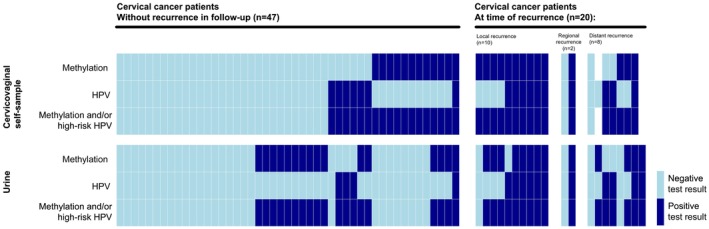
Early detection of recurrent cervical cancer is important to improve survival rates. The aim of this study was to explore the clinical performance of DNA methylation markers and high-risk human papillomavirus (HPV) in cervicovaginal self-samples and urine for the detection of recurrent cervical cancer. Cervical cancer patients without recurrence (n = 47) collected cervicovaginal self-samples and urine pre- and posttreatment. Additionally, 20 patients with recurrent cervical cancer collected cervicovaginal self-samples and urine at time of recurrence. All samples were self-collected at home and tested for DNA methylation and high-risk HPV DNA by PCR. In patients without recurrent cervical cancer, DNA methylation levels decreased 2-years posttreatment compared to pretreatment in cervicovaginal self-samples (p < .0001) and urine (p < .0001). DNA methylation positivity in cervicovaginal self-samples was more frequently observed in patients with recurrence (77.8%) than in patients without recurrence 2-years posttreatment (25.5%; p = .0004). Also in urine, DNA methylation positivity was more frequently observed in patients with recurrence (65%) compared to those without recurrence (35.6%; p = .038). Similarly, high-risk HPV positivity in both cervicovaginal self-samples and urine was more frequent (52.6% and 55%, respectively) in patients with recurrence compared to patients without recurrence (14.9% and 8.5%, respectively) (p = .004 and p = .0001). In conclusion, this study shows the potential of posttreatment monitoring of cervical cancer patients for recurrence by DNA methylation and high-risk HPV testing in cervicovaginal and urine samples collected at home. The highest recurrence detection rate was achieved by DNA methylation testing in cervicovaginal self-samples, detecting 77.8% of all recurrences and, specifically, 100% of the local recurrences.
早期发现复发性宫颈癌对于提高生存率很重要。本研究的目的是探讨DNA甲基化标志物和高危型人乳头瘤病毒(HPV)在宫颈阴道自我采集样本和尿液中检测复发性宫颈癌的临床表现。无复发的宫颈癌患者(n = 47)在治疗前后采集宫颈阴道自我采集样本和尿液。此外,20例复发性宫颈癌患者在复发时采集宫颈阴道自我采集样本和尿液。所有样本均在家中自行采集,并通过PCR检测DNA甲基化和高危型HPV DNA。在无复发性宫颈癌的患者中,与治疗前相比,治疗后2年宫颈阴道自我采集样本(p <.0001)和尿液(p <.0001)中的DNA甲基化水平降低。与治疗后2年无复发的患者(25.5%;p = 0.0004)相比,复发患者宫颈阴道自我采集样本中DNA甲基化阳性更为常见(77.8%)。同样在尿液中,复发患者中DNA甲基化阳性(65%)比无复发患者(35.6%;p = 0.038)更常见。同样,与无复发患者(分别为14.9%和8.5%)相比,复发患者宫颈阴道自我采集样本和尿液中的高危型HPV阳性更为频繁(分别为52.6%和55%)(p = 0.004和p = 0.0001)。总之,本研究表明,通过对在家中采集的宫颈阴道和尿液样本进行DNA甲基化和高危型HPV检测,对宫颈癌患者进行复发的治疗后监测具有潜力。通过宫颈阴道自我采集样本中的DNA甲基化检测实现了最高的复发检测率,检测到所有复发的77.8%,特别是100%的局部复发。