Healthcare Research Institute Hospital 12 de Octubre (imas12), Hospital Universitario 12 de Octubre, Madrid, Spain.
Immunology Department, Hospital Universitario 12 de Octubre, Madrid, Spain.
Front Immunol. 2024 Jul 26;15:1443096. doi: 10.3389/fimmu.2024.1443096. eCollection 2024.
Influenza virus infection can cause a range of clinical symptoms, including respiratory failure (RF) and even death. The mechanisms responsible for the most severe forms of the disease are not yet well understood. The objective is to assess the initial immune response upon admission and its potential impact on infection progression.
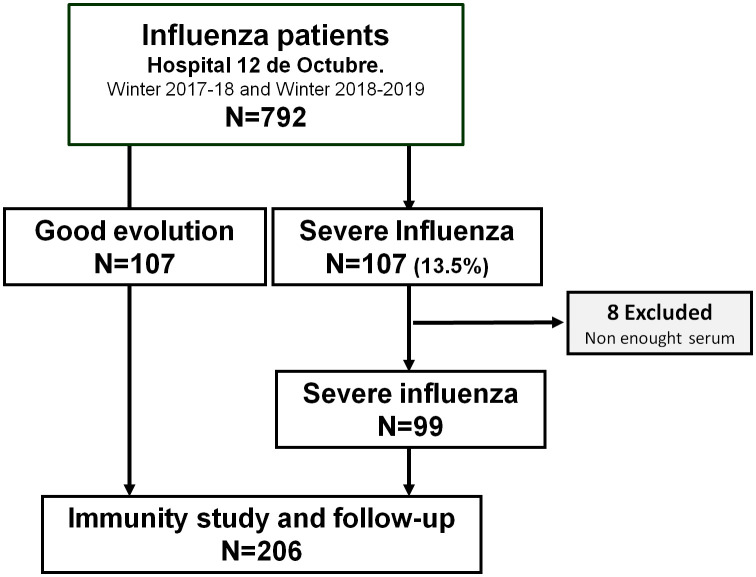
We conducted a prospective observational study of patients with influenza virus infection who required admission to a tertiary hospital in the 2017/18 and 2018/19 flu seasons. Immune markers, surrogate markers of neutrophil activation, and blood levels of DNase I and Apolipoprotein-H (ApoH) were determined in the first serum sample available during hospital care. Patients were followed until hospital discharge or death. Initially, 792 patients were included. From this group, 107 patients with poor evolution were selected, and a random control group was matched by day of admission.
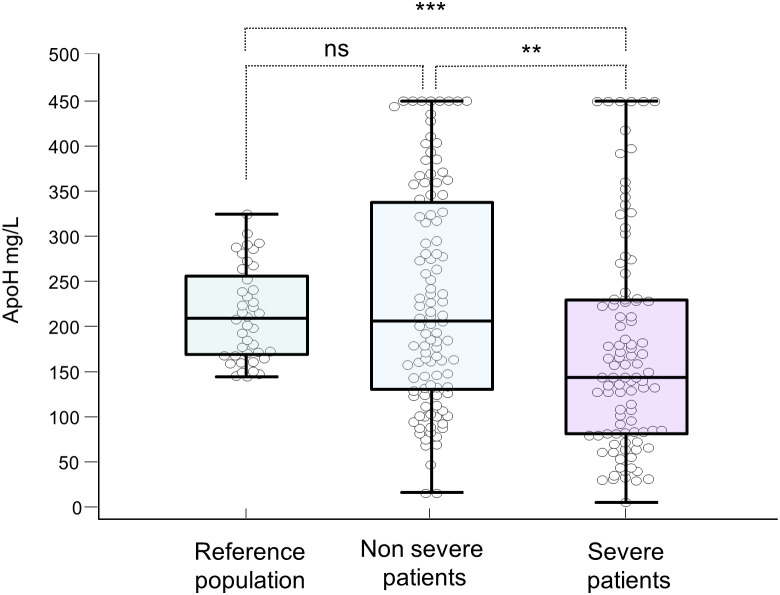
Patients with poor outcomes had significantly reduced ApoH levels, a soluble protein that regulate both complement and coagulation pathways. In multivariate analysis, low plasma levels of ApoH (OR:5.43; 2.21-13.4), high levels of C- reactive protein (OR:2.73: 1.28-5.4), hyperferritinemia (OR:2.83; 1.28-5.4) and smoking (OR:3.41; 1.04-11.16), were significantly associated with a worse prognosis. RF was independently associated with low levels of ApoH (OR: 5.12; 2.02-1.94), while high levels of IL15 behaved as a protective factor (OR:0.30; 0.12-0.71).
Therefore, in hospitalized influenza patients, a dysregulated early immune response is associated with a worse outcome. Adequate plasma levels of ApoH are protective against severe influenza and RF and High levels of IL15 protect against RF.
流感病毒感染可引起多种临床症状,包括呼吸衰竭(RF)甚至死亡。导致疾病最严重形式的机制尚不清楚。目的是评估入院时的初始免疫反应及其对感染进展的潜在影响。
我们对 2017/18 和 2018/19 流感季节需要住院治疗的流感病毒感染患者进行了前瞻性观察研究。在住院期间首次获得的血清样本中测定免疫标志物、中性粒细胞激活的替代标志物、DNase I 和载脂蛋白-H(ApoH)的血液水平。患者随访至出院或死亡。最初纳入了 792 名患者。从该组中选择了 107 名病情恶化的患者,并按入院日进行随机对照。
预后不良的患者 ApoH 水平明显降低,ApoH 是一种调节补体和凝血途径的可溶性蛋白。在多变量分析中,低血浆 ApoH 水平(OR:5.43;2.21-13.4)、高 C 反应蛋白水平(OR:2.73;1.28-5.4)、高铁蛋白血症(OR:2.83;1.28-5.4)和吸烟(OR:3.41;1.04-11.16)与预后不良显著相关。RF 与 ApoH 水平降低独立相关(OR:5.12;2.02-1.94),而 IL15 水平升高则表现为保护因素(OR:0.30;0.12-0.71)。
因此,在住院流感患者中,失调的早期免疫反应与不良结局相关。适当的 ApoH 血浆水平可预防严重流感和 RF,高 IL15 水平可预防 RF。