Arreola-Diaz R, Majluf-Cruz A, Sanchez-Torres L E, Hernandez-Juarez J
Departamento de Inmunologia, Escuela Nacional de Ciencias Biologicas, Instituto Politecnico Nacional, Ciudad de Mexico, Mexico.
Unidad de Investigacion Medica en Trombosis, Hemostasia y Aterogenesis, Instituto Mexicano del Seguro Social, Ciudad de Mexico, Mexico.
Clin Appl Thromb Hemost. 2022 Jan-Dec;28:10760296221088576. doi: 10.1177/10760296221088576.
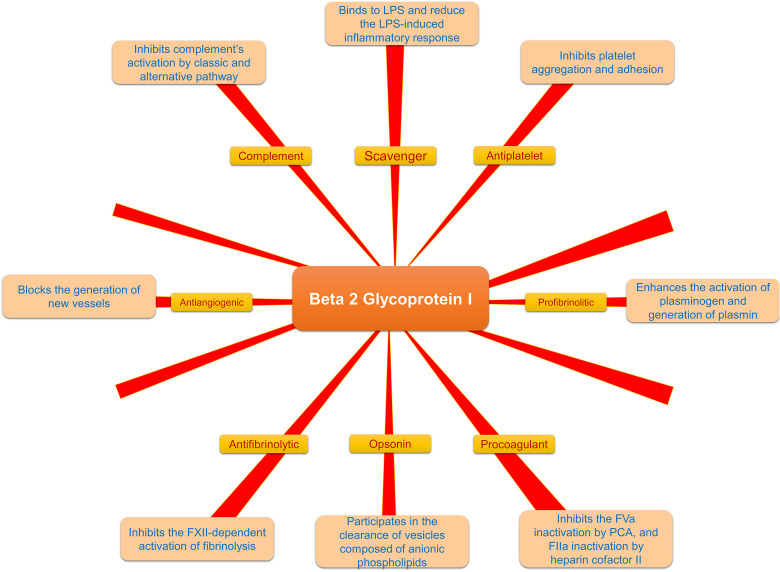
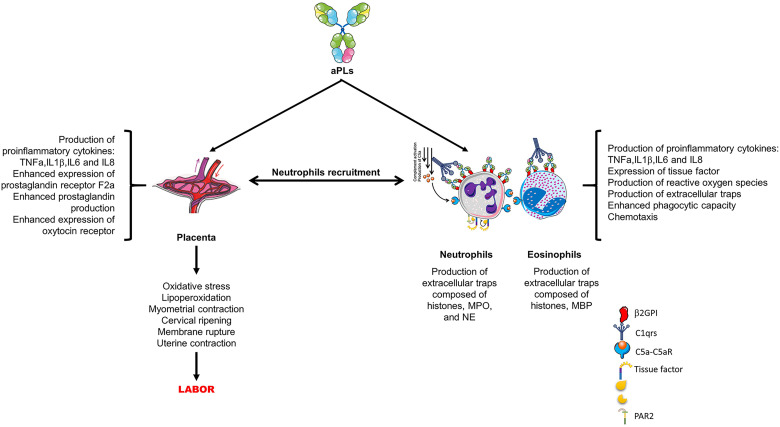
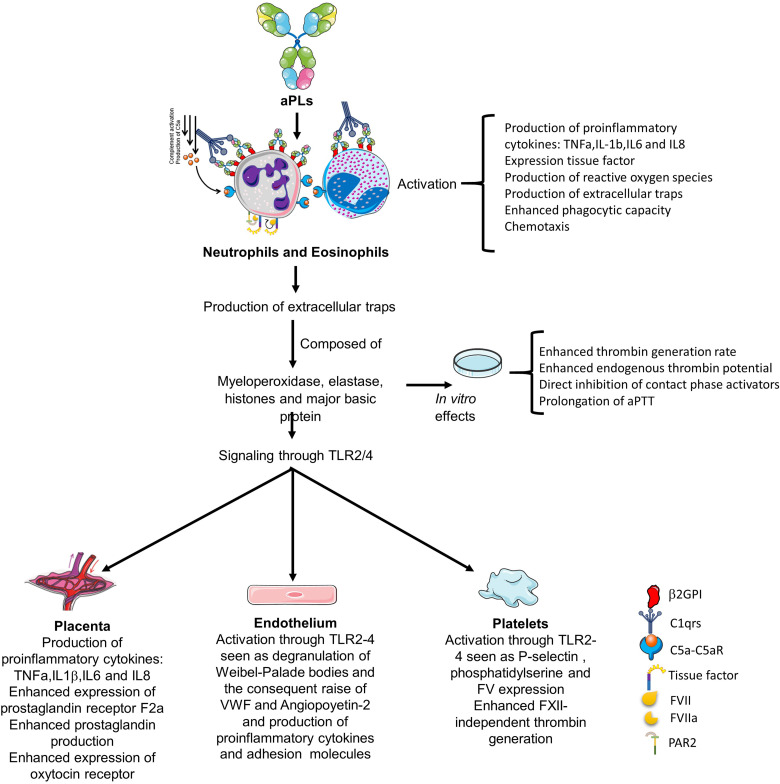
The antiphospholipid syndrome (APS), a systemic autoimmune disease characterized by a hypercoagulability associated to vascular thrombosis and/or obstetric morbidity, is caused by the presence of antiphospholipid antibodies such as lupus anticoagulant, anti-β-2-glycoprotein 1, and/or anticardiolipin antibodies. In the obstetrical APS, antiphospholipid antibodies induce the production of proinflammatory cytokines and tissue factor by placental tissues and recruited neutrophils. Moreover, antiphospholipid antibodies activate the complement system which, in turn, induces a positive feedback leading to recruitment of neutrophils as well as activation of the placenta. Activation of these cells triggers myometrial contractions and cervical ripening provoking the induction of labor. In thrombotic and obstetrical APS, antiphospholipid antibodies activate endothelial cells, platelets, and neutrophils and they may alter the multimeric pattern and concentration of von Willebrand factor, increase the concentration of thrombospondin 1, reduce the inactivation of factor XI by antithrombin, increase the activation of factor XII, and reduce the activity of tissue plasminogen activator with the subsequent production of plasmin. All these effects result in less permeable clots, denser, thinner, and with more branched fibrin fibers which are more difficult to lysate. As a consequence, thrombosis, the defining clinical criterion of APS, complicates the clinical course of the patient.
抗磷脂综合征(APS)是一种全身性自身免疫性疾病,其特征为与血管血栓形成和/或产科并发症相关的高凝状态,由抗磷脂抗体(如狼疮抗凝物、抗β2糖蛋白1和/或抗心磷脂抗体)的存在所致。在产科抗磷脂综合征中,抗磷脂抗体可诱导胎盘组织和募集的中性粒细胞产生促炎细胞因子和组织因子。此外,抗磷脂抗体激活补体系统,进而诱导正反馈,导致中性粒细胞募集以及胎盘激活。这些细胞的激活引发子宫肌层收缩和宫颈成熟,从而诱发分娩。在血栓形成性和产科抗磷脂综合征中,抗磷脂抗体激活内皮细胞、血小板和中性粒细胞,它们可能改变血管性血友病因子的多聚体模式和浓度,增加血小板反应蛋白1的浓度,减少抗凝血酶对因子XI的灭活,增加因子XII的激活,并降低组织型纤溶酶原激活物的活性,随后产生纤溶酶。所有这些效应导致血栓凝块通透性降低、更致密、更薄且纤维蛋白纤维分支更多,更难溶解。因此,血栓形成作为抗磷脂综合征的决定性临床标准,使患者的临床病程复杂化。