Simone Marta, Lucisano Giuseppe, Guerra Tommaso, Paolicelli Damiano, Rocca Maria A, Brescia Morra Vincenzo, Patti Francesco, Annovazzi Pietro, Gasperini Claudio, De Luca Giovanna, Ferraro Diana, Margari Lucia, Granella Franco, Pozzilli Carlo, Romano Silvia, Perini Paola, Bergamaschi Roberto, Coniglio Maria Gabriella, Lus Giacomo, Vianello Marika, Lugaresi Alessandra, Portaccio Emilio, Filippi Massimo, Amato Maria Pia, Iaffaldano Pietro
Child Neuropsychiatry Unit, Department of Precision and Regenerative Medicine, Jonic Area University of Bari "Aldo Moro", Bari, Italy.
CORESEARCH, Pescara, Italy.
J Neurol. 2024 Oct;271(10):6782-6790. doi: 10.1007/s00415-024-12638-0. Epub 2024 Aug 23.
To compare Expanded Disability Status Scale (EDSS) trajectories over time between Multiple Sclerosis (MS) groups with pediatric (POMS), adult (AOMS) and late (LOMS) onset, and between patients with and without progression independent of relapse activity (PIRA).
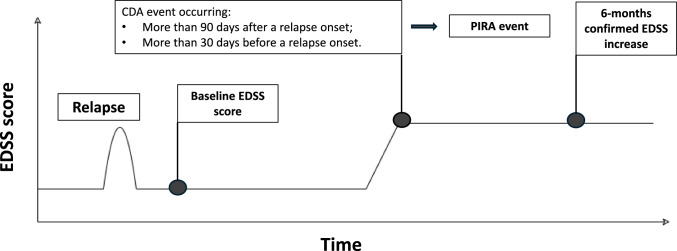
Patients with a first visit within 1 year from onset, ≥ 5-year follow-up and ≥ 1 visit every 6 months were selected from the Italian MS Register. Adjusted disability trajectories were assessed by longitudinal models for repeated measures. Comparisons between groups and between patients with and without PIRA in subgroups were performed by evaluating the yearly differences of mean EDSS score changes versus baseline (delta-EDSS). A first CDA event was defined as a 6-months confirmed disability increase from study baseline, measured by EDSS (increase ≥ 1.5 points with baseline EDSS = 0; ≥ 1.0 with baseline EDSS score ≤ 5.0 and ≥ 0.5 point with baseline EDSS > 5.5). PIRA was defined as a CDA event occurring more than 90 days after and more than 30 days before the onset of a relapse.
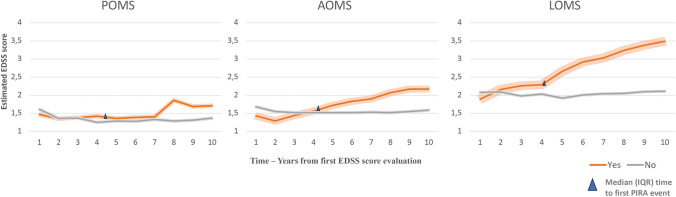
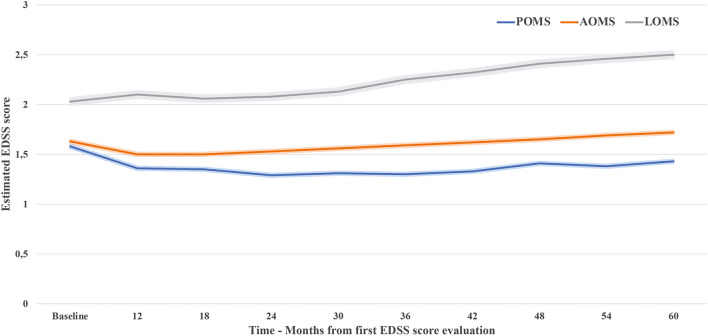
3777 MS patients (268 POMS, 3282 AOMS, 227 LOMS) were included. The slope of disability trajectories significantly diverged in AOMS vs POMS starting from the second year of follow-up (Year 2: delta2-EDSS 0.18 (0.05; 0.31), p = 0.0054) and then mean delta2-EDSS gradually increased up to 0.23 (0.07; 0.39, p = 0.004) at year 5. Patients with PIRA had significant (p < 0.0001) steeper increase in EDSS scores than those without PIRA in all groups, although in POMS, the disability trajectories began to diverge later and at a lesser extent with delta-EDSS score of 0.48 vs 0.83 in AOMS and 1.57 in LOMS, at 3 years after the first PIRA.
Age is relevant in determining disability progression in MS. POMS shows a less steep increase in EDSS scores over time than older patients. The effect of PIRA in accelerating EDSS progression is less pronounced in POMS than in AOMS and LOMS.
比较儿童期起病的多发性硬化症(POMS)、成年期起病的多发性硬化症(AOMS)和晚期起病的多发性硬化症(LOMS)患者随时间变化的扩展残疾状态量表(EDSS)轨迹,以及有和无与复发活动无关的疾病进展(PIRA)患者之间的轨迹。
从意大利多发性硬化症登记处选取起病1年内首次就诊、随访≥5年且每6个月至少就诊1次的患者。通过纵向重复测量模型评估调整后的残疾轨迹。通过评估平均EDSS评分相对于基线的年度变化差异(delta-EDSS),对各亚组中的组间以及有和无PIRA的患者进行比较。首次临床残疾进展事件(CDA)定义为自研究基线起6个月内经EDSS确认的残疾增加(基线EDSS = 0时增加≥1.5分;基线EDSS评分≤5.0时增加≥1.0分;基线EDSS > 5.5时增加≥0.5分)。PIRA定义为在复发开始前30天以上且复发开始后90天以上发生的CDA事件。
纳入3777例多发性硬化症患者(268例POMS,3282例AOMS,227例LOMS)。从随访第二年开始,AOMS与POMS的残疾轨迹斜率显著不同(第2年:delta2-EDSS 0.18(0.05;0.31),p = 0.0054),然后到第5年平均delta2-EDSS逐渐增加至0.23(0.07;0.39,p = 0.004)。所有组中有PIRA的患者EDSS评分的增加显著(p < 0.0001)高于无PIRA的患者,尽管在POMS中,残疾轨迹开始出现差异的时间较晚且程度较小,首次PIRA发生后3年时delta-EDSS评分为0.48,而AOMS为0.83,LOMS为1.57。
年龄在多发性硬化症残疾进展的决定中具有相关性。与老年患者相比,POMS随时间推移EDSS评分的增加较平缓。PIRA在加速EDSS进展方面对POMS的影响不如对AOMS和LOMS明显。