Department of Infection Biology, Faculty of Infectious and Tropical Diseases, London School of Hygiene & Tropical Medicine, London, WC1E 7HT, UK.
National Tuberculosis Reference Laboratory, Research Institute for Tropical Medicine, Department of Health, Filinvest, Alabang, Muntinlupa City, Philippines.
Sci Rep. 2024 Aug 23;14(1):19602. doi: 10.1038/s41598-024-70471-x.
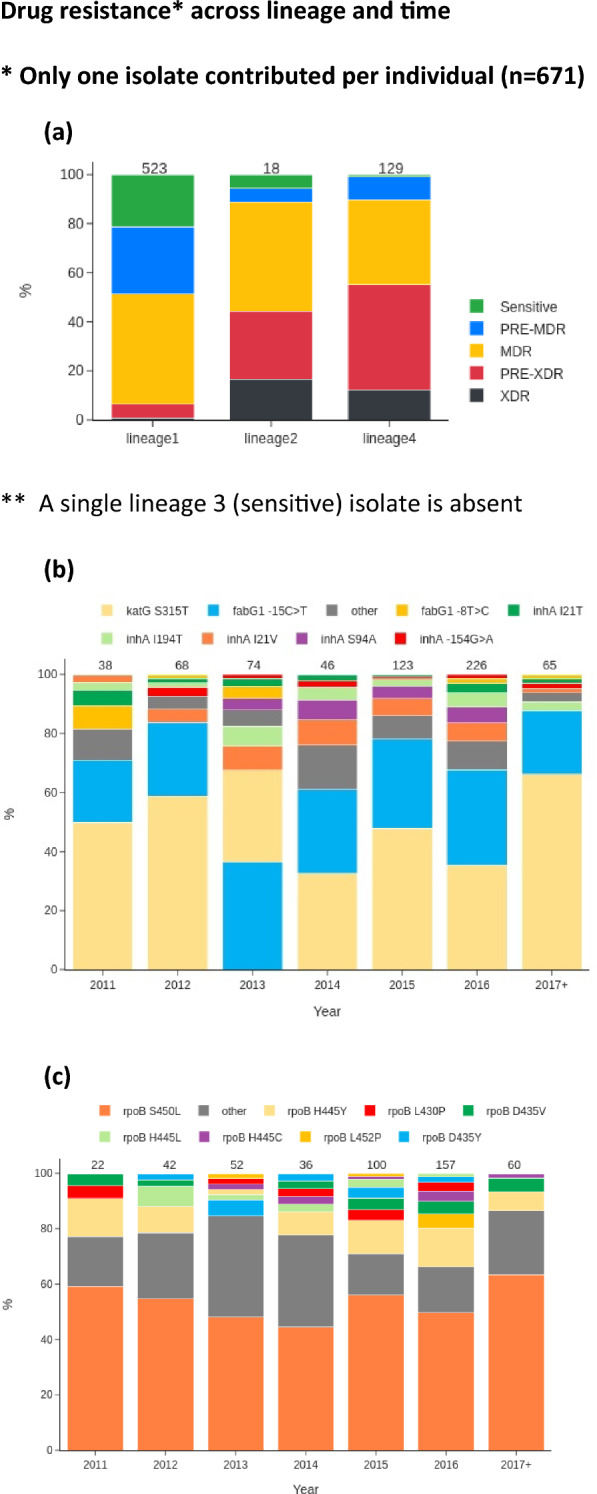
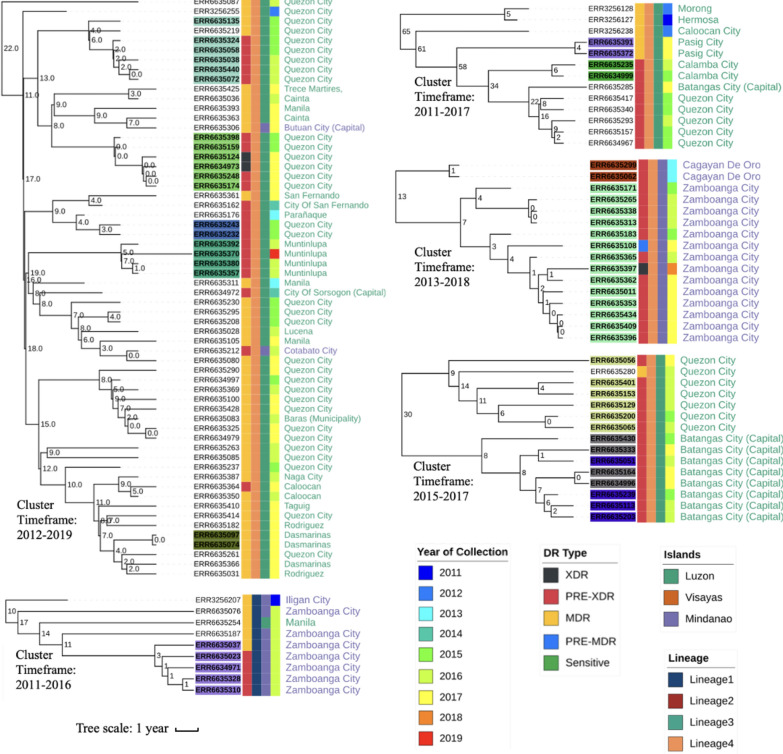
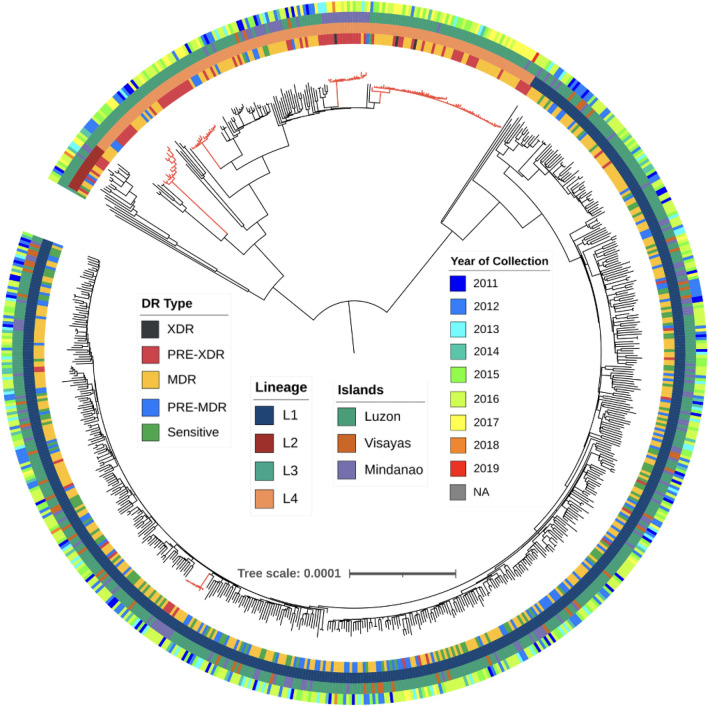
The Philippines is a high-incidence country for tuberculosis, with the increasing prevalence of multi- (MDR-TB) and extensively-drug (XDR-TB) resistant Mycobacterium tuberculosis strains posing difficulties to disease control. Understanding the genetic diversity of circulating strains can provide insights into underlying drug resistance mutations and transmission dynamics, thereby assisting the design of diagnostic tools, including those using next generation sequencing (NGS) platforms. By analysing genome sequencing data of 732 isolates from Philippines drug-resistance survey collections spanning from 2011 to 2019, we found that the majority belonged to lineages L1 (531/732; 72.5%) and L4 (European-American; n = 174; 23.8%), with the Manila strain (L1.2.1.2.1) being the most prominent (475/531). Approximately two-thirds of isolates were found to be at least MDR-TB (483/732; 66.0%), and potential XDR-TB genotypic resistance was observed (3/732; 0.4%), highlighting an emerging problem in the country. Genotypic resistance was highly concordant with laboratory drug susceptibility testing. By finding isolates with (near-)identical genomic variation, five major clusters containing a total of 114 isolates were identified: all containing either L1 or L4 isolates with at least MDR-TB resistance and spanning multiple years of collection. Closer inspection of clusters revealed transmission in prisons, some involving isolates with XDR-TB, and mutations linked to third-line drug bedaquiline. We have also identified previously unreported mutations linked to resistance for isoniazid, rifampicin, ethambutol, and fluoroquinolones. Overall, this study provides important insights into the genetic diversity, transmission and circulating drug resistance mutations of M. tuberculosis in the Philippines, thereby informing clinical and surveillance decision-making, which is increasingly using NGS platforms.
菲律宾是结核病高发国家,耐多药(MDR-TB)和广泛耐药(XDR-TB)结核分枝杆菌菌株的流行率不断上升,给疾病控制带来了困难。了解流行菌株的遗传多样性可以深入了解潜在的耐药突变和传播动态,从而有助于设计诊断工具,包括使用下一代测序(NGS)平台的工具。通过分析 2011 年至 2019 年菲律宾耐药性调查中收集的 732 株分离株的基因组测序数据,我们发现大多数菌株属于谱系 L1(531/732;72.5%)和 L4(欧洲裔美国人;n=174;23.8%),其中马尼拉菌株(L1.2.1.2.1)最为突出(475/531)。大约三分之二的分离株至少为 MDR-TB(483/732;66.0%),并且观察到潜在的 XDR-TB 基因型耐药性(3/732;0.4%),这突出了该国的一个新问题。基因型耐药性与实验室药物敏感性测试高度一致。通过发现具有(近)相同基因组变异的分离株,鉴定出了包含总共 114 株分离株的五个主要簇:所有这些簇都包含至少有 MDR-TB 耐药性的 L1 或 L4 分离株,并且跨越了多年的采集。对聚类的进一步检查显示了监狱中的传播,其中一些涉及 XDR-TB 分离株,以及与三线药物贝达喹啉相关的突变。我们还鉴定了以前未报道的与异烟肼、利福平、乙胺丁醇和氟喹诺酮耐药相关的突变。总的来说,这项研究提供了重要的见解,了解了菲律宾结核分枝杆菌的遗传多样性、传播和循环耐药突变,从而为临床和监测决策提供了信息,这些决策越来越多地使用 NGS 平台。