Pneumology Department, Hospital Universitario La Princesa, Madrid, Spain.
Research Laboratory, Instituto de Investigación La Princesa (IIS Princesa), Madrid, Spain.
Clin Infect Dis. 2024 Oct 15;79(4):910-919. doi: 10.1093/cid/ciae227.
Plitidepsin has shown potent preclinical activity against severe acute respiratory syndrome coronavirus 2 and was generally well tolerated in a phase I trial of hospitalized patients with coronavirus disease 2019 (COVID-19). NEPTUNO, a phase III, multicenter, randomized, controlled trial, was designed to evaluate the efficacy and safety of plitidepsin in the management of moderate COVID-19 in hospitalized adult patients.
Included patients had documented severe acute respiratory syndrome coronavirus 2 infection, required oxygen therapy, and had adequate organ function. The planned sample size was 609 patients. Patients were randomized 1:1:1 to at least 3 days of dexamethasone plus either plitidepsin (1.5 mg/day or 2.5 mg/day, for 3 days) or standard of care (control). The primary endpoint was the time to sustained withdrawal of supplemental oxygen. Secondary endpoints included time to sustained hospital discharge, clinical status, duration of oxygen support, percentage of patients requiring admission to the intensive care unit, and safety.
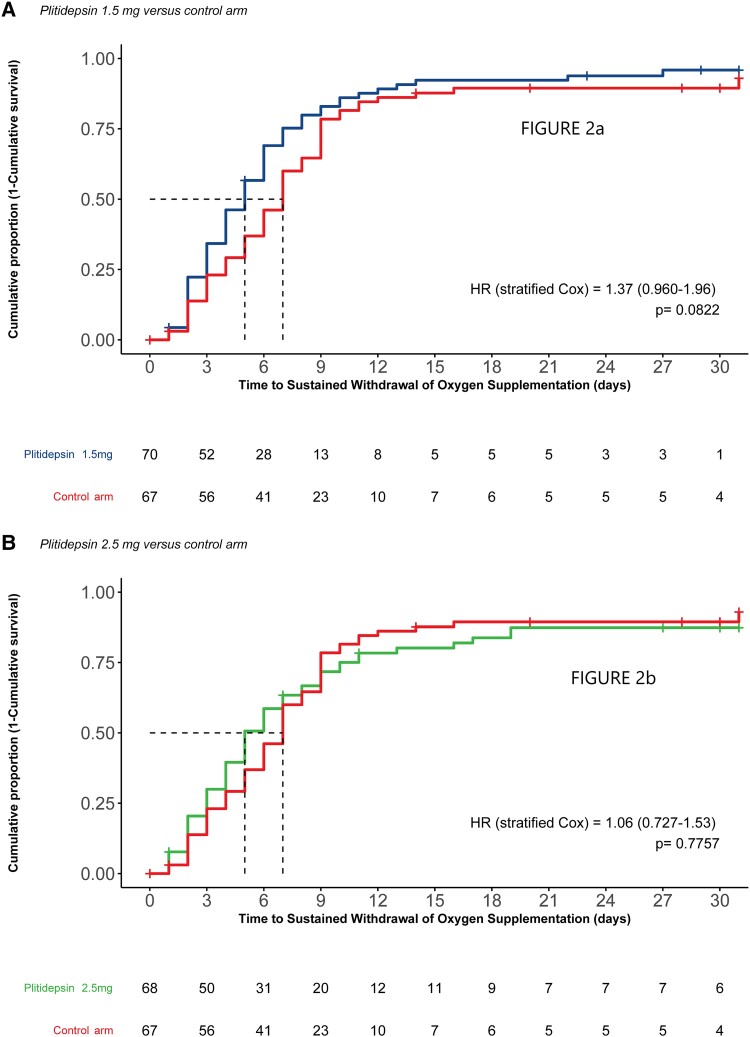
After randomizing 205 patients, NEPTUNO was discontinued due to a notable drop in COVID-19-related hospitalizations. Available data suggest a 2-day improvement in the median time to sustained oxygen therapy discontinuation (5 vs 7 days) favoring both plitidepsin arms (hazard ratio, 1.37; 95% confidence interval, .96-1.96; P = .08 for plitidepsin 1.5 mg vs control; hazard ratio, 1.06; 95% confidence interval, .73-1.53; P = .78 for plitidepsin 2.5 mg vs control). Plitidepsin was generally well tolerated.
Despite the trial limitations, these results suggest that plitidepsin may have a positive benefit-risk ratio in the management of patients requiring oxygen therapy. Further studies with plitidepsin, including those in immunosuppressed patients, are warranted.Results from this phase III trial suggest that plitidepsin, a first-in-class antiviral, may have a positive benefit-risk ratio in the management of hospitalized patients requiring oxygen therapy for moderate COVID-19.
普里替定在严重急性呼吸综合征冠状病毒 2 中显示出强大的临床前活性,并且在一项针对 2019 年冠状病毒病(COVID-19)住院患者的 I 期试验中总体上耐受性良好。NEPTUNO 是一项 III 期、多中心、随机、对照试验,旨在评估普里替定在管理住院成人中度 COVID-19 中的疗效和安全性。
纳入的患者有明确的严重急性呼吸综合征冠状病毒 2 感染,需要氧疗,且有足够的器官功能。计划的样本量为 609 例患者。患者以 1:1:1 的比例随机分为至少 3 天的地塞米松加普里替定(1.5mg/天或 2.5mg/天,连用 3 天)或标准治疗(对照组)。主要终点是持续停用补充氧气的时间。次要终点包括持续出院时间、临床状态、氧支持时间、需要入住重症监护病房的患者比例以及安全性。
在随机分配 205 例患者后,由于 COVID-19 相关住院率显著下降,NEPTUNO 被终止。可用数据表明,中位数持续吸氧治疗停止时间缩短 2 天(5 天 vs 7 天),普里替定两个臂均有优势(风险比,1.37;95%置信区间,0.96-1.96;普里替定 1.5mg 与对照组相比,P=0.08;风险比,1.06;95%置信区间,0.73-1.53;普里替定 2.5mg 与对照组相比,P=0.78)。普里替定总体上耐受性良好。
尽管试验存在局限性,但这些结果表明,普里替定在管理需要氧疗的患者方面可能具有积极的获益风险比。需要进一步研究普里替定,包括在免疫抑制患者中的研究。这项 III 期试验的结果表明,普里替定,一种首创的抗病毒药物,在管理需要氧疗的中度 COVID-19 住院患者方面可能具有积极的获益风险比。