Lymphoma Center, Department of Hematology, the First Affiliated Hospital of Nanjing Medical University, Jiangsu Province Hospital, Nanjing Medical University, Nanjing, China.
Key Laboratory of Hematology, Nanjing Medical University, Nanjing, China.
Clin Transl Med. 2024 Aug;14(8):e1815. doi: 10.1002/ctm2.1815.
Extrachromosomal circular DNAs (eccDNAs), a type of double-stranded DNAs (dsDNAs) that facilitate the activation of the DNA sensing machinery, have been implicated in the progression and prognosis of various diseases. While the roles of eccDNAs remain contentious, their significance in diffuse large B-cell lymphoma (DLBCL) has not been reported.
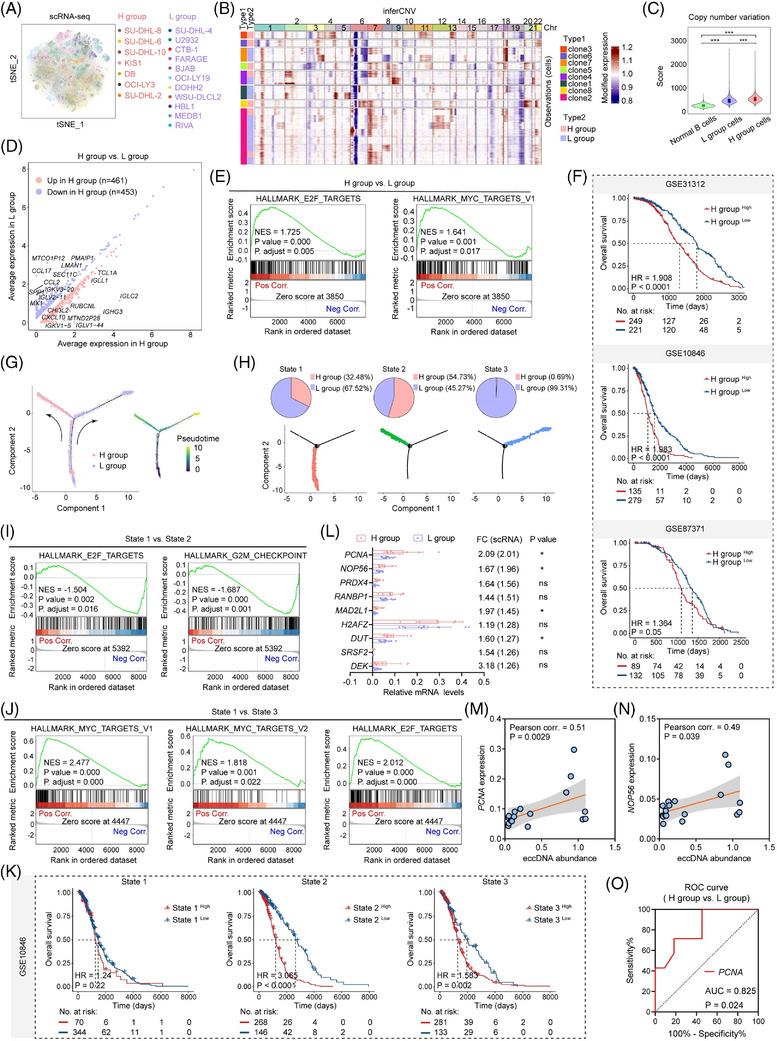
Circular DNA sequencing (circle-seq) was used to demonstrate the expression profile of eccDNAs in DLBCL, and atomic force microscopy to validate the presence of eccDNAs. CCK-8 and scRNA-seq techniques were employed to uncover the activation of eccDNA in the STING pathway, leading to enhanced cell proliferation. Chemotherapeutic drugs were used to test the hypothesis that DNA damage induces the production of eccDNA, thereby activating the STING pathway independent of cGAS. GEO databases were used for verification of the prognosis of the eccDNA-related genes, and animal models were used to investigate the synergistic effects of DNA damage therapy in combination with STING inhibitors on anti-tumour responses.
EccDNAs were widely expressed in DLBCL and associated with the prognosis of patients. Elevated abundance of eccDNAs promoted the progression of DLBCL. Chemotherapeutic drugs-induced DNA damage triggered the generation of eccDNAs, resulting in the activation of the STING signalling in a cGAS-independent manner. Moreover, inhibition of STING exerted a synergistic anti-tumour effect with cisplatin.
EccDNAs induced by DNA damage exert an oncogenic role in DLBCL via activating the STING signalling independently of cGAS. This finding offers a rational therapeutic strategy combining chemotherapy with targeting STING.
EccDNAs induced by DNA damage exert an oncogenic role in DLBCL via activating the STING signalling independently of cGAS. The combined treatment of chemotherapeutic drugs with STING inhibitor significantly delayed the tumor progression, providing new insights into the therapeutic strategy for patients with DLBCL, particularly the relapsed and/or refractory (R/R) ones.
外染色体环状 DNA(eccDNA)是一种双链 DNA(dsDNA),可促进 DNA 传感机制的激活,与各种疾病的进展和预后有关。虽然 eccDNA 的作用仍有争议,但它们在弥漫性大 B 细胞淋巴瘤(DLBCL)中的意义尚未报道。
采用环状 DNA 测序(circle-seq)技术,揭示 eccDNA 在 DLBCL 中的表达谱,原子力显微镜验证 eccDNA 的存在。采用 CCK-8 和 scRNA-seq 技术揭示 eccDNA 在 STING 通路中的激活作用,从而增强细胞增殖。采用化疗药物检测假设,即 DNA 损伤诱导 eccDNA 的产生,从而独立于 cGAS 激活 STING 通路。使用 GEO 数据库验证 eccDNA 相关基因的预后,并使用动物模型研究 DNA 损伤治疗与 STING 抑制剂联合治疗对抗肿瘤反应的协同作用。
eccDNA 在 DLBCL 中广泛表达,与患者的预后相关。eccDNA 丰度的升高促进了 DLBCL 的进展。化疗药物诱导的 DNA 损伤触发 eccDNA 的产生,导致 STING 信号的激活,这种激活方式不依赖于 cGAS。此外,抑制 STING 与顺铂联合具有协同抗肿瘤作用。
DNA 损伤诱导的 eccDNA 通过独立于 cGAS 的 STING 信号激活,在 DLBCL 中发挥致癌作用。这一发现为联合化疗和靶向 STING 的治疗策略提供了合理的依据。
DNA 损伤诱导的 eccDNA 通过独立于 cGAS 的 STING 信号激活,在 DLBCL 中发挥致癌作用。化疗药物联合 STING 抑制剂的治疗显著延缓了肿瘤进展,为 DLBCL 患者,特别是复发/难治性(R/R)患者的治疗策略提供了新的思路。