R K Karpagam, Ravipati Chakradhar, Ramakrishnan Karthik Krishna, Ramaswami Sukumar, Natarajan Paarthipan
Department of Radiology, Saveetha Medical College and Hospital, Saveetha Institute of Medical and Technical Sciences, Saveetha University, Chennai, IND.
Cureus. 2024 Jul 24;16(7):e65241. doi: 10.7759/cureus.65241. eCollection 2024 Jul.
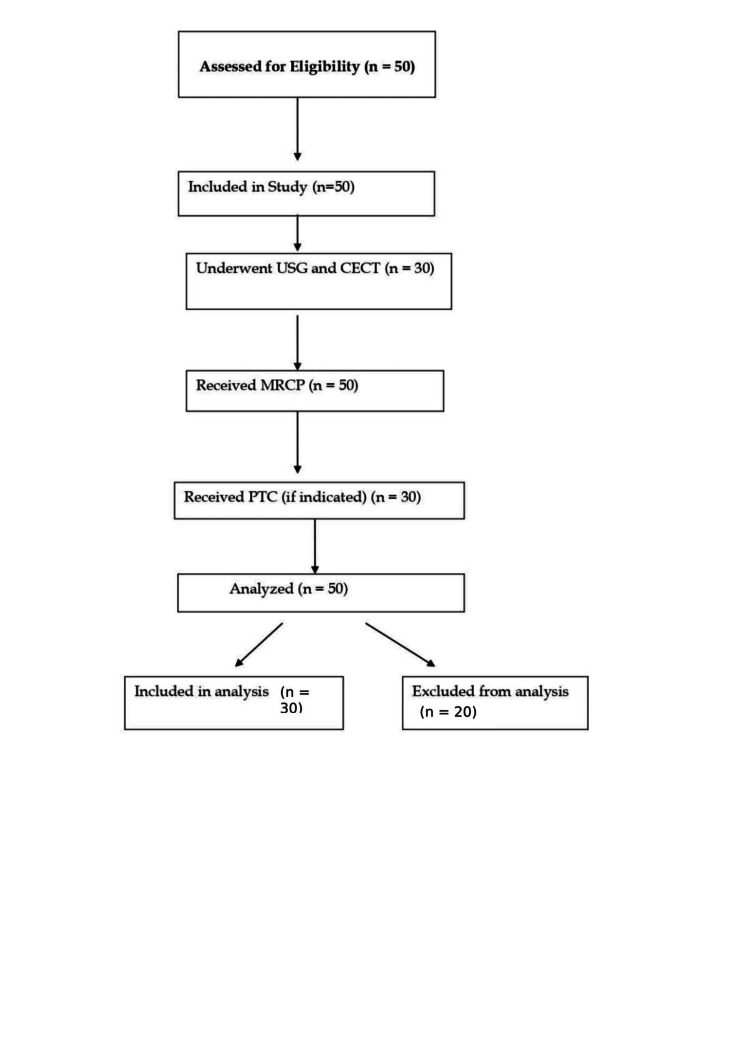
Introduction Obstructive jaundice due to proximal biliary obstruction presents significant diagnostic and therapeutic challenges. Accurate and timely diagnosis is essential for effective management. Objective/aim This study aimed to evaluate and compare the diagnostic accuracy of magnetic resonance cholangiopancreatography (MRCP) and percutaneous transhepatic cholangiography (PTC) along with percutaneous transhepatic biliary drainage (PTBD) stenting in obstructive jaundice, while also incorporating the comparison of ultrasonography (USG) and computed tomography (CT) findings. Materials and methods A prospective study was conducted at a tertiary healthcare center in South India from January 2020 to June 2022. Comprehensive diagnostic evaluations were performed using USG, contrast-enhanced computed tomography (CECT), MRCP, and PTC. The diagnostic outcomes from USG and CECT were initially assessed, followed by MRCP for every patient. These results were then compared with PTC, focusing on identifying the causes and levels of biliary obstruction. Results Fifty patients with suspected obstructive jaundice were included in the study. The study predominantly involved patients aged between the fourth and eighth decades (80%). Choledocholithiasis was identified as the leading cause (30%). MRCP demonstrated superior sensitivity in identifying both the cause (80%) and level (88%) of obstruction. It was particularly effective in detecting hilar masses with 100% sensitivity. Conversely, PTC, while less sensitive in detection, offered the advantage of simultaneous therapeutic intervention through stenting, with a sensitivity rate of 93% in detecting hilar masses. Conclusion MRCP outperforms PTC in diagnostic sensitivity for obstructive jaundice caused by proximal biliary obstruction. However, the advantage of PTC lies in its capacity for immediate therapeutic intervention via stent placement, addressing both diagnostic and treatment needs.
引言 近端胆管梗阻所致的梗阻性黄疸带来了重大的诊断和治疗挑战。准确及时的诊断对于有效管理至关重要。目的 本研究旨在评估和比较磁共振胰胆管造影(MRCP)和经皮经肝胆管造影(PTC)以及经皮经肝胆管引流(PTBD)支架置入术在梗阻性黄疸诊断中的准确性,同时纳入超声检查(USG)和计算机断层扫描(CT)结果的比较。材料与方法 2020年1月至2022年6月在印度南部的一家三级医疗中心进行了一项前瞻性研究。使用USG、对比增强计算机断层扫描(CECT)、MRCP和PTC进行全面的诊断评估。首先评估USG和CECT的诊断结果,然后对每位患者进行MRCP检查。然后将这些结果与PTC进行比较,重点是确定胆管梗阻的原因和部位。结果 50例疑似梗阻性黄疸患者纳入研究。研究主要涉及年龄在第四至第八个十年之间的患者(80%)。胆总管结石被确定为主要病因(30%)。MRCP在确定梗阻原因(80%)和部位(88%)方面表现出更高的敏感性。它在检测肝门部肿块方面特别有效,敏感性为100%。相反,PTC虽然检测敏感性较低,但具有通过支架置入同时进行治疗干预的优势,检测肝门部肿块的敏感性为93%。结论 在近端胆管梗阻所致梗阻性黄疸的诊断敏感性方面,MRCP优于PTC。然而,PTC的优势在于其能够通过支架置入立即进行治疗干预,满足诊断和治疗需求。