Krishnakumar Karthika, Kalaskar Ritesh, Kalaskar Ashita, Bhadule Shivani, Joshi Suyash
Department of Pediatric and Preventive Dentistry, Government Dental College & Hospital, Nagpur, Maharashtra, India.
Department of Oral Medicine and Radiology, Government Dental College & Hospital, Nagpur, Maharashtra, India.
Int J Clin Pediatr Dent. 2024 Feb;17(2):221-228. doi: 10.5005/jp-journals-10005-2757.
This systematic review was designed to compare the clinical effectiveness of high-viscosity glass ionomer cement (HVGIC) restorations to direct composite resin (CR) restorations in single- or multisurface cavities in primary teeth.
Restorative procedures are typically used to treat caries in primary teeth. Due to their improved preservation of the natural tooth structure and their adhesion to the remaining tooth structure, CR and GIC have drawn attention as the preferred restorative materials. In the literature, over the past 20 years, the term HVGIC has developed. Compared to C-GICs, HVGICs appear to have a higher survival rate. However, isolated studies provide contradictory findings regarding the durability of restorations in primary teeth.
Major electronic databases were thoroughly searched to find publications from the years 2000 to 2021. Studies included were randomized and nonrandomized clinical trials on children aged 3-13 years, in which restoration of primary teeth using HVGIC and CR was performed.
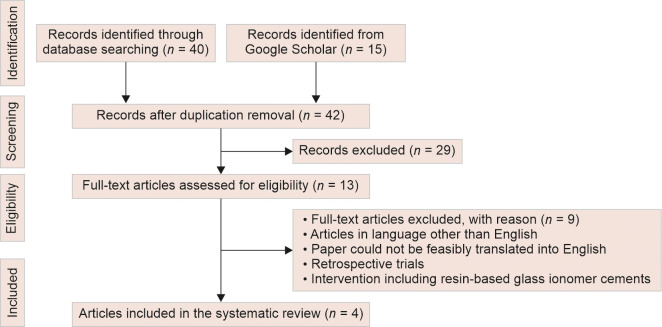
This systematic review includes four studies [three randomized controlled trials (RCTs) and one nonrandomized controlled trial]. No statistically significant difference between these materials was seen in any of the included studies.
This systematic review of findings supports the assertion that both HVGIC and CR restorations deliver satisfactory outcomes in terms of clinical efficacy and overall survivability. It was found that, for both materials, class I restorations had statistically higher survival rates than class II restorations. Long-term studies are essential to evaluate the clinical efficacy of both restorations.
This systematic review outlines the application of HVGIC and CR as restorative materials for pediatric dentists to use in their everyday dental practices.
Krishnakumar K, Kalaskar R, Kalaskar A, Clinical Effectiveness of High-viscosity Glass Ionomer Cement and Composite Resin as a Restorative Material in Primary Teeth: A Systematic Review of Clinical Trials. Int J Clin Pediatr Dent 2024;17(2):221-228.
本系统评价旨在比较高粘度玻璃离子水门汀(HVGIC)修复与直接复合树脂(CR)修复在乳牙单表面或多表面龋洞中的临床效果。
修复程序通常用于治疗乳牙龋齿。由于其能更好地保留天然牙体结构并与剩余牙体结构黏附,CR和玻璃离子水门汀(GIC)作为首选修复材料受到关注。在过去20年的文献中,出现了“HVGIC”一词。与传统玻璃离子水门汀(C-GIC)相比,HVGIC似乎具有更高的存留率。然而,个别研究对于乳牙修复体的耐久性给出了相互矛盾的结果。
全面检索主要电子数据库以查找2000年至2021年的出版物。纳入的研究为针对3至13岁儿童的随机和非随机临床试验,其中使用HVGIC和CR对乳牙进行修复。
本系统评价纳入四项研究[三项随机对照试验(RCT)和一项非随机对照试验]。在所纳入的任何研究中,这些材料之间均未观察到统计学上的显著差异。
本系统评价结果支持以下观点,即HVGIC和CR修复在临床疗效和总体存留率方面均能带来满意的结果。研究发现,对于这两种材料,I类修复体的存留率在统计学上高于II类修复体。长期研究对于评估这两种修复体的临床疗效至关重要。
本系统评价概述了HVGIC和CR作为修复材料在儿科牙医日常牙科实践中的应用。
Krishnakumar K, Kalaskar R, Kalaskar A, 高粘度玻璃离子水门汀和复合树脂作为乳牙修复材料的临床效果:临床试验的系统评价。《国际临床儿科牙科学杂志》2024年;17(2):221 - 228。