Khan Naveera, Garg Nishita, Pathivada Lumbini, Yeluri Ramakrishna
Department of Pedodontics and Preventive Dentistry, Teerthanker Mahaveer Dental College and Research Centre (TMDC&RC), Teerthanker Mahaveer University, Moradabad, Uttar Pradesh, India.
Department of Pedodontics and Preventive Dentistry, Rajendra Institute of Medical Sciences (RIMS), Ranchi, Jharkhand, India.
Int J Clin Pediatr Dent. 2024 Apr;17(Suppl 1):S55-S60. doi: 10.5005/jp-journals-10005-2811.
To enhance the survival rate of atraumatic restorative treatment (ART) restorations using (class I and class II) bilayer technique of placing glass ionomer cement (GIC) along with nanofilled coating (NC) over the restorations, thereby improving longevity.
A total of 178 primary molars in 67 children were selected and randomly divided into four groups. Group IA was treated with a single layer of GIC, followed by a protective layer of petroleum jelly in class I restoration. Group IB was treated with a single layer of GIC, followed by a protective layer of petroleum jelly in class II restoration. Group IIA was treated with bilayer GIC restoration followed by NC of GC-Coat Plus in class I, whereas group IIB was treated with bilayer GIC restoration followed by GC-Coat Plus in class II. Clinical analysis of all three groups was performed at 1, 3, 6, 9, and 12 months to evaluate the success of treatment procedures using predetermined criteria. Pearson's Chi-square and Kaplan-Meier estimates were utilized to evaluate the success of all four treatment procedures ( < 0.05).
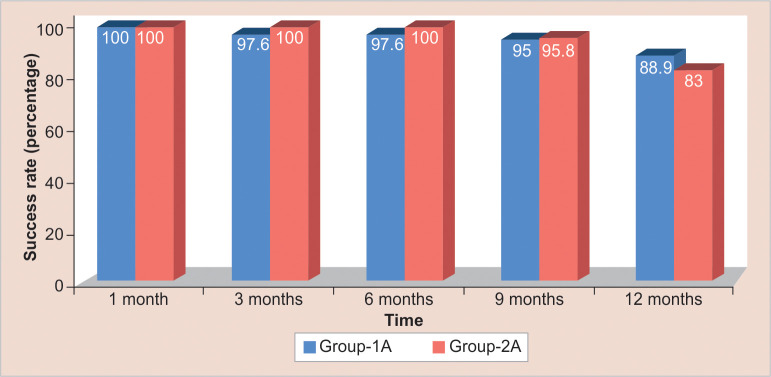
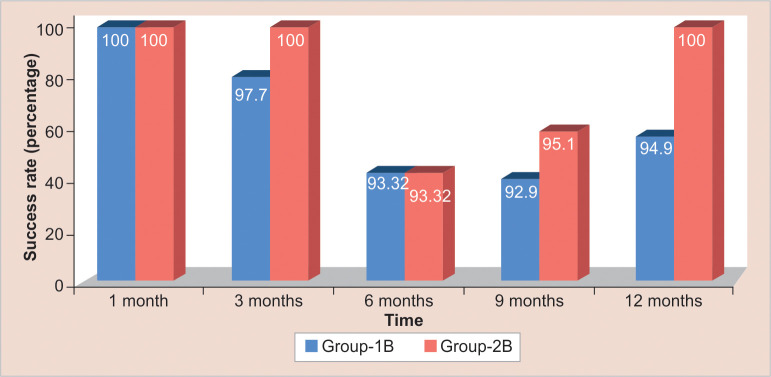
Out of 178 teeth, 33 teeth were in group IA, 36 teeth were in group IB, 43 teeth were in group IIA, and 40 teeth were available for evaluation at the end of the 12-month follow-up period. The overall success was determined to be 81% for group IA, 79.2% for group IB, 79.5% for group IIA, and 88.6% for IIB. At 6th-month follow-up, one clinical failure was observed in groups IA and IB. At 9 months follow-up, two clinical failures were observed in both group IA and group IB and three failures were observed in group IIB. At 12 months follow-up, four clinical failures were observed in group IA, three in group IB and one clinical failure was observed in group IIB. There was no statistically significant difference observed between the success of the four groups, suggesting that either of the techniques can be utilized for ART.
No statistically significant difference was observed between the survival of class I and class II restorations of both the groups, indicating that either single-layer or bilayer technique along with NC can be adopted for the management of dental caries in primary molars using the ART approach.
Khan N, Garg N, Garg N, Comparative Evaluation of the Survival Rates of Atraumatic Restorative Treatment Restorations Using Bilayer Technique along with Nanofilled Coating in Primary Molars: A Clinical Study. Int J Clin Pediatr Dent 2024;17(S-1):S55-S60.
采用双层技术(I类和II类)在修复体上放置玻璃离子水门汀(GIC)并覆盖纳米填充涂层(NC),以提高非创伤性修复治疗(ART)修复体的存活率,从而延长使用寿命。
选取67名儿童的178颗乳磨牙,随机分为四组。IA组在I类修复中用单层GIC治疗,随后用凡士林保护层。IB组在II类修复中用单层GIC治疗,随后用凡士林保护层。IIA组在I类修复中用双层GIC修复,随后用GC-Coat Plus纳米涂层;而IIB组在II类修复中用双层GIC修复,随后用GC-Coat Plus纳米涂层。在1、3、6、9和12个月时对所有三组进行临床分析,使用预定标准评估治疗程序的成功率。采用Pearson卡方检验和Kaplan-Meier估计法评估所有四种治疗程序的成功率(P<0.05)。
在178颗牙齿中,IA组有33颗牙齿,IB组有36颗牙齿,IIA组有43颗牙齿,在12个月随访期结束时,有40颗牙齿可供评估。IA组的总体成功率为81%,IB组为79.2%,IIA组为79.5%,IIB组为88.6%。在6个月随访时,IA组和IB组各观察到1例临床失败。在9个月随访时,IA组和IB组各观察到2例临床失败,IIB组观察到3例失败。在12个月随访时,IA组观察到4例临床失败,IB组观察到3例,IIB组观察到1例临床失败。四组成功率之间未观察到统计学显著差异,表明两种技术均可用于ART。
两组I类和II类修复体的存活率之间未观察到统计学显著差异,这表明在使用ART方法治疗乳磨牙龋齿时,单层或双层技术结合纳米涂层均可采用。
Khan N, Garg N, Garg N, 采用双层技术结合纳米填充涂层对乳磨牙非创伤性修复治疗修复体存活率的比较评价:一项临床研究。《国际临床儿科牙科学杂志》2024;17(S-1):S55-S60。