Boujenah Jeremy, Cohen Jonathan, Allouche Michael, Ziol Marianne, Benbara Amélie, Fermaut Marion, Fain Olivier, Carbillon Lionel, Mekinian Arsène
Service de Gynécologie Obstétrique et Médecine de la Reproduction, Hôpital Jean Verdier, AP-HP, Université Paris 13, Bondy, France (Boujenah, Benbara, Fermaut, Carbillon).
Service de Gynécologie Obstétrique et Médecine de la Reproduction, Clinique Sainte Thérèse. 9 rue Gustave Dore. 75017 Paris (Cohen).
AJOG Glob Rep. 2024 Jul 17;4(3):100374. doi: 10.1016/j.xagr.2024.100374. eCollection 2024 Aug.
Since the Consensus Statement diffused by the Amsterdam Placental Workshop Group, knowledge of the meaning of placental vascular malperfusion has become essential in the unavoidable analysis of obstetrical history in a patient followed for autoimmune disease or any other maternal comorbidity. We aimed to analyse the prevalence of various placental lesions from a 6-months prospective observational study and to correlate the various placental profiles to obstetrical outcome, maternal diseases and pregnancy treatments. The frequency of foetal vascular malperfusion lesion could be estimated at 8.7%, in our population and to understand its neonatal associations.
The study groups consisted of 208 consecutive women which ended the pregnancy and have placental analysis during the period of the study.
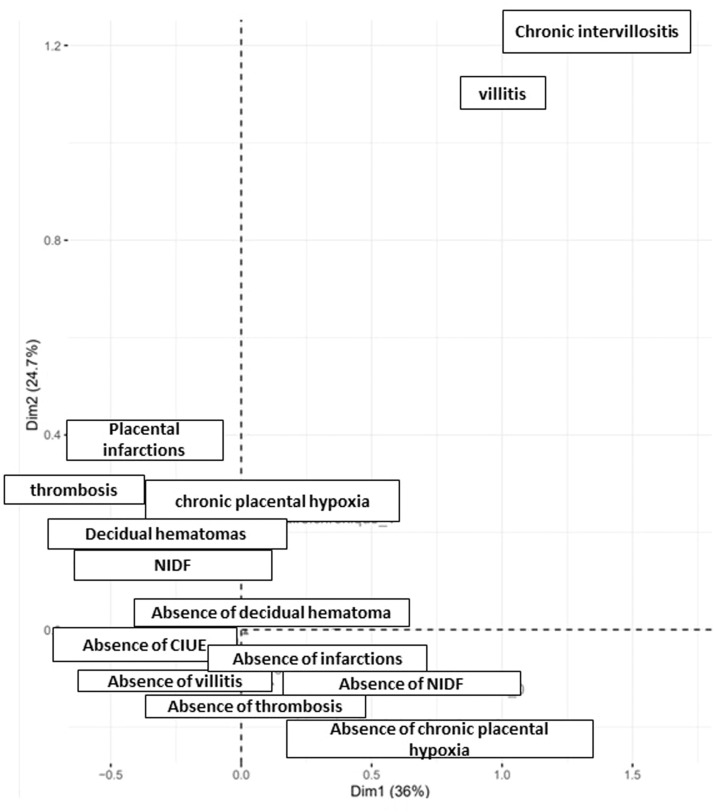
From December 2015 to October 2017, from overall 4398 delivered pregnancies in university obstetrical department, 208 (4.7%) placental analysis have been done and included in the study. The placental analysis have been done for vascular obstetrical complications during the pregnancy (n = 106; 51%), unexplained abnormal foetal heart rate tracings (n = 59; 28,3%), suspicion of intra-amniotic infection (n = 12; 5,7%%), term new-borns Apgar score <7 or arterial cord blood pH ≤ 7 (n = 7; 3,5%), spontaneous preterm delivery (n = 19; 9,1%), intrahepatic cholestasis of pregnancy (n = 5; 2,4%). An adverse obstetrical event was noted in 87 cases (42%): preeclampsia or HELLP syndrome (n = 15; 7%), FGR (n = 59; 28%), gestational diabetes (n = 33; 16%) and gestational hypertension (n = 19; 9%). Placental histological analysis showed abnormal vascular features in 159 cases (76%), inflammatory features in 16 placentas (8%), vascular and inflammatory features in 10 cases (4%), chorioamnionitis in 38 cases (18%) and absence of any abnormality in 43 cases (21%). A cluster analysis of histological features allowed distinguishing three placental patterns: a normal pattern characterised by the absence of any placental lesions, an inflammatory pattern characterised by the presence of villitis and/or chronic intervillositis; a vascular pattern with the presence of thrombosis, maternal floor infarct with massive perivillous fibrin deposition, infarction and chronic villositis hypoxia. Women with inflammatory placental profile have significantly increased frequencies of tobacco use (50% vs. 9%; = 0.03), pathological vascular Doppler (50% vs. 5%; = 0.001), FGR (100% vs. 14%; = 0.0001) and oligohydramnios (67% vs. 5%; = 0.0001) than those with normal placentas. A higher rate of vascular or inflammatory lesion were observed in women with Hypertensive disorder of pregnancy, where as those with inflammatory pattern have significantly more frequent FGR (100% vs 34%; = 0.02) and oligohydramnios (67% vs 5%; = 0.0002).
The placenta analysis is important to understand the origin of adverse obstetrical outcome and the risk for subsequent pregnancy.
自阿姆斯特丹胎盘研讨会小组发布共识声明以来,了解胎盘血管灌注不良的意义对于在患有自身免疫性疾病或任何其他母体合并症的患者的产科病史不可避免的分析中变得至关重要。我们旨在通过一项为期6个月的前瞻性观察性研究分析各种胎盘病变的患病率,并将各种胎盘特征与产科结局、母体疾病和妊娠治疗相关联。在我们的人群中,胎儿血管灌注不良病变的发生率估计为8.7%,并了解其与新生儿的关联。
研究组由208名连续妊娠结束且在研究期间进行胎盘分析的女性组成。
2015年12月至2017年10月,在大学产科部门总共4398例分娩的妊娠中,进行了208例(4.7%)胎盘分析并纳入研究。胎盘分析针对妊娠期间的血管性产科并发症(n = 106;51%)、不明原因的异常胎儿心率描记(n = 59;28.3%)、羊膜腔内感染怀疑(n = 12;5.7%)、足月新生儿阿氏评分<7或脐动脉血pH≤7(n = 7;3.5%)、自发性早产(n = 19;9.1%)、妊娠肝内胆汁淤积症(n = 5;2.4%)。87例(42%)出现不良产科事件:子痫前期或HELLP综合征(n = 15;7%)、胎儿生长受限(FGR)(n = 59;28%)、妊娠期糖尿病(n = 33;16%)和妊娠高血压(n = 19;9%)。胎盘组织学分析显示159例(76%)有异常血管特征,16例胎盘(8%)有炎症特征,10例(4%)有血管和炎症特征,38例(18%)有绒毛膜羊膜炎,43例(21%)无任何异常。对组织学特征进行聚类分析可区分出三种胎盘模式:一种正常模式,其特征是无任何胎盘病变;一种炎症模式,其特征是存在绒毛炎和/或慢性绒毛间炎;一种血管模式,其特征是存在血栓形成、伴有大量绒毛周围纤维蛋白沉积的胎盘基底部梗死、梗死和慢性绒毛炎缺氧。与胎盘正常的女性相比,具有炎症性胎盘特征的女性吸烟频率(50%对9%;P = 0.03)、病理性血管多普勒(50%对5%;P = 0.001)、FGR(100%对14%;P = 0.0001)和羊水过少(67%对5%;P = 0.0001)的发生率显著增加。妊娠高血压疾病女性中观察到更高的血管或炎症病变发生率,而具有炎症模式的女性FGR(100%对34%;P = 0.02)和羊水过少(67%对5%;P = 0.0002)的发生率显著更高。
胎盘分析对于了解不良产科结局的起源以及后续妊娠的风险很重要。