Romero Roberto, Kim Yeon Mee, Pacora Percy, Kim Chong Jai, Benshalom-Tirosh Neta, Jaiman Sunil, Bhatti Gaurav, Kim Jung-Sun, Qureshi Faisal, Jacques Suzanne M, Jung Eun Jung, Yeo Lami, Panaitescu Bogdan, Maymon Eli, Hassan Sonia S, Hsu Chaur-Dong, Erez Offer
Perinatology Research Branch, NICHD/NIH/DHHS, Bethesda, MD, USA, and Detroit, MI,USA.
Department of Obstetrics and Gynecology, University of Michigan, Ann Arbor, MI,USA.
J Perinat Med. 2018 Aug 28;46(6):613-630. doi: 10.1515/jpm-2018-0055.
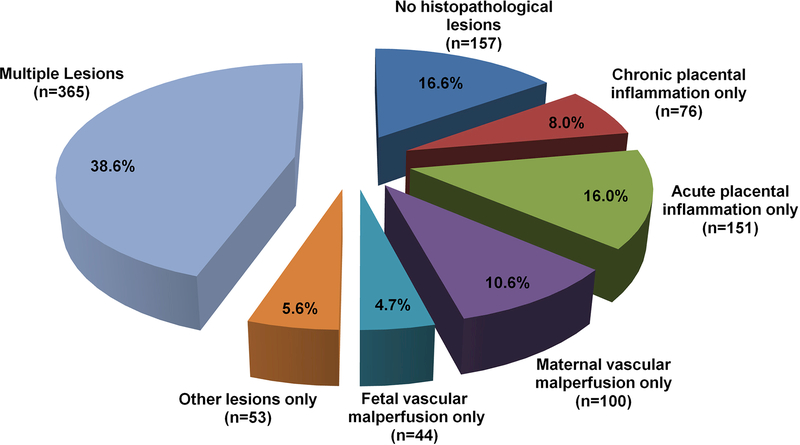
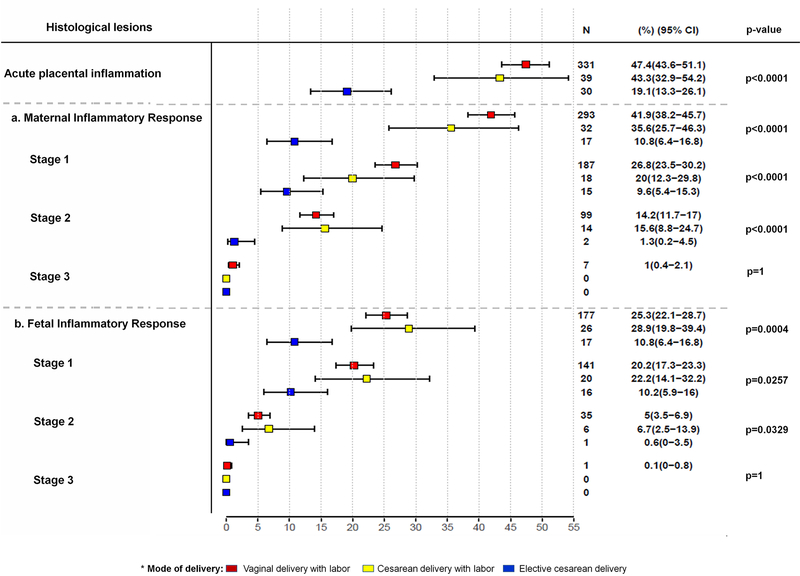
Objective To determine the frequency and type of histopathologic lesions in placentas delivered by women with a normal pregnancy outcome. Methods This retrospective cohort study included placental samples from 944 women with a singleton gestation who delivered at term without obstetrical complications. Placental lesions were classified into the following four categories as defined by the Society for Pediatric Pathology and by our unit: (1) acute placental inflammation, (2) chronic placental inflammation, (3) maternal vascular malperfusion and (4) fetal vascular malperfusion. Results (1) Seventy-eight percent of the placentas had lesions consistent with inflammatory or vascular lesions; (2) acute inflammatory lesions were the most prevalent, observed in 42.3% of the placentas, but only 1.0% of the lesions were severe; (3) acute inflammatory lesions were more common in the placentas of women with labor than in those without labor; (4) chronic inflammatory lesions of the placenta were present in 29.9%; and (5) maternal and fetal vascular lesions of malperfusion were detected in 35.7% and 19.7%, respectively. Two or more lesions with maternal or fetal vascular features consistent with malperfusion (high-burden lesions) were present in 7.4% and 0.7%, respectively. Conclusion Most placentas had lesions consistent with inflammatory or vascular lesions, but severe and/or high-burden lesions were infrequent. Mild placental lesions may be interpreted either as acute changes associated with parturition or as representative of a subclinical pathological process (intra-amniotic infection or sterile intra-amniotic inflammation) that did not affect the clinical course of pregnancy.
目的 确定妊娠结局正常的孕妇所分娩胎盘的组织病理学病变的频率及类型。方法 这项回顾性队列研究纳入了944名单胎妊娠且足月分娩无产科并发症的孕妇的胎盘样本。胎盘病变根据儿科病理学会及本单位的定义分为以下四类:(1)急性胎盘炎症,(2)慢性胎盘炎症,(3)母体血管灌注不良,(4)胎儿血管灌注不良。结果 (1)78%的胎盘有与炎症或血管病变相符的病变;(2)急性炎症病变最为常见,在42.3%的胎盘中观察到,但只有1.0%的病变为重度;(3)急性炎症病变在有产程的孕妇的胎盘中比无产程的孕妇的胎盘中更常见;(4)胎盘慢性炎症病变占29.9%;(5)母体和胎儿血管灌注不良病变分别占35.7%和19.7%。分别有7.4%和0.7%的胎盘存在两种或更多与灌注不良相符的具有母体或胎儿血管特征的病变(高负荷病变)。结论 大多数胎盘有与炎症或血管病变相符的病变,但重度和/或高负荷病变并不常见。轻度胎盘病变可能被解释为与分娩相关的急性变化,或代表未影响妊娠临床过程的亚临床病理过程(羊膜腔内感染或无菌性羊膜腔内炎症)。