Andreani Mariana, Frola Claudia E, Cáceres Diego H, Bozzano Claudia, Diaz Liliana, Cattani Maria E, Rodriguez-Tudela Juan L, Rolón Maria J, Guelfand Liliana
División Laboratorio de Análisis Clínicos, Sección Microbiología, Hospital General de Agudos "Dr. Juan A. Fernández", 1425, Buenos Aires, Argentina.
División Infectología, Hospital General de Agudos "Dr. Juan A. Fernández", 1425, Buenos Aires, Argentina.
IJID Reg. 2024 Jul 8;12:100403. doi: 10.1016/j.ijregi.2024.100403. eCollection 2024 Sep.
Despite advancements in HIV diagnosis and treatment, advanced HIV disease (AHD) is still a significant concern worldwide, especially in countries with a high percentage of undiagnosed cases and late-stage diagnoses.
A prospective pilot study was conducted in Buenos Aires, Argentina to assess the feasibility of implementing a package for people living with HIV, integrating a point-of-care clusters of differentiation (CD4) test, followed by rapid and antigen (Ag) detection.
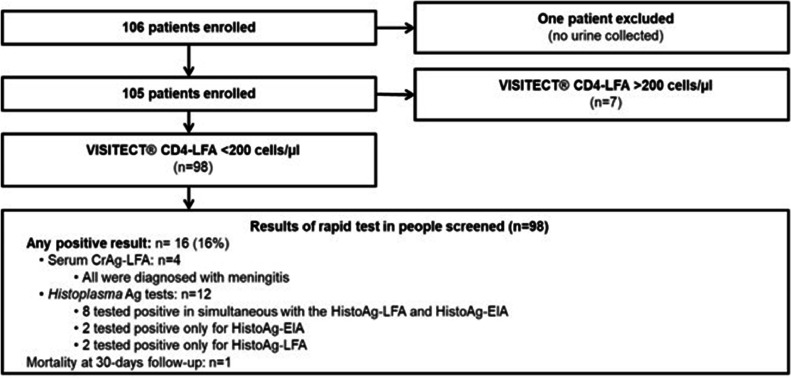
A total of 105 people living with HIV were enrolled, during June 2021 to October 2021. The VISITECT CD4 Advanced Disease Lateral Flow Assay (CD4-LFA) (Accubio) classified 98 (93%) patients with AHD. Compared with flow cytometry, the CD4-LFA performed with a high sensitivity (100%) but low specificity (19%) and limited accuracy (47%). In the 98 patients classified with AHD using the CD4-LFA, 16 tested positive for any of the rapid Ag used, including 12 patients positive for the Ag test and four positive for Ag; all four patients with positive Ag in sera and were diagnosed with meningitis. In the 30-day follow-up, one death was recorded.
The CD4-LFA correctly classified all patients with CD4 ≤200 cells/µL by flow cytometry, but a high frequency of patients misclassified with AHD was recorded. We also observed a high prevalence of opportunistic fungal infections, as previously observed in the hospital where this pilot study was conducted; however, in contrast with those previous reports, mortality was lower. The study underscores the importance of scaling up comprehensive care strategies and collaborating with governmental and non-governmental partners to enhance access to essential diagnostic tools and treatments for people living with HIV. Further research with larger sample sizes is needed to validate these findings.
尽管在艾滋病毒诊断和治疗方面取得了进展,但晚期艾滋病毒疾病(AHD)在全球范围内仍是一个重大问题,尤其是在未确诊病例和晚期诊断比例较高的国家。
在阿根廷布宜诺斯艾利斯进行了一项前瞻性试点研究,以评估为艾滋病毒感染者实施一套综合方案的可行性,该方案整合了即时护理分化簇(CD4)检测,随后进行快速抗原(Ag)检测。
2021年6月至2021年10月期间,共招募了105名艾滋病毒感染者。VISITECT CD4晚期疾病侧向流动分析(CD4-LFA)(Accubio)将98名(93%)患者归类为AHD。与流式细胞术相比,CD4-LFA的灵敏度较高(100%),但特异性较低(19%),准确性有限(47%)。在使用CD4-LFA归类为AHD的98名患者中,16名使用的任何一种快速Ag检测呈阳性,包括12名Ag检测呈阳性的患者和4名Ag检测呈阳性的患者;所有4名血清中Ag检测呈阳性的患者均被诊断为脑膜炎。在30天的随访中,记录到1例死亡。
CD4-LFA通过流式细胞术正确分类了所有CD4≤200细胞/µL的患者,但记录到被错误归类为AHD的患者频率较高。我们还观察到机会性真菌感染的高患病率,正如在进行该试点研究的医院中先前观察到的那样;然而,与先前的报告相比,死亡率较低。该研究强调了扩大综合护理策略以及与政府和非政府合作伙伴合作以增加艾滋病毒感染者获得基本诊断工具和治疗的机会的重要性。需要进行更大样本量的进一步研究来验证这些发现。