Teasdale Emma J, Everitt Hazel A, Alderson Sarah L, Ford Alexander C, Hanney James, Chaddock Matthew, Williamson Emmajane, Cook Heather, Farrin Amanda J, Fernandez Catherine, Guthrie Elspeth A, Hartley Suzanne, Herbert Amy, Howdon Daniel, Muir Delia, Newman Sonia, Ow Pei Loo, Ridd Matthew J, Taylor Christopher M, Thornton Ruth, Wright-Hughes Alexandra, Bishop Felicity L
Centre for Clinical and Community Applications of Health Psychology, School of Psychology, University of Southampton, Southampton
Primary Care Research Centre, Faculty of Medicine, University of Southampton, Southampton.
Br J Gen Pract. 2025 May 29;75(755):e431-e439. doi: 10.3399/BJGP.2024.0303. Print 2025 Jun.
Irritable bowel syndrome (IBS) can cause troublesome symptoms, which impact patients' quality of life and incur considerable health service resource use. Guidelines suggest low-dose amitriptyline for IBS as second-line treatment, but this is rarely prescribed in primary care.
To explore patients' and GPs' views and experiences of using low-dose amitriptyline for IBS.
Qualitative interview study with patients and GPs in England, nested within the ATLANTIS trial of low-dose amitriptyline versus placebo (ISRCTN48075063).
Semi-structured telephone interviews were conducted with 42 patients at 6 months post-randomisation, with 19 patients again at 12 months post-randomisation, and with 16 GPs between April 2020 and March 2022. Reflexive thematic analysis was used to analyse patient and GP data separately, then together, to identify unique and cross-cutting themes.
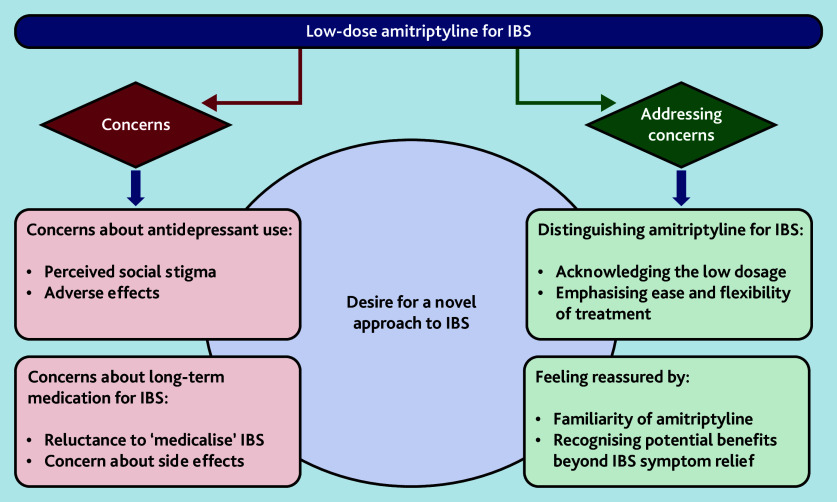
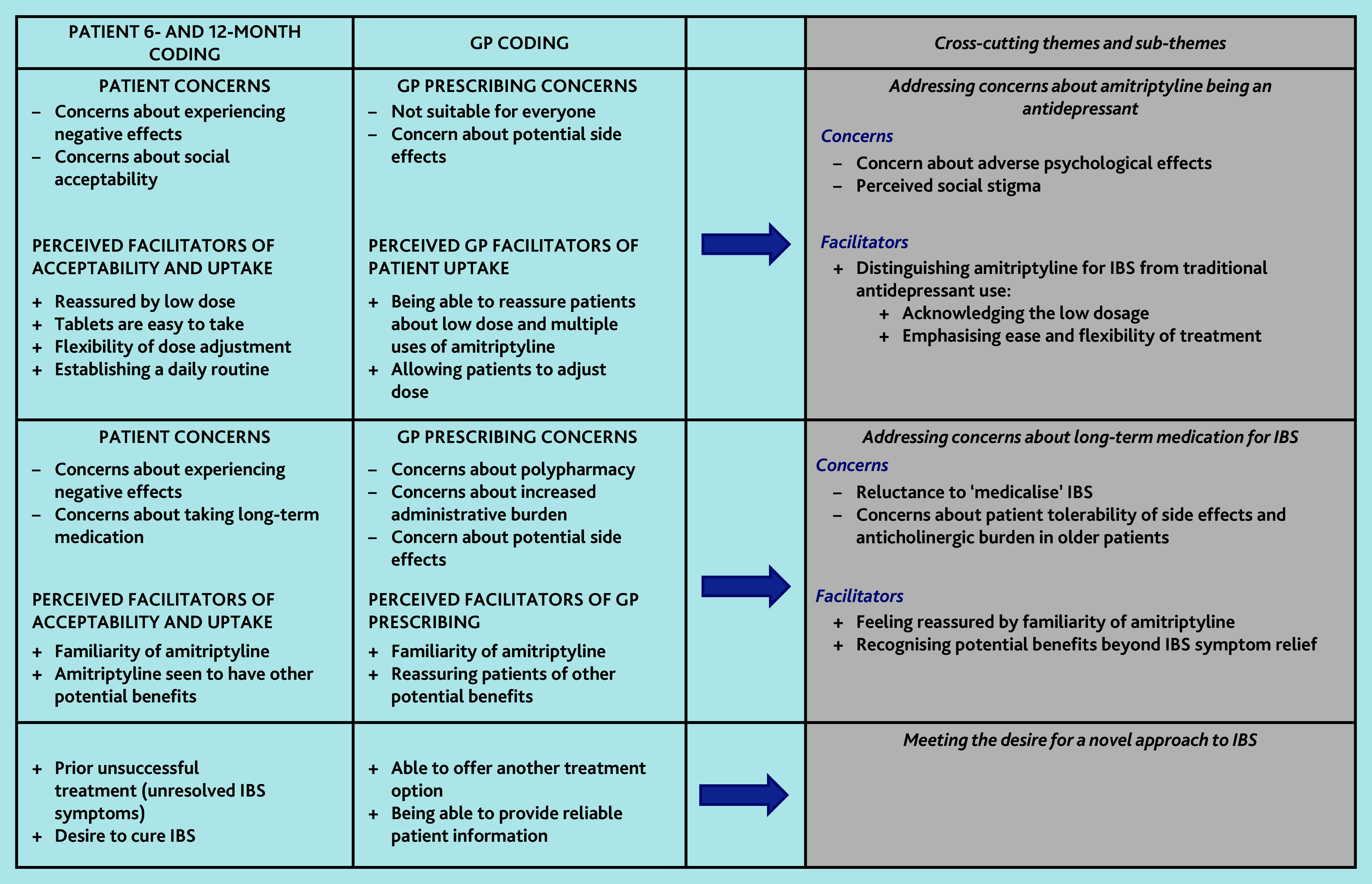
We found concerns about amitriptyline being an antidepressant, medicalising IBS, and side effects. Perceived benefits included the low and flexible dose, ease of treatment, and familiarity of amitriptyline and its potential to offer benefits beyond IBS symptom relief. These concerns and perceived benefits were expressed in the context of desire for a novel approach to IBS: GPs were keen to offer more options for IBS and patients sought a cure for their symptoms.
Patients and GPs felt that the potential benefits of trying low-dose amitriptyline for IBS outweighed their concerns. When offering low-dose amitriptyline for IBS, GPs could address patient concerns about taking an antidepressant for IBS, highlighting the low and flexible dosage, and other potential benefits of amitriptyline such as improved sleep.
肠易激综合征(IBS)可引发令人困扰的症状,影响患者生活质量,并导致大量医疗服务资源的使用。指南建议将低剂量阿米替林作为IBS的二线治疗药物,但在初级医疗中很少被处方。
探讨患者和全科医生(GP)对使用低剂量阿米替林治疗IBS的看法和经验。
在英国对患者和全科医生进行定性访谈研究,该研究嵌套于低剂量阿米替林与安慰剂对照的ATLANTIS试验(ISRCTN48075063)中。
在随机分组后6个月对42名患者进行半结构式电话访谈,在随机分组后12个月对19名患者再次进行访谈,并在2020年4月至2022年3月期间对16名全科医生进行访谈。采用反思性主题分析分别对患者和全科医生的数据进行分析,然后综合分析,以确定独特和贯穿各方面的主题。
我们发现了对阿米替林作为抗抑郁药、将IBS医学化以及副作用的担忧。感知到的益处包括剂量低且灵活、治疗简便,以及对阿米替林的熟悉度及其可能带来的超出缓解IBS症状的益处。这些担忧和感知到的益处在对IBS新治疗方法的渴望背景下被表达出来:全科医生热衷于为IBS提供更多选择,而患者寻求治愈其症状的方法。
患者和全科医生认为,尝试使用低剂量阿米替林治疗IBS的潜在益处超过了他们的担忧。当为IBS患者提供低剂量阿米替林时,全科医生可以解决患者对服用抗抑郁药治疗IBS的担忧,强调剂量低且灵活,以及阿米替林的其他潜在益处,如改善睡眠。