Laar Godfred Kiteinkwa, Mwinbeku Justine, Pappoe Ebenezer Allotey, Obike Emmanuella, Ankomah Elizabeth, Baidoo Belinda, Morrison Diana Baaba, Boachie Joseph, Adu Patrick
Department of Medical Laboratory Sciences, School of Allied Health Sciences, University of Cape Coast, Cape Coast, Ghana.
Arch Public Health. 2024 Aug 27;82(1):138. doi: 10.1186/s13690-024-01379-1.
Sickle cell disease (SCD) is a common monogenic inheritable condition in sub-Saharan Africa. 30% of Ghanaians are estimated to be carriers creating a condition for stable SCD penetrance. Being inheritable, SCD is scientifically preventable through intentional spousal selection. This study therefore explored young adults' knowledge, beliefs and prevention strategies regarding SCD.
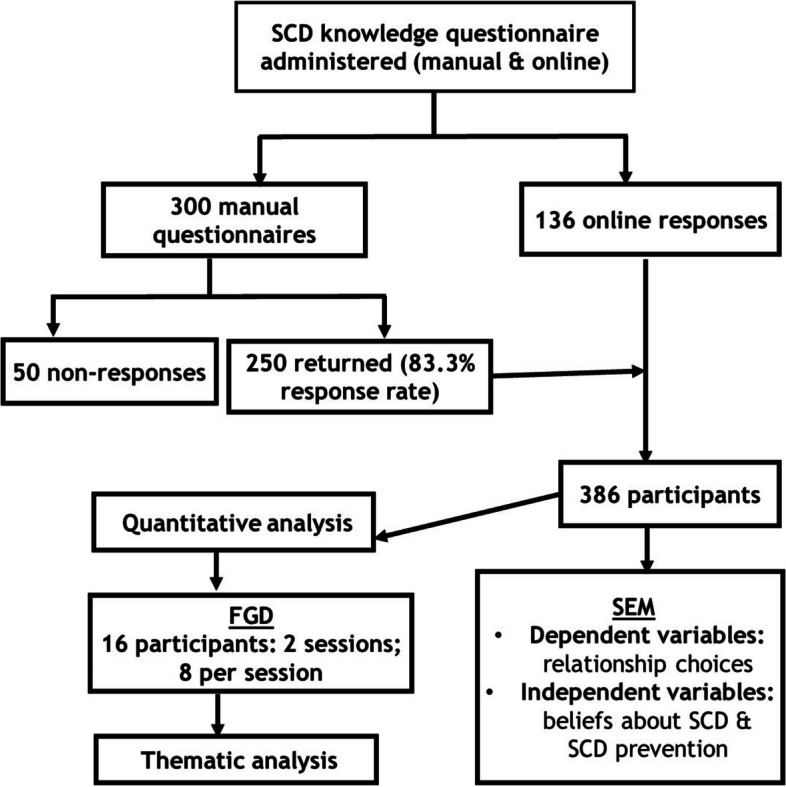
This exploratory study employed a mixed-methods approach (semi-structured questionnaires and focus group discussion [FGD]) to explore the SCD knowledge and beliefs of participants (15-49 years). The data collection was intentionally sequential; initial administration of 386 questionnaires and then followed by the FGD (16 participants). FGD was thematically analysed whereas quantitative data was explored using structural equation modeling (SEM); p < 0.05 was considered statistically significant under two-tailed assumptions.
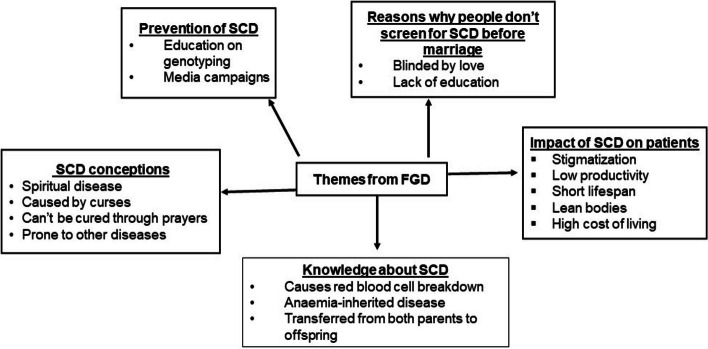
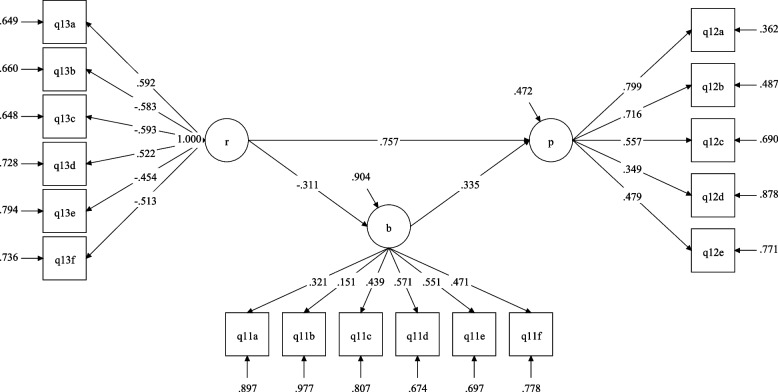
Whereas 98.7% reported having heard about SCD, < 50% got the information through formal education. Overall, 49.7% knew their respective SCD status; the proportion increased with age (48.8% in < 30 years vs 64.4% in ≥ 30 years old), or higher degree status (48.8% in undergraduates vs 67.4% in postgraduates). Moreover, whereas nine-in-ten correctly identified that SCD is hereditable, three-in-ten believed that having a SCD child was a matter of fate. Our FGD revealed that whereas curses, and spiritual attack were misconceived as potential causes of SCD, stigmatization associated with SCD was a major concern. The SEM demonstrated that one's knowledge about SCD prevention is significantly positively associated with relationship choices (b = 0.757, p < 0.05). Also, a participant's knowledge about SCD preventive strategies was significantly associated with the individual's beliefs about SCD (b = 0.335; p < 0.05). However, a participant's SCD beliefs negatively mediated SCD preventive strategies-relationship choices association.
SCD beliefs likely transform linear quantitative associations into a complex non-linear interaction; public health campaigns ought to unearth and address SCD beliefs to maximize achieving the intended targets.
镰状细胞病(SCD)是撒哈拉以南非洲常见的单基因遗传性疾病。据估计,30%的加纳人是携带者,为SCD的稳定发病率创造了条件。由于SCD是可遗传的,从科学上讲,通过有意选择配偶可以预防。因此,本研究探讨了年轻人对SCD的知识、信念和预防策略。
本探索性研究采用混合方法(半结构化问卷和焦点小组讨论[FGD])来探究参与者(15 - 49岁)对SCD的知识和信念。数据收集有意采用顺序法;最初发放386份问卷,然后进行焦点小组讨论(16名参与者)。对焦点小组讨论进行主题分析,而定量数据则使用结构方程模型(SEM)进行探究;在双尾假设下,p < 0.05被认为具有统计学意义。
虽然98.7%的人报告听说过SCD,但不到50%的人是通过正规教育获得该信息的。总体而言,49.7%的人知道自己的SCD状态;这一比例随年龄增长而增加(30岁以下为48.8%,30岁及以上为64.4%),或随学历提高而增加(本科生为48.8%,研究生为67.4%)。此外,虽然十分之九的人正确认识到SCD是可遗传的,但十分之三的人认为生患SCD的孩子是命运问题。我们的焦点小组讨论显示,虽然诅咒和精神攻击被误解为SCD的潜在原因,但与SCD相关的污名化是一个主要问题。结构方程模型表明,一个人对SCD预防的知识与关系选择显著正相关(b = 0.757,p < 0.05)。此外,参与者对SCD预防策略的知识与个人对SCD的信念显著相关(b = 0.335;p < 0.05)。然而,参与者的SCD信念对SCD预防策略与关系选择之间的关联起负向中介作用。
SCD信念可能将线性定量关联转变为复杂的非线性相互作用;公共卫生运动应挖掘并解决SCD信念问题,以最大程度实现预期目标。