Chanpura Aditya, Gupta Rajesh K, Sriwastava Shitiz K, Rahmig Jan
Department of Neurology, State University of New York Downstate Health Sciences University, Brooklyn, NY, USA.
Division of Multiple Sclerosis and Neuroimmunology, Department of Neurology, University of Texas Health Science Center at Houston, Houston, TX, USA.
J Cent Nerv Syst Dis. 2024 Aug 26;16:11795735241274186. doi: 10.1177/11795735241274186. eCollection 2024.
Neurosarcoidosis is an inflammatory granulomatous disease. Up to 25% of occult sarcoidosis affecting the nervous system are only detected by autopsy. In addition, in recent years the suspicion arose that the soluble Interleukin-2 Receptor (sIL-2R) might be useful in differentiating between neurosarcoidosis and neurosarcoidosis-like diseases such as neurotuberculosis, multiple sclerosis, or cerebral lymphoma.
Therefore, we aimed to systematically review randomized controlled trials (RCT), observational studies, and case-control studies evaluating sIL-2R levels in neurosarcoidosis patients.
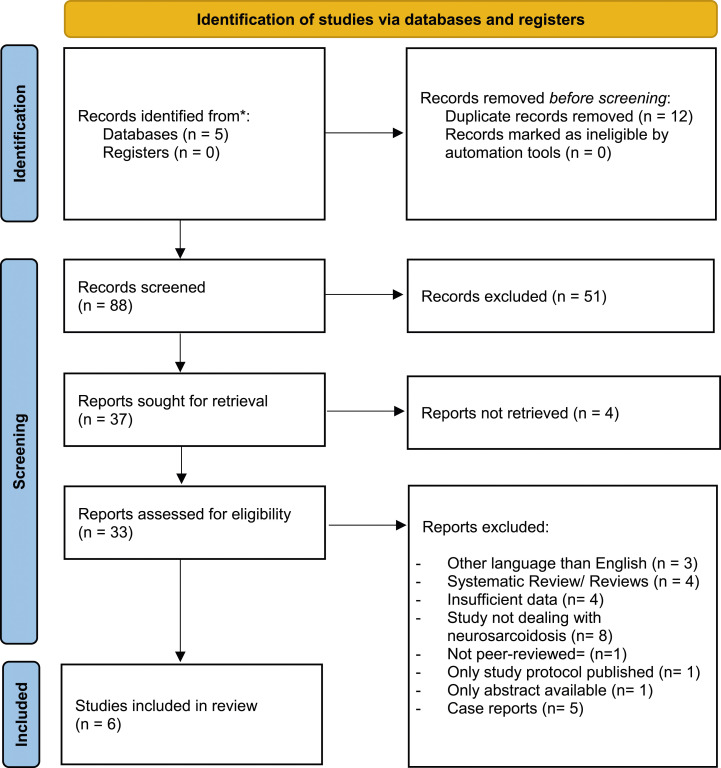
For this systematic review, a comprehensive literature search of electronic databases including EMBASE, The Web Of Science, The Cochrane Library, MEDLINE, and Google Scholar was conducted. The search was limited to the English language and publication date up to January 08 2024.
As part of the search strategy conducted, 6 articles met the inclusion criteria. Two independent reviewers extracted the relevant data from each article. In addition, 2 independent reviewers assessed the quality of each study using the Newcastle-Ottawa Scale (NOS).
We included 6 studies comprising 98 patients suffering from neurosarcoidosis, 525 non-sarcoidosis patients, and 118 healthy controls. Included studies were published between 2010 and 2023. Cerebrospinal fluid (CSF) sIL-2R levels differed significantly between neurosarcoidosis patients and multiple sclerosis, vasculitis, and healthy controls whereas serum sIL-2R levels did not reveal sufficient discriminative power. sIL-2R index was able to discriminate neurosarcoidosis from neurotuberculosis, bacterial/viral meningitis, and healthy controls.
In this systematic review, we found indications that sIL-2R may be a useful biomarker for the diagnosis of neurosarcoidosis. To determine an additional diagnostic value of sIL-2R, large prospective studies are needed that not only examine absolute sIL-2R levels in serum or CSF but also the dynamic changes as well as the implications of renal function on sIL-2R levels.
神经结节病是一种炎症性肉芽肿疾病。高达25%累及神经系统的隐匿性结节病仅在尸检时才被发现。此外,近年来人们怀疑可溶性白细胞介素-2受体(sIL-2R)可能有助于区分神经结节病与神经结节病样疾病,如神经结核、多发性硬化症或脑淋巴瘤。
因此,我们旨在系统评价评估神经结节病患者sIL-2R水平的随机对照试验(RCT)、观察性研究和病例对照研究。
对于这项系统评价,我们对包括EMBASE、科学网、考克兰图书馆、MEDLINE和谷歌学术在内的电子数据库进行了全面的文献检索。检索限于英文文献和截至2024年1月8日的发表日期。
作为检索策略的一部分,6篇文章符合纳入标准。两名独立的评审员从每篇文章中提取相关数据。此外,两名独立的评审员使用纽卡斯尔-渥太华量表(NOS)评估每项研究的质量。
我们纳入了6项研究,包括98例神经结节病患者、525例非结节病患者和118例健康对照。纳入的研究发表于2010年至2023年之间。神经结节病患者与多发性硬化症、血管炎患者及健康对照之间脑脊液(CSF)sIL-2R水平存在显著差异,而血清sIL-2R水平没有显示出足够的鉴别能力。sIL-2R指数能够区分神经结节病与神经结核、细菌性/病毒性脑膜炎及健康对照。
在这项系统评价中,我们发现有迹象表明sIL-2R可能是诊断神经结节病的有用生物标志物。为了确定sIL-2R的额外诊断价值,需要进行大型前瞻性研究,不仅要检测血清或脑脊液中的绝对sIL-2R水平,还要检测其动态变化以及肾功能对sIL-2R水平的影响。