Yim Chi-Ming, Allan Michael, Pang Chi Lun, Thornton Geoff
Department of Chemistry and London Centre for Nanotechnology, University College London, 20 Gordon Street, London WC1H 0AJ, U.K.
Tsung Dao Lee Institute and School of Physics and Astronomy, Shanghai Jiao Tong University, 1 Lisuo Road, Shanghai 201210, China.
J Phys Chem C Nanomater Interfaces. 2024 Aug 8;128(33):14100-14106. doi: 10.1021/acs.jpcc.4c03751. eCollection 2024 Aug 22.
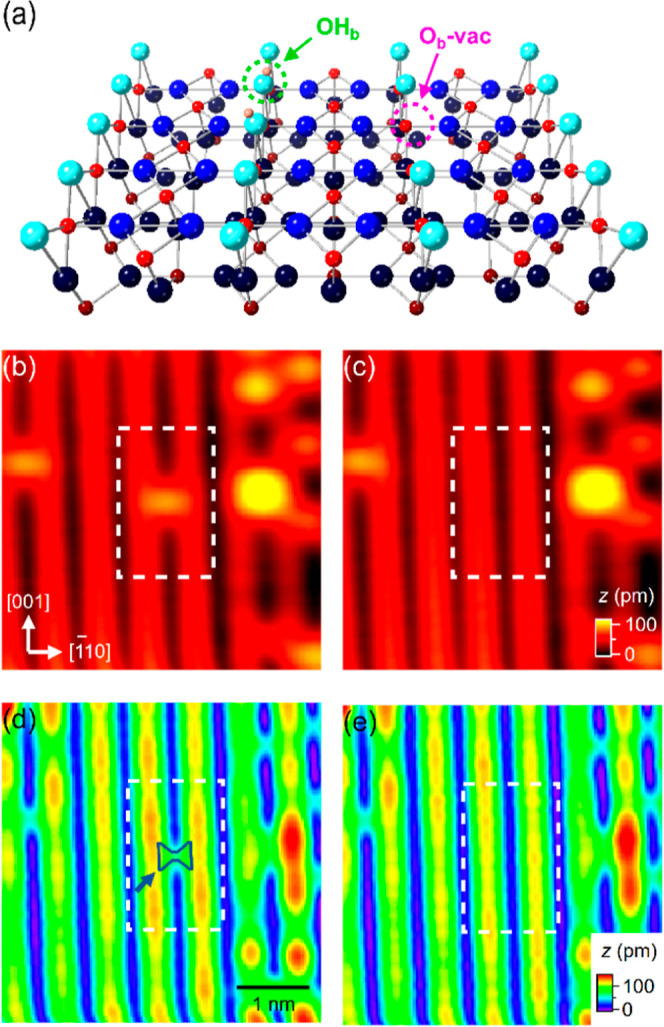
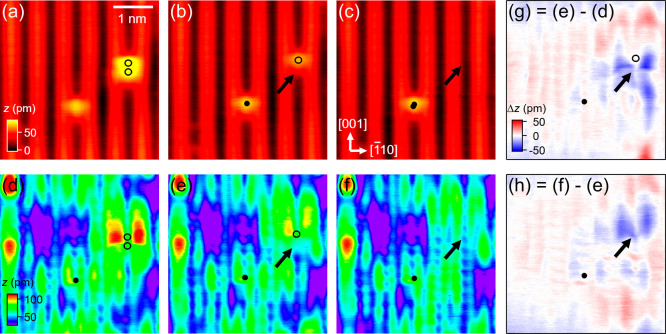
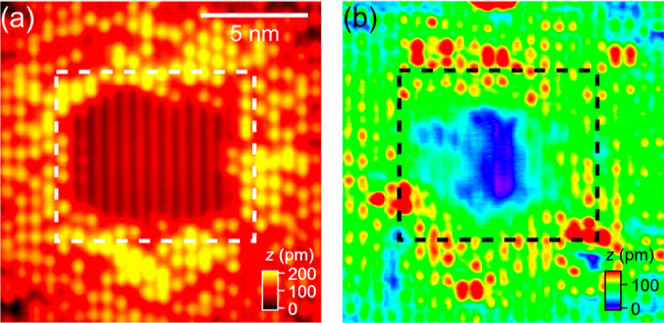
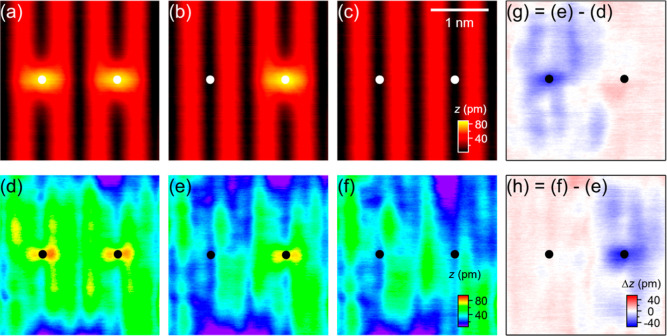
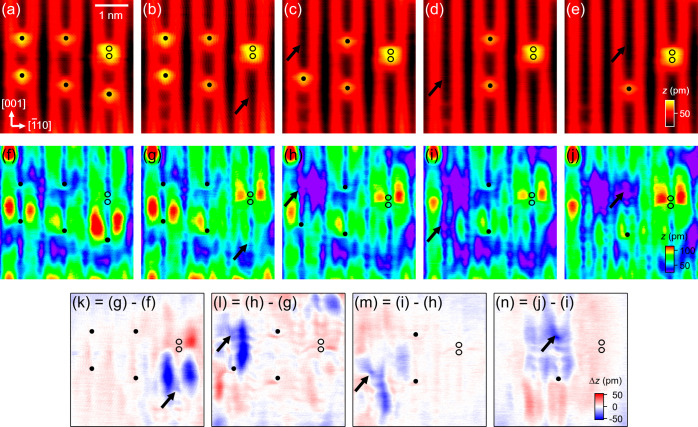
Using scanning tunneling microscopy (STM), we investigate the spatial distribution of the bridging hydroxyl (OH) bound excess electrons on the rutile TiO(110) surface and its temperature dependence. By performing simultaneously recorded empty and filled state imaging on single OHs at different temperatures in STM, we determine that the spatial distribution of the OH bound excess electrons retains a symmetric four-lobe structure around the OH at both 78 and 7 K. This indicates that OHs are much weaker charge traps compared to bridging O vacancies (O-vac). In addition, by sequentially removing the capping H of each OH using voltage pulses, we find that the annihilation of each OH is accompanied by the disappearance of some lobes in the filled state STM, thus verifying the direct correlation between OHs and their excess electrons.
利用扫描隧道显微镜(STM),我们研究了金红石型TiO(110)表面桥连羟基(OH)所束缚的过量电子的空间分布及其温度依赖性。通过在STM中于不同温度下对单个OH同时进行空态和满态成像记录,我们确定在78 K和7 K时,OH所束缚的过量电子的空间分布在OH周围均保持对称的四叶结构。这表明与桥连氧空位(O-vac)相比,OH是弱得多的电荷陷阱。此外,通过使用电压脉冲依次去除每个OH的封端H,我们发现每个OH的湮灭伴随着满态STM中一些叶瓣的消失,从而证实了OH与其过量电子之间的直接关联。