COVID-19 Response Team, Centers for Disease Control and Prevention, Atlanta, Georgia, USA.
ICF, Agency for Toxic Substances and Disease Registry, Atlanta, Georgia, USA.
Microbiol Spectr. 2024 Oct 3;12(10):e0069124. doi: 10.1128/spectrum.00691-24. Epub 2024 Aug 28.
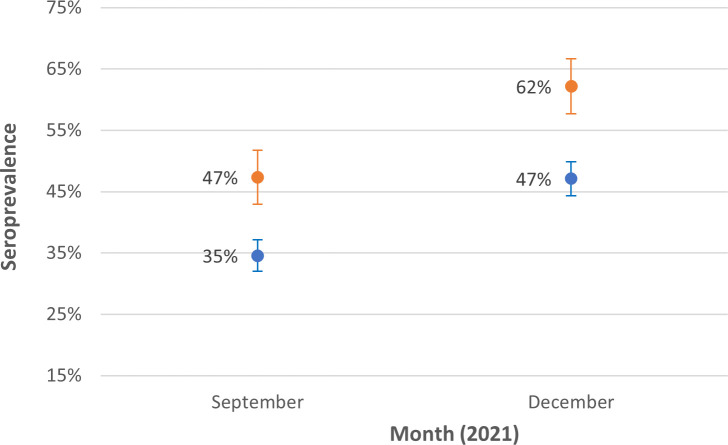
During September to December 2021, school mask policies to mitigate SARS-CoV-2 transmission varied throughout the US. We compared infection-induced seroprevalence estimates and estimated seroconversion among children residing in areas with and without school mask requirements. We estimated infection-induced seroprevalence among children in three age groups (5-17, 5-11, and 12-17 years) in areas with and without school district mask requirements for two time points: September 1-30, 2021 and December 15, 2021 to January 14, 2022. Robust Poisson regression models estimated population seroconversion over the semester among initially seronegative children. Permutation tests assessed for significant differences in the estimated population seroconversion due to incident infections by school district mask policy. Residing in an area with no school mask requirement was associated with higher infection-induced seroprevalence among children aged 5-17 years (adjusted prevalence ratio [aPR] = 1.18, 95% confidence interval [CI]: 1.10, 1.26), and those aged 5-11 years (aPR) = 1.21, 95% CI: 1.10, 1.32) and those aged 12-17 years (aPR = 1.16, 95% CI: 1.07, 1.26), compared with areas requiring masks in school. Estimated population seroconversion during the semester was also significantly higher among children in districts without mask policies than those with school mask requirements among all age groups (5-17 years: 23.7% vs 18.1%, < 0.001; 5-11 years: 6.4% vs 4.5%, = 0.002;12-17 years: 27.2% vs 21.0%, < 0.001). During the U.S. Fall 2021 semester, areas with school mask requirements had lower infection-induced seroprevalence and an estimated lower proportion of seroconversion due to incident infection among school-aged children compared with areas without school mask requirements; causality cannot necessarily be inferred from these associations.
During the U.S. Fall 2021 school semester, the estimated proportion of previously uninfected school-aged children who experienced a first infection with SARS-CoV-2 was lower in areas where public school district policies required masks for all staff and students compared with areas where the school districts had no mask requirements. Because children are more likely than adults to experience asymptomatic or mild SARS-CoV-2 infections, the presence of infection-induced antibodies is a more accurate measure of infection history than clinical testing. The proportion of children with these antibodies (i.e., seroprevalence) can improve our understanding of SARS-CoV-2 by detecting more infections and eliminating potential bias due to local testing and reporting practices. Enhanced robustness of surveillance for respiratory infections in children, including records of mitigation policies in communities and schools, as well as seroprevalence data, would establish a better evidence base for policy decisions and response measures during future respiratory outbreaks.
在 2021 年 9 月至 12 月期间,美国各地的学校口罩政策各不相同,以减轻 SARS-CoV-2 的传播。我们比较了有和没有学校口罩要求的地区儿童中感染诱导的血清阳性率估计值和估计的血清转化率。我们估计了三个年龄组(5-17 岁、5-11 岁和 12-17 岁)的儿童在有和没有学区口罩要求的地区在两个时间点的感染诱导血清阳性率:2021 年 9 月 1 日至 30 日和 2021 年 12 月 15 日至 2022 年 1 月 14 日。稳健泊松回归模型估计了最初血清阴性儿童在学期内的人群血清转化率。置换检验评估了因学区口罩政策而导致的感染事件引起的人群血清转化率的显著差异。
在有和没有学校口罩要求的地区,与有口罩要求的地区相比,5-17 岁(调整后的患病率比[aPR] = 1.18,95%置信区间[CI]:1.10,1.26)、5-11 岁(aPR = 1.21,95%CI:1.10,1.32)和 12-17 岁(aPR = 1.16,95%CI:1.07,1.26)儿童的感染诱导血清阳性率更高,表明没有口罩要求的地区感染率更高。在所有年龄组中,没有口罩政策的地区的儿童在学期内的估计人群血清转化率也明显高于有学校口罩要求的地区(5-17 岁:23.7%比 18.1%,<0.001;5-11 岁:6.4%比 4.5%,=0.002;12-17 岁:27.2%比 21.0%,<0.001)。
在 2021 年美国秋季学期期间,与没有学校口罩要求的地区相比,有学校口罩要求的地区的感染诱导血清阳性率和估计的因感染而发生血清转化率较低。在这些地区,所有工作人员和学生都需要戴口罩。由于儿童比成年人更容易发生无症状或轻度 SARS-CoV-2 感染,因此感染诱导抗体的存在是感染史的更准确衡量标准,而不是临床检测。这些抗体(即血清阳性率)的儿童比例可以通过检测更多的感染来提高我们对 SARS-CoV-2 的认识,并消除由于当地检测和报告实践而导致的潜在偏差。在未来的呼吸道传染病爆发期间,加强对儿童呼吸道感染的监测,包括记录社区和学校的缓解政策以及血清阳性率数据,将为政策决策和应对措施提供更好的证据基础。