Wang Shuyuan, Bashir Zubair, Chen Edward W, Kadiyala Vishnu, Sherrod Charles F, Has Phinnara, Song Christopher, Ventetuolo Corey E, Simmons James, Haines Philip
Department of Cardiology, First Affiliated Hospital of Nanjing Medical University, Nanjing 210029, China.
Department of Ultrasound Medicine, Union Hospital, Tongji Medical College, Huazhong University of Science and Technology, Wuhan 430022, China.
J Cardiovasc Dev Dis. 2024 Aug 9;11(8):246. doi: 10.3390/jcdd11080246.
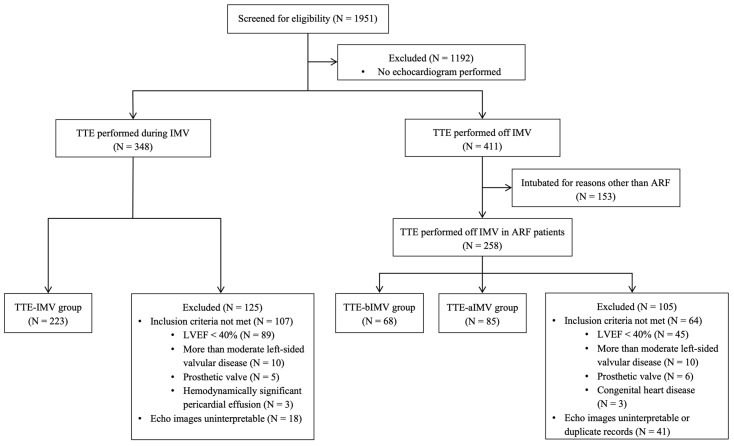
Right ventricular (RV) dysfunction is associated with poor prognosis in acute respiratory failure (ARF). Our study evaluates the efficacy of RV strain in detecting RV dysfunction in ARF patients requiring invasive mechanical ventilation (IMV) compared to tricuspid annular plane systolic excursion (TAPSE). In this retrospective study involving 376 patients diagnosed with ARF and requiring IMV, we extracted clinical and outcome data from patient records. RV global longitudinal strain (RVGLS), free wall longitudinal strain (FWLS), and TAPSE were measured retrospectively using speckle tracking echocardiography (STE) and traditional echocardiography, respectively. We divided the cohort into three groups: TTE during IMV (TTE-IMV, 223 patients), before IMV (TTE-bIMV, 68 patients), and after IMV (TTE-aIMV, 85 patients). Multivariable regression analysis, adjusted for covariates, revealed significantly higher RVGLS and FWLS in the groups not on IMV at the time of TTE compared to the TTE-IMV group. Specifically, the TTE-bIMV group showed higher RVGLS (β = 7.28, 95% CI 5.07, 9.48) and FWLS (β = 5.83, 95% CI 3.36, 8.31), while the TTE-aIMV group exhibited higher RVGLS (β = 9.39, 95% CI 6.10, 12.69) and FWLS (β = 7.54, 95% CI 4.83, 10.24). TAPSE did not reveal any significant differences across the groups. Our study suggests an association between IMV and lower RVGLS and FWLS in ARF patients, indicating that IMV itself may contribute to RV dysfunction. RVGLS and FWLS appear to be more sensitive than TAPSE in detecting changes in RV function that were previously subclinical in patients on IMV. Prospective studies with TTE before, during, and after IMV are necessary to assess the primary driver of RV dysfunction and to prognosticate STE-detected RV dysfunction in this population.
右心室(RV)功能障碍与急性呼吸衰竭(ARF)的不良预后相关。我们的研究评估了与三尖瓣环平面收缩期位移(TAPSE)相比,RV应变在检测需要有创机械通气(IMV)的ARF患者右心室功能障碍方面的有效性。在这项涉及376例诊断为ARF且需要IMV的患者的回顾性研究中,我们从患者记录中提取了临床和结局数据。分别使用斑点追踪超声心动图(STE)和传统超声心动图回顾性测量RV整体纵向应变(RVGLS)、游离壁纵向应变(FWLS)和TAPSE。我们将队列分为三组:IMV期间的经胸超声心动图(TTE-IMV,223例患者)、IMV前(TTE-bIMV,68例患者)和IMV后(TTE-aIMV,85例患者)。在对协变量进行调整的多变量回归分析中,与TTE-IMV组相比,在TTE时未进行IMV的组中RVGLS和FWLS显著更高。具体而言,TTE-bIMV组显示出更高的RVGLS(β = 7.28,95%CI 5.07,9.48)和FWLS(β = 5.83,95%CI 3.36,8.31),而TTE-aIMV组表现出更高的RVGLS(β = 9.39,95%CI 6.10,12.69)和FWLS(β = 7.54,95%CI 4.83,10.24)。TAPSE在各组之间未显示出任何显著差异。我们的研究表明,IMV与ARF患者较低的RVGLS和FWLS之间存在关联,这表明IMV本身可能导致右心室功能障碍。在检测IMV患者先前亚临床的右心室功能变化方面,RVGLS和FWLS似乎比TAPSE更敏感。有必要进行IMV前、期间和后的TTE前瞻性研究,以评估右心室功能障碍的主要驱动因素,并对该人群中STE检测到的右心室功能障碍进行预后评估。