Lin Ruixuan, Zhang Jack Jiaqi, Zhong Lingling, Chan Sofina S Y, Kwong Patrick W H, Lorentz Lukas, Shaikh Usman Jawed, Lam Tommy L H, Mehler David M A, Fong Kenneth N K
Department of Rehabilitation Sciences, The Hong Kong Polytechnic University, Hung Hom, Hong Kong SAR, China.
Division of Clinical Cognitive Sciences, Department of Neurology, University Hospital RWTH Aachen, Aachen, Germany.
J Neurol. 2024 Oct;271(10):6494-6507. doi: 10.1007/s00415-024-12612-w. Epub 2024 Aug 28.
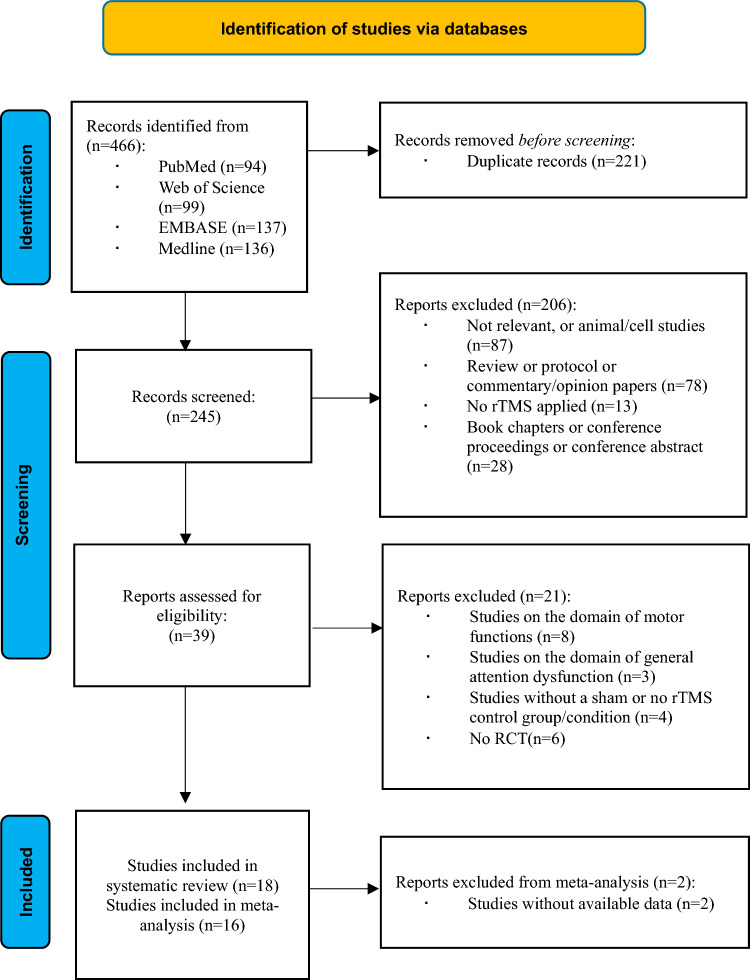
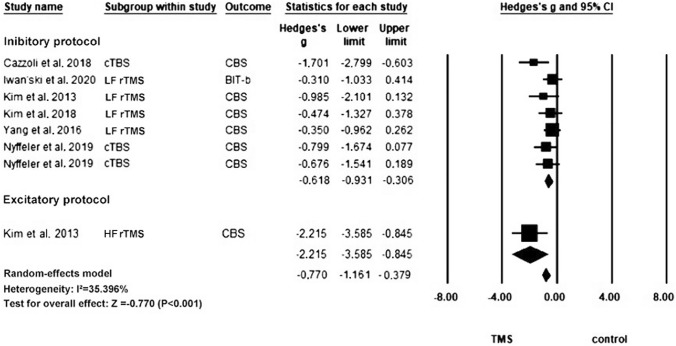
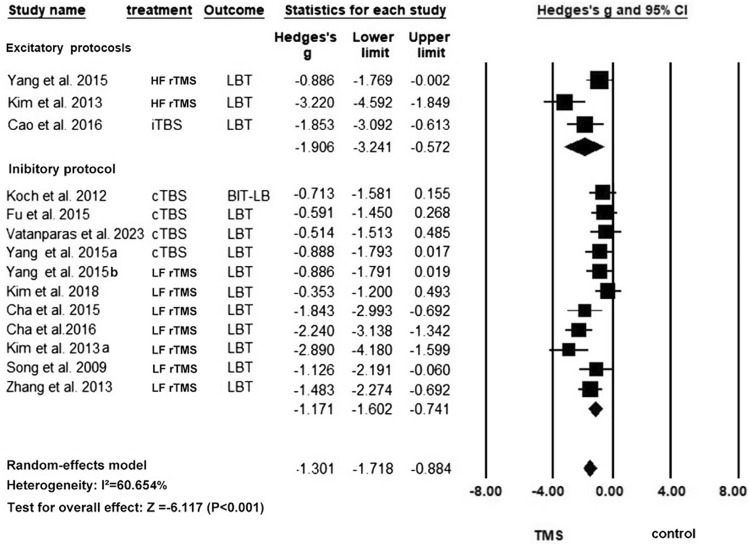
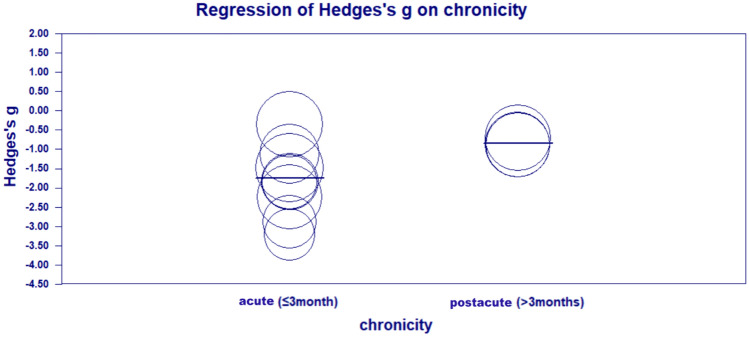
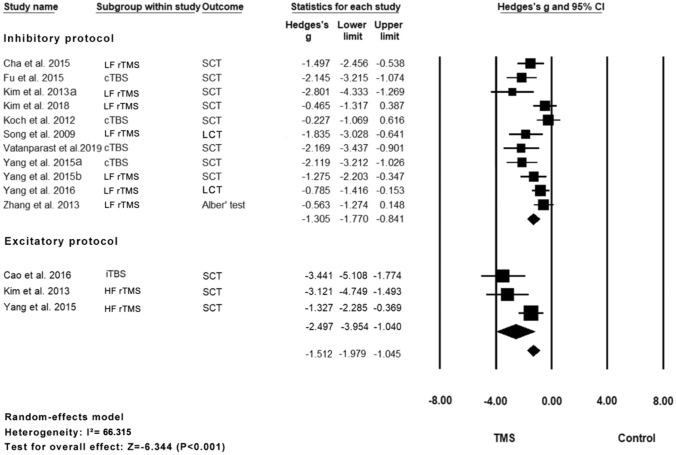
This review aimed to assess the effect of repetitive transcranial magnetic stimulation (rTMS) in improving post-stroke unilateral spatial neglect (USN) using a meta-analysis. Further, we aimed to identify any association between rTMS parameters, patient demographics, and treatment effect sizes using subgroup analyses and meta-regression. A literature search was conducted through four databases from inception to March 6, 2024, to retrieve all relevant controlled trials investigating the effects of rTMS on symptoms of USN in post-stroke patients. Overall, rTMS significantly improved post-stroke USN, as measured by the line bisection test (Hedges' g = - 1.301, p < 0.0001), the cancelation test (Hedge's g = - 1.512, p < 0.0001), and the Catherine Bergego Scale (Hedges'g = - 0.770, p < 0.0001), compared to sham stimulation. Subgroup analysis found that generally larger effect sizes following excitatory rTMS across several outcome measures, indicating that excitatory rTMS on the ipsilesional hemisphere may be more effective than inhibitory rTMS on the contralesional hemisphere in ameliorating neglect symptoms. Meta-regression analysis of the line bisection test showed a significant difference in the chronicity of stroke patients, suggesting that rTMS may be more effective for USN in patients at the acute stage (within 3 months since stroke) than in those at the post-acute stage (p = 0.035). In conclusion, rTMS appears to be effective in promoting recovery from post-stroke USN. Excitatory protocols and early intervention may enhance recovery outcomes for neglect behaviors in post-stroke survivors.
本综述旨在通过荟萃分析评估重复经颅磁刺激(rTMS)对改善中风后单侧空间忽视(USN)的效果。此外,我们旨在通过亚组分析和元回归确定rTMS参数、患者人口统计学特征与治疗效应大小之间的任何关联。从数据库建立至2024年3月6日,通过四个数据库进行文献检索,以检索所有研究rTMS对中风后患者USN症状影响的相关对照试验。总体而言,与假刺激相比,rTMS显著改善了中风后的USN,这通过直线二等分试验(Hedges' g = - 1.301,p < 0.0001)、划消试验(Hedge's g = - 1.512,p < 0.0001)和凯瑟琳·贝热戈量表(Hedges' g = - 0.770,p < 0.0001)得以衡量。亚组分析发现,在多项结局指标上,兴奋性rTMS后的效应大小通常更大,这表明在改善忽视症状方面,对患侧半球进行兴奋性rTMS可能比对健侧半球进行抑制性rTMS更有效。直线二等分试验的元回归分析显示,中风患者的病程存在显著差异,这表明rTMS对急性期(中风后3个月内)患者的USN可能比对亚急性期患者更有效(p = 0.035)。总之,rTMS似乎对促进中风后USN的恢复有效。兴奋性方案和早期干预可能会提高中风幸存者忽视行为的恢复效果。