Division of Pediatric Rheumatology, Department of Pediatrics, University Hospitals Leuven, Leuven, Belgium.
Pôle de Pathologies Rhumatismales Systémiques Et Inflammatoires, Institut de Recherche Expérimentale Et Clinique, Université Catholique de Louvain, Brussels, Belgium.
J Clin Immunol. 2024 Aug 28;44(8):185. doi: 10.1007/s10875-024-01788-5.
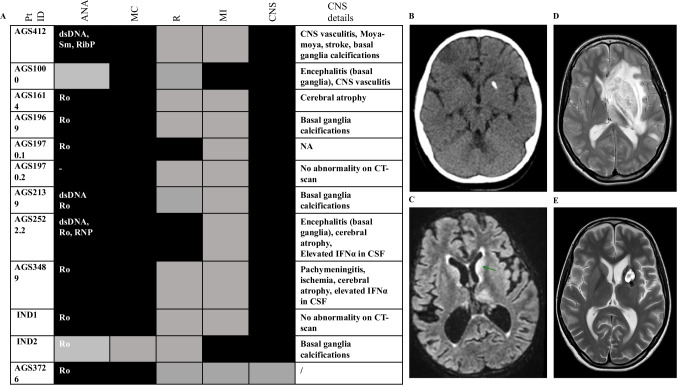
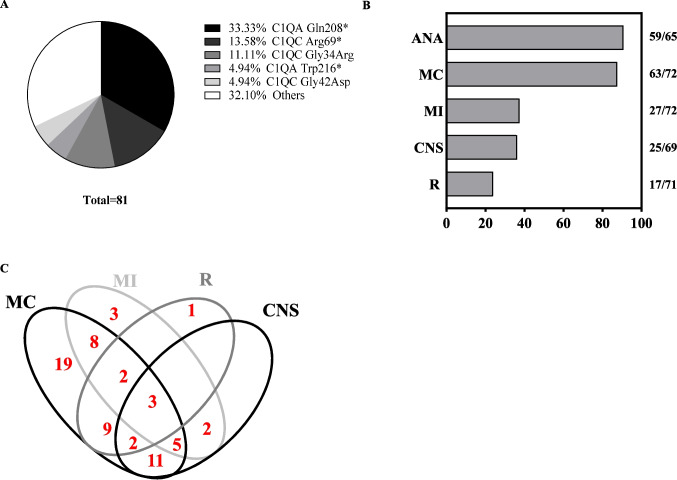
Hereditary C1q deficiency (C1QDef) is a rare monogenic disorder leading to defective complement pathway activation and systemic lupus erythematosus (SLE)-like manifestations. The link between impairment of the complement cascade and autoimmunity remains incompletely understood. Here, we assessed type 1 interferon pathway activation in patients with C1QDef. Twelve patients with genetically confirmed C1QDef were recruited through an international collaboration. Clinical, biological and radiological data were collected retrospectively. The expression of a standardized panel of interferon stimulated genes (ISGs) in peripheral blood was measured, and the level of interferon alpha (IFNα) protein in cerebrospinal fluid (CSF) determined using SIMOA technology. Central nervous system (encompassing basal ganglia calcification, encephalitis, vasculitis, chronic pachymeningitis), mucocutaneous and renal involvement were present, respectively, in 10, 11 and 2 of 12 patients, and severe infections recorded in 2/12 patients. Elevated ISG expression was observed in all patients tested (n = 10/10), and serum and CSF IFNα elevated in 2/2 patients. Three patients were treated with Janus-kinase inhibitors (JAKi), with variable outcome; one displaying an apparently favourable response in respect of cutaneous and neurological features, and two others experiencing persistent disease despite JAKi therapy. To our knowledge, we report the largest original series of genetically confirmed C1QDef yet described. Additionally, we present a review of all previously described genetically confirmed cases of C1QDef. Overall, individuals with C1QDef demonstrate many characteristics of recognized monogenic interferonopathies: particularly, cutaneous involvement (malar rash, acral vasculitic/papular rash, chilblains), SLE-like disease, basal ganglia calcification, increased expression of ISGs in peripheral blood, and elevated levels of CSF IFNα.
遗传性 C1q 缺陷症(C1QDef)是一种罕见的单基因疾病,导致补体途径激活缺陷和系统性红斑狼疮(SLE)样表现。补体级联反应受损与自身免疫之间的联系仍不完全清楚。在这里,我们评估了 C1QDef 患者的 1 型干扰素途径激活情况。通过国际合作招募了 12 名经基因证实的 C1QDef 患者。回顾性收集临床、生物学和放射学数据。测量外周血中标准化干扰素刺激基因(ISG)表达谱,并使用 SIMOA 技术测定脑脊液(CSF)中干扰素α(IFNα)蛋白水平。12 例患者中分别有 10 例存在中枢神经系统(包括基底节钙化、脑炎、血管炎、慢性硬膜下炎)、黏膜皮肤和肾脏受累,2 例患者记录有严重感染。所有接受检测的患者(n=10/10)均观察到 ISG 表达升高,2/2 例患者血清和 CSF IFNα 升高。3 例患者接受了 Janus 激酶抑制剂(JAKi)治疗,疗效不一;1 例患者在皮肤和神经特征方面表现出明显的良好反应,而另外 2 例患者尽管接受了 JAKi 治疗,但仍持续存在疾病。据我们所知,我们报告了迄今为止最大的遗传性 C1QDef 原始系列。此外,我们还回顾了所有先前描述的遗传性 C1QDef 病例。总体而言,C1QDef 患者表现出许多公认的单基因干扰素病的特征:特别是皮肤受累(蝶形皮疹、肢端血管炎/丘疹性皮疹、冻疮样皮疹)、SLE 样疾病、基底节钙化、外周血 ISG 表达增加和 CSF IFNα 水平升高。