Department of Neuropsychiatry, Toho University School of Medicine, 6-11-1 Omori-nishi, Ota-ku, Tokyo, 143-8541, Japan.
Department of Psychiatry and Implementation Science, Toho University School of Medicine, 6-11-1 Omori-nishi, Ota-ku, Tokyo, 143-8541, Japan.
Brain Imaging Behav. 2024 Oct;18(5):1153-1162. doi: 10.1007/s11682-024-00906-6. Epub 2024 Aug 28.
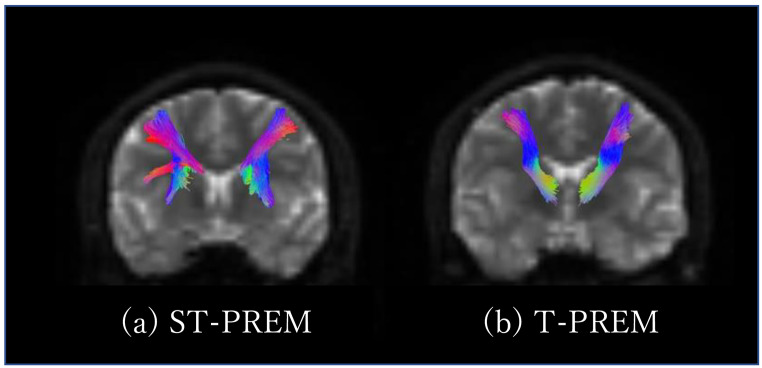
Frontal-striatal-thalamic circuit impairment is presumed to underlie schizophrenia. Individuals with attenuated psychosis syndrome (APS) show longitudinal volume reduction of the putamen in the striatum, which has a neural connection with the premotor cortex through the frontal-striatal-thalamic subcircuit. However, comprehensive investigations into the biological changes in the frontal-striatal-thalamic subcircuit originating from the premotor cortex in APS are lacking. We investigated differences in fractional anisotropy (FA) values between the striatum and premotor cortex (ST-PREM) and between the thalamus and premotor cortex (T-PREM) in individuals with APS and healthy controls, using a novel method TractSeg. Our study comprised 36 individuals with APS and 38 healthy controls. There was a significant difference between the control and APS groups in the right T-PREM (odds ratio = 1.76, p = 0.02). Other factors, such as age, sex, other values of FA, and antipsychotic medication, were not associated with differences between groups. However, while FA value reduction of ST-PREM and T-PREM in schizophrenia has been previously reported, in the present study on APS, the alteration of the FA value was limited to T-PREM in APS. This finding suggests that ST-PREM impairment is not predominant in APS but emerges in schizophrenia. Impairment of the neural network originating from the premotor cortex can lead to catatonia and aberrant mirror neuron networks that are presumed to provoke various psychotic symptoms of schizophrenia. Our findings highlight the potential role of changes in a segment of the frontal-thalamic pathway derived from the premotor cortex as a biological basis of APS.
前额叶-纹状体-丘脑回路损伤被认为是精神分裂症的基础。有精神病前驱症状(APS)的个体在前纹状体的壳核中表现出纵向体积减少,壳核通过前额叶-纹状体-丘脑亚回路与运动前皮质有神经连接。然而,对于 APS 中起源于运动前皮质的前额叶-纹状体-丘脑亚回路的生物学变化,缺乏全面的研究。我们使用一种新的方法 TractSeg 研究了 APS 个体与健康对照组之间纹状体和运动前皮质(ST-PREM)以及丘脑和运动前皮质(T-PREM)之间的各向异性分数(FA)值的差异。我们的研究包括 36 名 APS 个体和 38 名健康对照者。对照组和 APS 组在右侧 T-PREM 之间存在显著差异(比值比=1.76,p=0.02)。其他因素,如年龄、性别、其他 FA 值和抗精神病药物,与组间差异无关。然而,虽然先前有研究报道了精神分裂症中 ST-PREM 和 T-PREM 的 FA 值降低,但在本项针对 APS 的研究中,仅在 APS 中观察到 T-PREM 的 FA 值改变。这一发现表明,ST-PREM 损伤在 APS 中并不占主导地位,而是在精神分裂症中出现。起源于运动前皮质的神经网络的损伤可导致紧张症和异常镜像神经元网络,这被认为会引发精神分裂症的各种精神病症状。我们的研究结果强调了源自运动前皮质的额-丘脑通路的一段改变作为 APS 的生物学基础的潜在作用。