Potvin Stéphane, Gamache Lydia, Lungu Ovidiu
Centre de Recherche de l'Institut Universitaire en Santé Mentale de Montréal, Montreal, QC, Canada.
Department of Psychiatry, Faculty of Medicine, University of Montreal, Montreal, QC, Canada.
Front Neurol. 2019 Sep 11;10:990. doi: 10.3389/fneur.2019.00990. eCollection 2019.
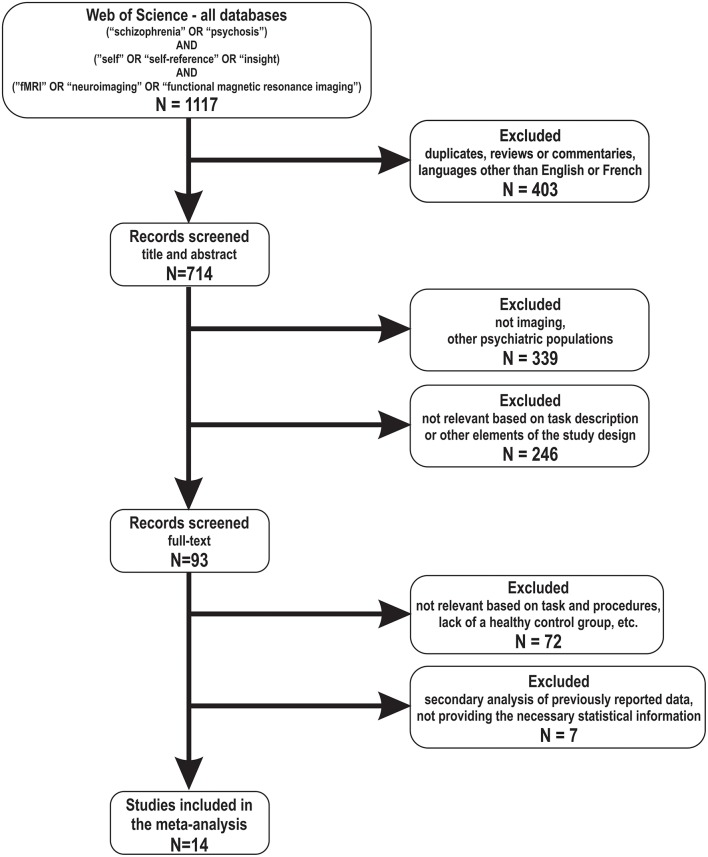
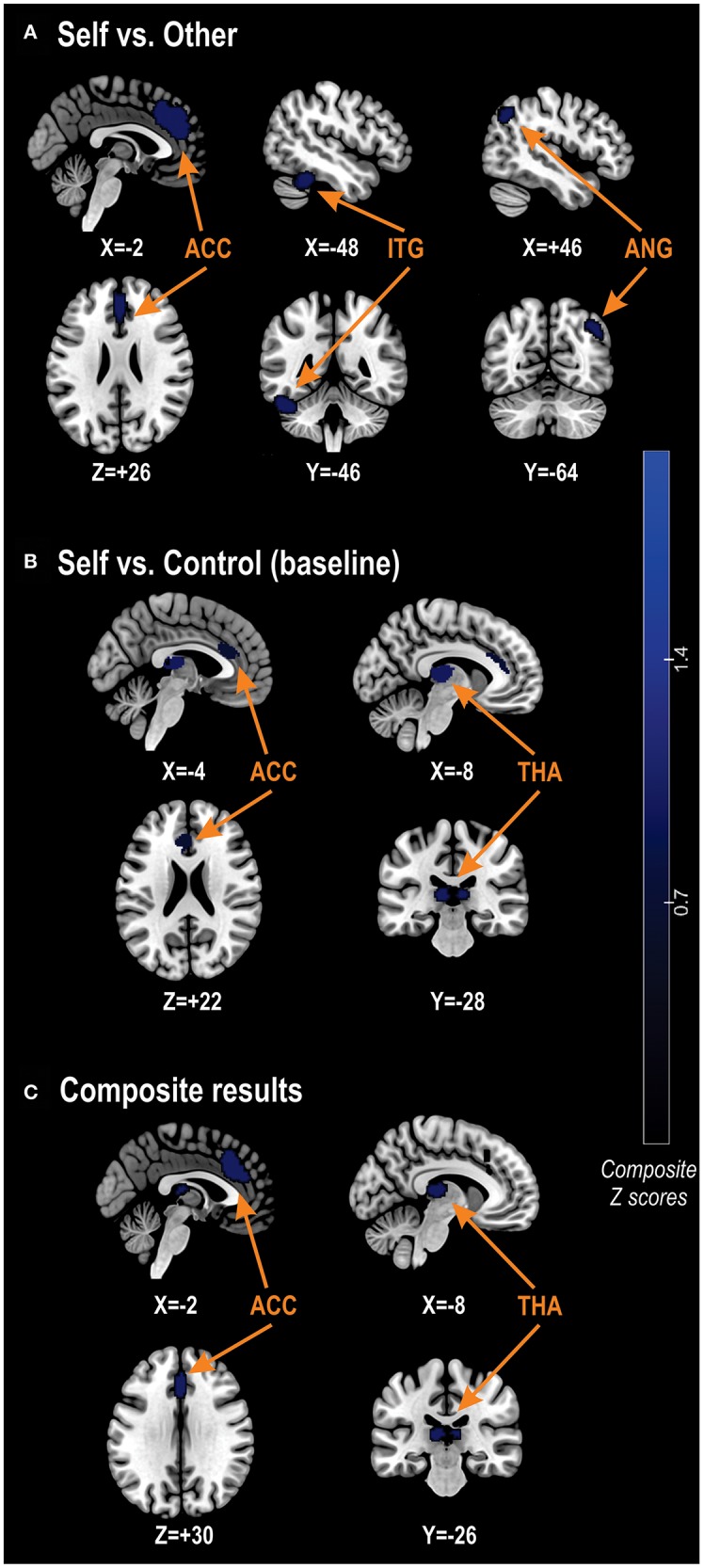
Schizophrenia is characterized by self-disturbances, including impaired self-evaluation abilities and source monitoring. The cortical midline structures (e.g., medial prefrontal cortex, anterior and posterior cingulate cortex, and precuneus) and the temporoparietal junction are known to play a key role in self-related processing. In theory, self-disturbances in schizophrenia may arise from impaired activity in these regions. We performed a functional neuroimaging meta-analysis to verify this hypothesis. A literature search was performed with PubMed and Google Scholar to identify functional neuroimaging studies examining the neural correlates of self-processing in schizophrenia, using self-other or source monitoring paradigms. Fourteen studies were retrieved, involving 245 patients and 201 controls. Using peak coordinates to recreate an effect-size map of contrast results, a standard random-effects variance weighted meta-analysis for each voxel was performed with the software. During self-processing, decreased activations were observed in schizophrenia patients relative to controls in the bilateral thalamus and the left dorsal anterior cingulate cortex (dACC) and dorso-medial prefrontal cortex. Importantly, results were homogeneous across studies, and no publication bias was observed. Sensitivity analyses revealed that results were replicable in 93-100% of studies. The current results partially support the hypothesized impaired activity of cortical midline brain regions in schizophrenia during self-processing. Decreased activations were observed in the dACC and dorsomedial prefrontal cortex, which are involved in cognitive control and/or salience attribution, as well as decision-making, respectively. These alterations may compromise patients' ability to direct their attention toward themselves and/or others and to make the decision whether a certain trait applies to one's self or to someone else. In addition, decreased activations were observed in the thalamus, which is not a core region of the default-mode network, and is involved in information integration. These thalamic alterations may compromise self-coherence in schizophrenia.
精神分裂症的特征是自我干扰,包括自我评估能力受损和源监测受损。已知皮质中线结构(如内侧前额叶皮质、前扣带回和后扣带回皮质以及楔前叶)和颞顶联合区在自我相关加工中起关键作用。理论上,精神分裂症中的自我干扰可能源于这些区域的活动受损。我们进行了一项功能性神经影像学荟萃分析以验证这一假设。使用PubMed和谷歌学术进行文献检索,以识别使用自我-他人或源监测范式研究精神分裂症自我加工神经相关性的功能性神经影像学研究。检索到14项研究,涉及245名患者和201名对照。使用峰值坐标重新创建对比结果的效应大小图,使用该软件对每个体素进行标准随机效应方差加权荟萃分析。在自我加工过程中,与对照组相比,精神分裂症患者在双侧丘脑、左侧背侧前扣带回皮质(dACC)和背内侧前额叶皮质的激活减少。重要的是,研究结果在各研究中具有同质性,未观察到发表偏倚。敏感性分析表明,93%-100%的研究结果具有可重复性。当前结果部分支持了精神分裂症患者在自我加工过程中皮质中线脑区活动受损的假设。在dACC和背内侧前额叶皮质观察到激活减少,它们分别参与认知控制和/或显著性归因以及决策。这些改变可能会损害患者将注意力指向自己和/或他人以及做出某一特征适用于自己还是他人的决定的能力。此外,在丘脑观察到激活减少,丘脑不是默认模式网络的核心区域,但参与信息整合。这些丘脑改变可能会损害精神分裂症患者的自我连贯性。