Institute for Systems Biology, Seattle, WA, 98109, USA.
Department of Bioengineering, University of Washington, Seattle, WA, 98195, USA.
Nat Commun. 2024 Aug 28;15(1):7451. doi: 10.1038/s41467-024-51759-y.
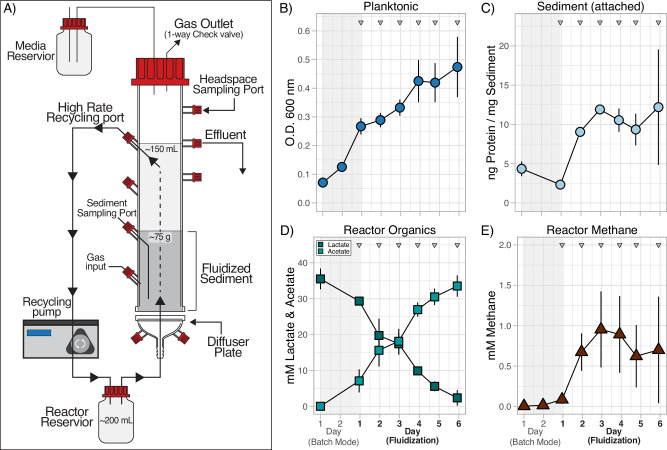
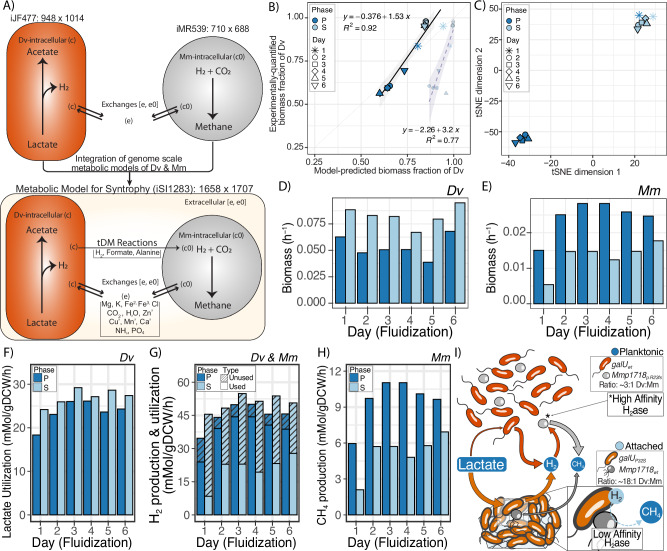
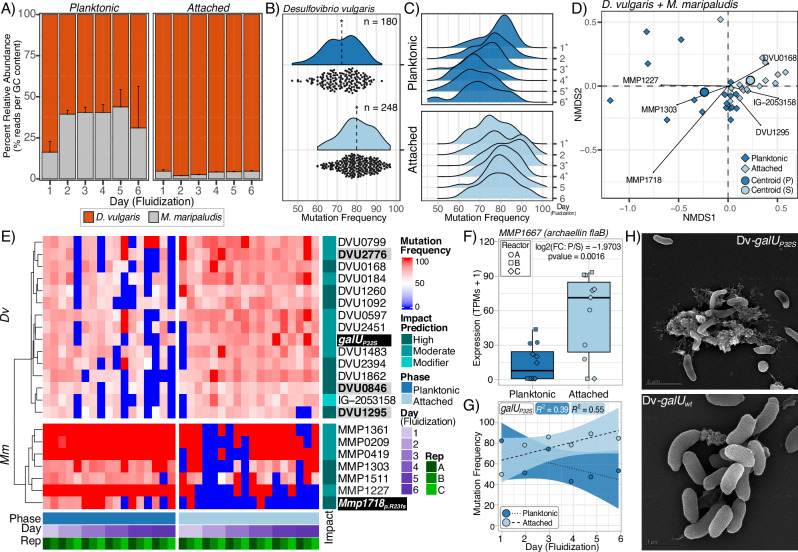
Resource partitioning is central to the incredible productivity of microbial communities, including gigatons in annual methane emissions through syntrophic interactions. Previous work revealed how a sulfate reducer (Desulfovibrio vulgaris, Dv) and a methanogen (Methanococcus maripaludis, Mm) underwent evolutionary diversification in a planktonic context, improving stability, cooperativity, and productivity within 300-1000 generations. Here, we show that mutations in just 15 Dv and 7 Mm genes within a minimal assemblage of this evolved community gave rise to co-existing ecotypes that were spatially enriched within a few days of culturing in a fluidized bed reactor. The spatially segregated communities partitioned resources in the simulated subsurface environment, with greater lactate utilization by attached Dv but partial utilization of resulting H by low affinity hydrogenases of Mm in the same phase. The unutilized H was scavenged by high affinity hydrogenases of planktonic Mm, producing copious amounts of methane. Our findings show how a few mutations can drive resource partitioning amongst niche-differentiated ecotypes, whose interplay synergistically improves productivity of the entire mutualistic community.
资源分区是微生物群落惊人生产力的核心,包括通过协同作用每年排放数十亿吨甲烷。以前的工作揭示了硫酸盐还原菌(脱硫弧菌,Dv)和产甲烷菌(巴氏甲烷八叠球菌,Mm)如何在浮游生物环境中进行进化多样化,从而在 300-1000 代内提高了稳定性、协作性和生产力。在这里,我们表明,在经过进化的群落的最小组合中,Dv 中只有 15 个和 Mm 中只有 7 个基因的突变导致了共存的生态型,这些生态型在流化床反应器中培养几天内就会在空间上富集。空间上分隔的群落将资源分配到模拟的地下环境中,附着的 Dv 更有效地利用乳酸盐,但低亲和力氢化酶的 Mm 部分利用产生的 H。未利用的 H 被浮游 Mm 的高亲和力氢化酶掠夺,产生大量甲烷。我们的研究结果表明,少数突变如何驱动生态型之间的资源分区,这些生态型的相互作用协同提高了整个共生群落的生产力。