Turkarslan Serdar, Stopnisek Nejc, Thompson Anne W, Arens Christina E, Valenzuela Jacob J, Wilson James, Hunt Kristopher A, Hardwicke Jessica, de Lomana Adrián López García, Lim Sujung, Seah Yee Mey, Fu Ying, Wu Liyou, Zhou Jizhong, Hillesland Kristina L, Stahl David A, Baliga Nitin S
Institute for Systems Biology, Seattle, WA, 98109, USA.
Civil and Environmental Engineering, University of Washington, Seattle, WA, 98195, USA.
ISME J. 2021 Aug;15(8):2233-2247. doi: 10.1038/s41396-021-00919-9. Epub 2021 Feb 21.
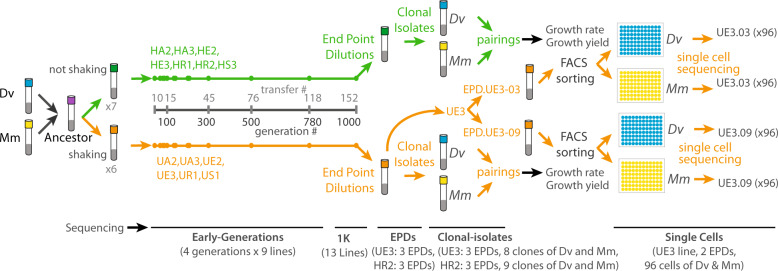
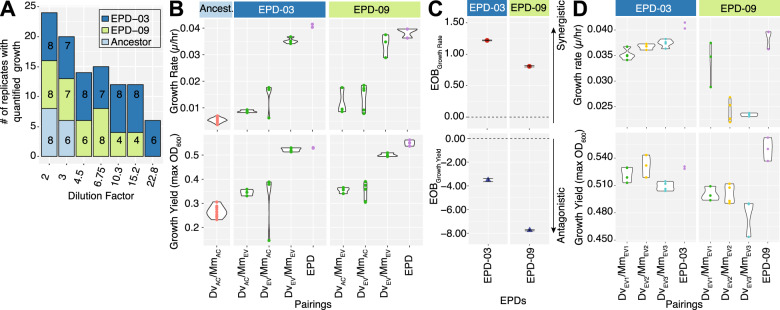
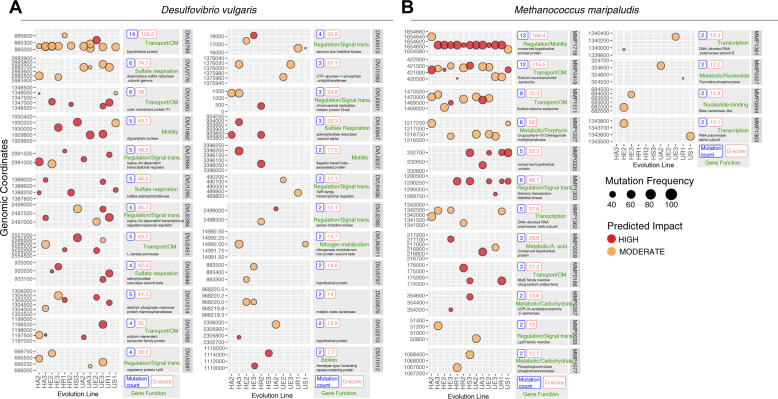
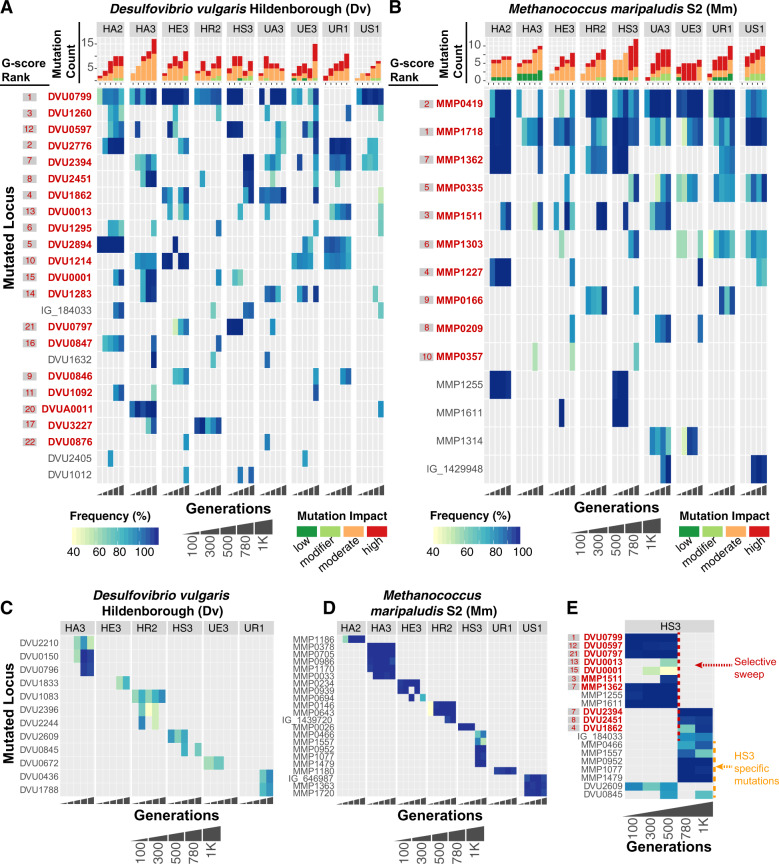
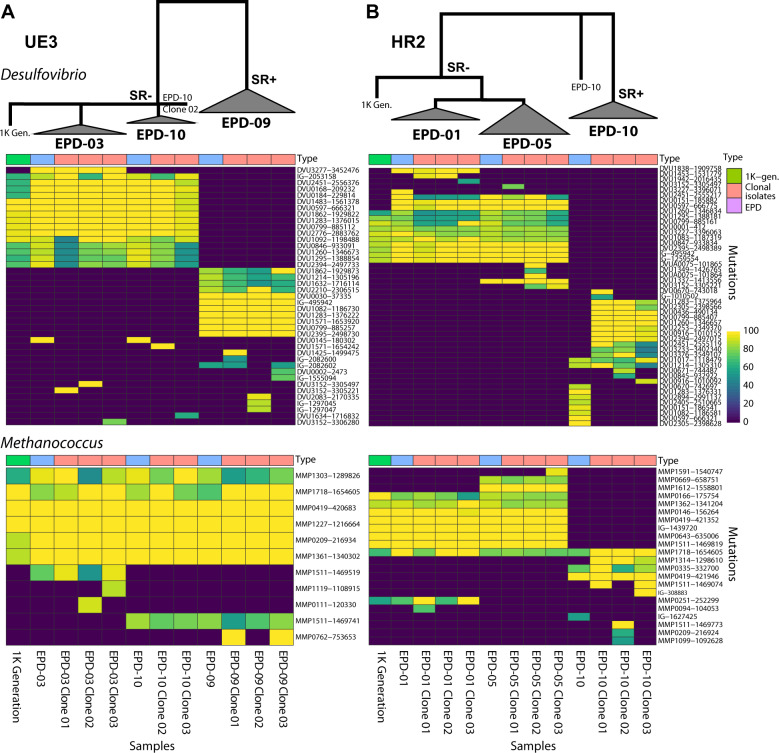
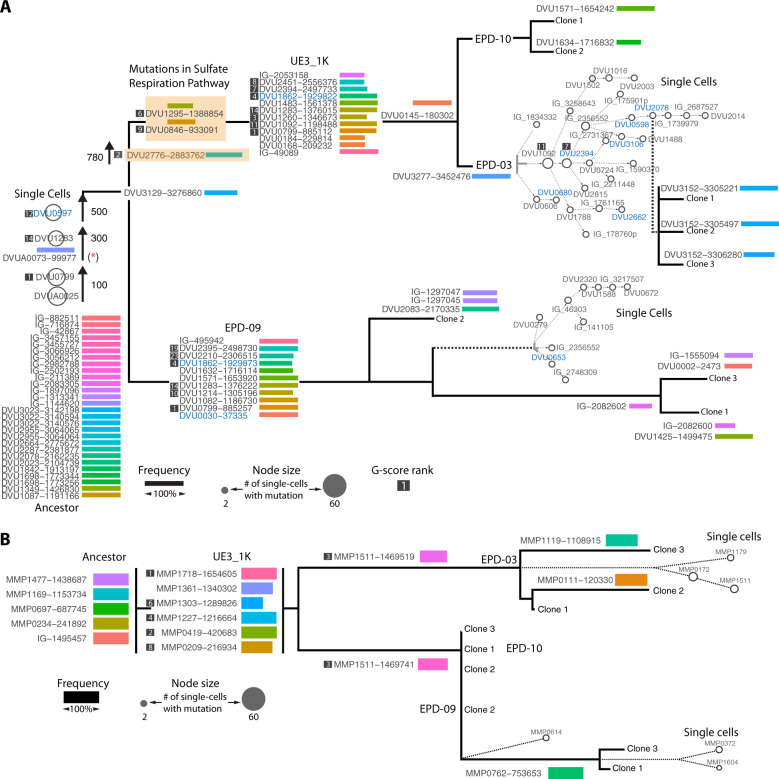
Early evolution of mutualism is characterized by big and predictable adaptive changes, including the specialization of interacting partners, such as through deleterious mutations in genes not required for metabolic cross-feeding. We sought to investigate whether these early mutations improve cooperativity by manifesting in synergistic epistasis between genomes of the mutually interacting species. Specifically, we have characterized evolutionary trajectories of syntrophic interactions of Desulfovibrio vulgaris (Dv) with Methanococcus maripaludis (Mm) by longitudinally monitoring mutations accumulated over 1000 generations of nine independently evolved communities with analysis of the genotypic structure of one community down to the single-cell level. We discovered extensive parallelism across communities despite considerable variance in their evolutionary trajectories and the perseverance within many evolution lines of a rare lineage of Dv that retained sulfate-respiration (SR+) capability, which is not required for metabolic cross-feeding. An in-depth investigation revealed that synergistic epistasis across pairings of Dv and Mm genotypes had enhanced cooperativity within SR- and SR+ assemblages, enabling their coexistence within the same community. Thus, our findings demonstrate that cooperativity of a mutualism can improve through synergistic epistasis between genomes of the interacting species, enabling the coexistence of mutualistic assemblages of generalists and their specialized variants.
互利共生的早期进化特征是具有重大且可预测的适应性变化,包括相互作用伙伴的特化,例如通过代谢交叉喂养不需要的基因中的有害突变。我们试图研究这些早期突变是否通过在相互作用物种的基因组之间表现出协同上位性来提高合作性。具体而言,我们通过纵向监测九个独立进化群落1000代积累的突变,并对一个群落的基因型结构进行单细胞水平分析,来表征普通脱硫弧菌(Dv)与马氏甲烷球菌(Mm)的互营共生相互作用的进化轨迹。我们发现,尽管各群落的进化轨迹存在相当大的差异,且许多进化谱系中保留硫酸盐呼吸(SR+)能力(代谢交叉喂养不需要该能力)的Dv稀有谱系持续存在,但各群落之间仍存在广泛的平行性。深入研究表明,Dv和Mm基因型配对之间的协同上位性增强了SR-和SR+组合内的合作性,使它们能够在同一群落中共存。因此,我们的研究结果表明,互利共生的合作性可以通过相互作用物种基因组之间的协同上位性来提高,从而使通才及其特化变体的互利共生组合能够共存。