Grupo de Investigación en Bioeconomía y Sostenibilidad Agroalimentaria, Escuela de Administración de Empresas Agropecuarias, Facultad Seccional Duitama, Universidad Pedagógica y Tecnológica de Colombia, Carrera 18 Con Calle 22, 150461, Duitama, Colombia.
Instituto de Investigaciones en Ciencia y Tecnología de Materiales (INTEMA), CCT-Mar del Plata, CONICET, Av. Colón 10850, 7600, Mar del Plata, Argentina.
Sci Rep. 2024 Aug 28;14(1):19968. doi: 10.1038/s41598-024-70690-2.
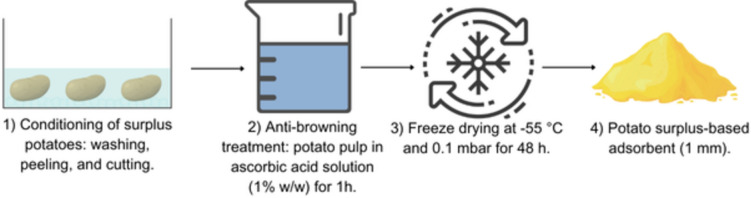
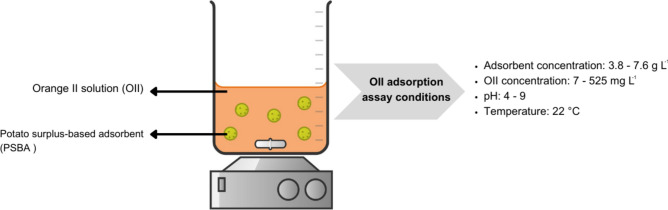
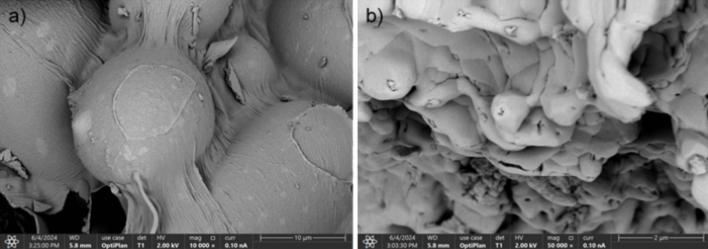
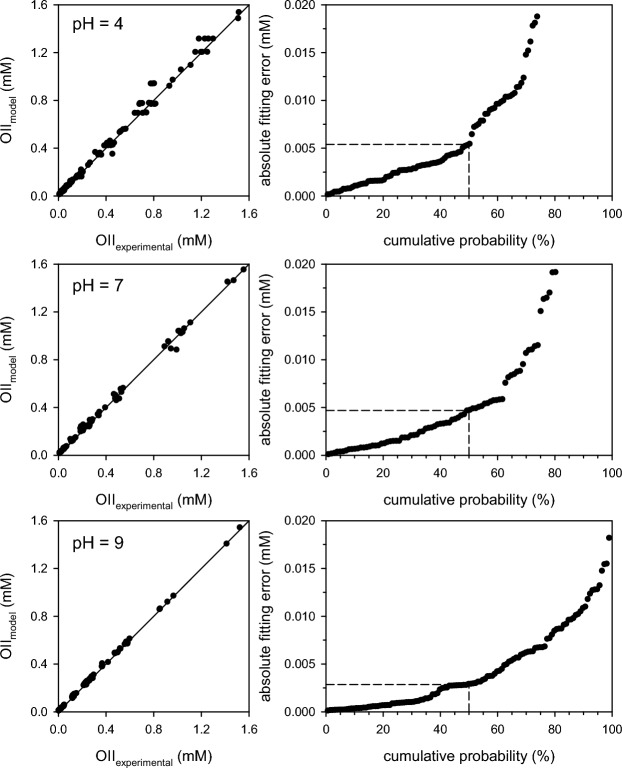
Orange II, an azo dye used in textile and leather industries, is toxic and contributes to reducing dissolved oxygen in water. In this sense, agri-food waste adsorbents offer efficient, cost-effective dye removal. In this study, potato surpluses were evaluated as adsorbents for the removal of Orange II at 22 °C and pH values between 4 and 9. The adsorbents were characterized by their morphology, elemental composition, infrared spectra, and point of zero charge. Adsorption isotherms were analysed using Langmuir and Freundlich models, revealing that the Langmuir equation (0.933 < r > 0.882) better described the adsorption process compared to the Freundlich model (0.909 < r > 0.852). The maximum adsorption capacity at pH 4 was 1.1 and 2.3 times higher than at pH 7 and 9, respectively. This increased capacity at pH 4 was due to favourable electrostatic interactions between the cationic adsorbent surface and the anionic dye. A kinetic model was developed to understand the adsorption dynamics of Orange II, demonstrating high accuracy with coefficients of determination (r) exceeding 0.99 across various pH values. The predictions of the kinetic model aligned well with the Langmuir isotherm results, indicating a strong theoretical foundation. The critical contact time required to achieve the minimum adsorbent concentration necessary for meeting a discharge limit of 14.7 mg L was determined using both the Langmuir and kinetic models. Simulation profiles showed that when the adsorbent concentration was increased from 12 to 40 g L, the contact time necessary to achieve the discharge limit decreased from 26 to 3.35 h, highlighting the trade-off between contact time and cost. This study offers a cost-effective solution for wastewater treatment and presents a robust model for optimizing batch adsorption processes, marking a significant advancement in using potato surpluses for dye removal.
橙色 II 是一种用于纺织和制革工业的偶氮染料,具有毒性,会导致水中溶解氧减少。在这种情况下,农业食品废物吸附剂提供了高效、经济有效的染料去除方法。在这项研究中,评估了土豆废料作为吸附剂,在 22°C 和 pH 值在 4 到 9 之间去除橙色 II。通过形貌、元素组成、红外光谱和零电荷点对吸附剂进行了表征。使用 Langmuir 和 Freundlich 模型分析了吸附等温线,结果表明 Langmuir 方程(0.933<r<0.882)比 Freundlich 模型(0.909<r<0.852)更好地描述了吸附过程。在 pH 值为 4 时的最大吸附容量比在 pH 值为 7 和 9 时分别高 1.1 和 2.3 倍。在 pH 值为 4 时,吸附容量增加是由于阳离子吸附剂表面与阴离子染料之间存在有利的静电相互作用。开发了一个动力学模型来理解 Orange II 的吸附动力学,该模型在不同 pH 值下的决定系数(r)均超过 0.99,具有很高的准确性。动力学模型的预测与 Langmuir 等温线结果吻合良好,表明其具有很强的理论基础。通过 Langmuir 和动力学模型确定了达到满足 14.7mg/L 排放限值所需的最小吸附剂浓度的临界接触时间。模拟曲线表明,当吸附剂浓度从 12 增加到 40g/L 时,达到排放限值所需的接触时间从 26 小时减少到 3.35 小时,这突出了接触时间和成本之间的权衡。本研究为废水处理提供了一种经济有效的解决方案,并为优化批量吸附过程提供了一个稳健的模型,这标志着利用土豆废料去除染料方面取得了重大进展。