Calandra Sara, Cantisani Emma, Conti Claudia, Salvadori Barbara, Barone Serena, Liccioli Lucia, Fedi Mariaelena, Salvatici Teresa, Arrighetti Andrea, Fratini Fabio, Garzonio Carlo Alberto
Department of Earth Sciences, University of Florence, 50121, Florence, Italy.
Institute of Heritage Science, National Research Council of Italy, 50019, Sesto Fiorentino (Florence), Italy.
Sci Rep. 2024 Aug 28;14(1):19979. doi: 10.1038/s41598-024-70763-2.
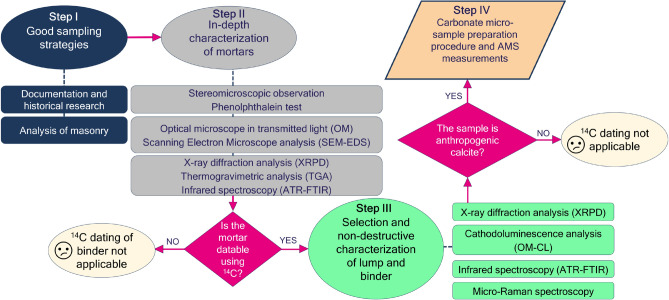
The overarching challenge of this research is setting up a procedure to select the most appropriate fraction from complex, heterogeneous materials such as historic mortars in case of radiocarbon dating. At present, in the international community, there is not a unique and fully accepted way of mortar sample preparation to systematically obtain accurate results. With this contribution, we propose a strategy for selecting suitable mortar samples for radiocarbon dating of anthropogenic calcite in binder or lump. A four-step procedure is proposed: (I) good sampling strategies along with architectural and historical surveys; (II) mineralogical, petrographic, and chemical characterization of mortars to evaluate the feasibility of sample dating; (III) a non-destructive multi-analytical characterization of binder-rich portions to avoid geogenic calcite contamination; (IV) carbonate micro-sample preparation and accelerator mass spectrometer (AMS) measurements. The most innovative feature of the overall procedure relies on the fact that, in case of positive validation in step III, exactly the same material is treated and measured in step IV. The paper aims to apply this procedure to the ancient mortar of the Florentine historical building (Trebbio Castle), selecting micro-samples suitable for dating in natural hydraulic mortars. The discussion of the mortar dating results with the historical-archaeological hypotheses provided significant insights into the construction history of the building.
这项研究的首要挑战是建立一种程序,以便在进行放射性碳测年时,从复杂的异质材料(如历史灰浆)中选择最合适的部分。目前,国际上还没有一种独特且被广泛接受的灰浆样品制备方法来系统地获得准确结果。通过这项研究,我们提出了一种为粘结剂或块状物中人为形成的方解石进行放射性碳测年选择合适灰浆样品的策略。我们提出了一个四步程序:(I)结合建筑和历史调查制定良好的采样策略;(II)对灰浆进行矿物学、岩石学和化学表征,以评估样品测年的可行性;(III)对富含粘结剂的部分进行非破坏性多分析表征,以避免地质成因方解石的污染;(IV)碳酸盐微样品制备和加速器质谱(AMS)测量。整个程序最具创新性的特点在于,如果在第三步得到肯定验证,那么在第四步中处理和测量的正是同一种材料。本文旨在将该程序应用于佛罗伦萨历史建筑(特雷比奥城堡)的古代灰浆,选择适合对天然水硬性灰浆进行测年的微样品。将灰浆测年结果与历史考古假设进行讨论,为该建筑的建造历史提供了重要见解。