Division of Nephrology, Taichung Veterans General Hospital, Taiwan Boulevard Sect. 4, Taichung, 40705, Taiwan.
College of Medicine, China Medical University, Taichung, Taiwan.
Sci Rep. 2024 Aug 28;14(1):20015. doi: 10.1038/s41598-024-70760-5.
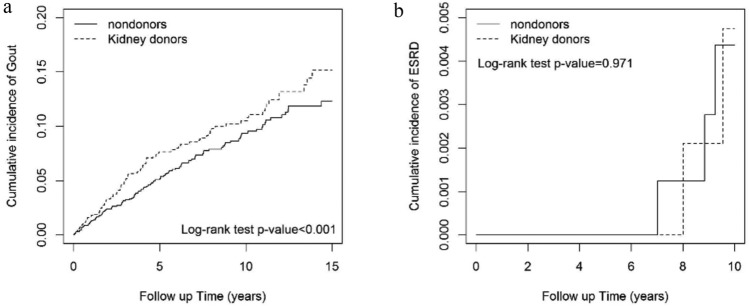
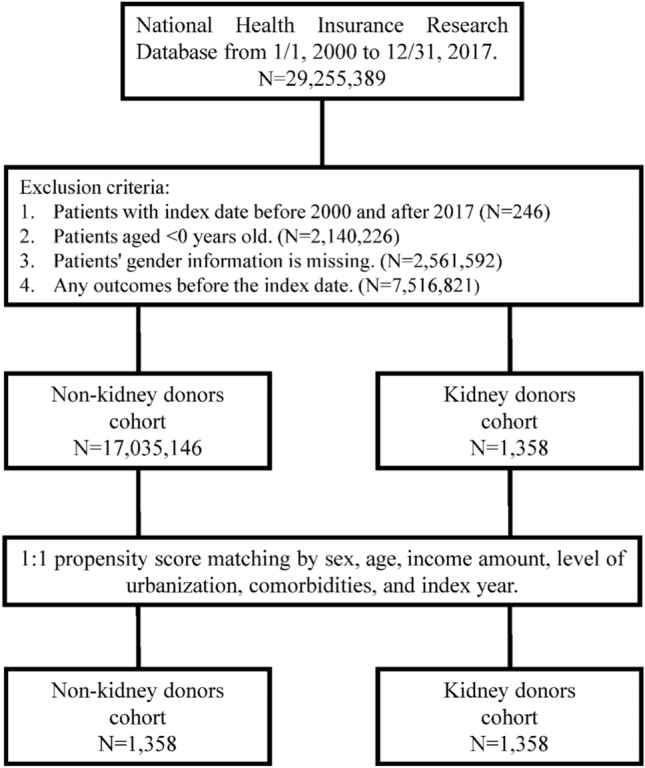
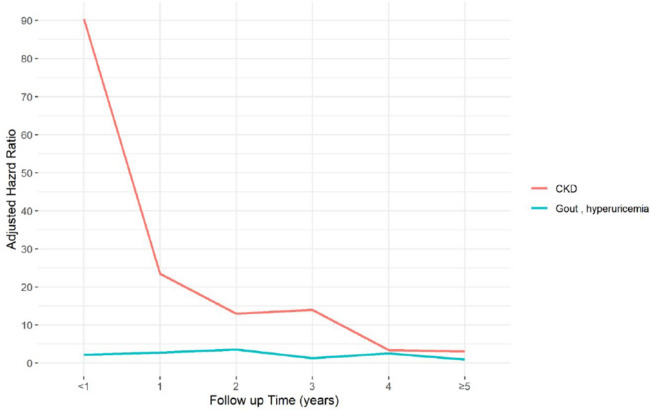
Living kidney donors have been regarded as those people having earned the healthiest status level after having undergone scrutiny. Although one's post-donation GFR is expected to fall to 50% of their pre-donation value, it is well documented that there is a compensatory increase in GFR which subsequently reaches approximately 60-70% of the donor's pre-donation value. Data regarding gout/hyperuricemia in living kidney donors has remained scarce until now. This study involved kidney donors enrolled within the years 2000 to 2017, where those who were selected to be matched to those in group of case cohort by age, year of index date, gender and co-morbidity were considered as the control cohort. During the 17-year study period 2,716 participants were enrolled. Results revealed that kidney donors experienced a risk of new onset gout/ hyperuricemia (adjusted HR = 1.73; 95%CI = 1.27, 2.36), and new onset CKD (adjusted HR = 6.7; 95% CI = 4.4, 10.21) were found to be higher in kidney donors. Our findings suggest that people after kidney donation are significantly associated with a higher risk of new onset gout/hyperuricemia. Clinical professionals therefore need to be cautious of new onset gouy/hyperuricemia after donation surgery.
活体肾捐献者被认为是在经过严格筛选后获得最佳健康状态的人群。尽管捐献后肾小球滤过率(GFR)预计会下降到捐献前的 50%,但已有充分的文献记载表明,GFR 会代偿性增加,随后达到捐献前的 60-70%左右。直到现在,有关活体肾捐献者痛风/高尿酸血症的数据仍然很少。这项研究涉及 2000 年至 2017 年期间登记的肾捐献者,那些通过年龄、索引日期年份、性别和合并症与病例队列相匹配的人被选为对照组。在 17 年的研究期间,共纳入了 2716 名参与者。结果显示,肾捐献者新发痛风/高尿酸血症的风险增加(调整后的 HR=1.73;95%CI=1.27,2.36),新发慢性肾脏病(CKD)的风险也更高(调整后的 HR=6.7;95%CI=4.4,10.21)。我们的研究结果表明,肾捐献者在捐赠后发生新发痛风/高尿酸血症的风险显著增加。因此,临床医生需要在捐赠手术后对新发痛风/高尿酸血症保持警惕。