Grosser Oliver S, Volk Martin, Georgiades Marilena, Punzet Daniel, Alsawalhi Bahaa, Kupitz Dennis, Omari Jazan, Wissel Heiko, Kreissl Michael C, Rose Georg, Pech Maciej
Department of Radiology and Nuclear Medicine, University Hospital Magdeburg and Medical Faculty of Otto-von-Guericke University, 39120 Magdeburg, Germany.
Research Campus STIMULATE, Otto-von-Guericke University, 39106 Magdeburg, Germany.
Bioengineering (Basel). 2024 Aug 16;11(8):838. doi: 10.3390/bioengineering11080838.
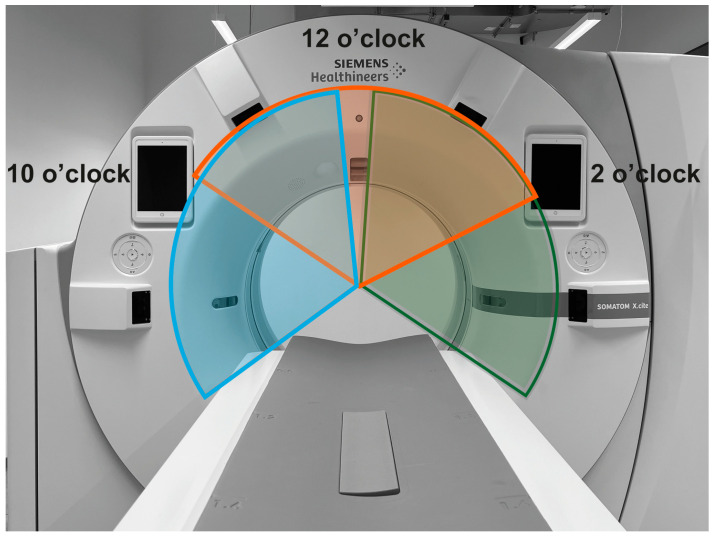
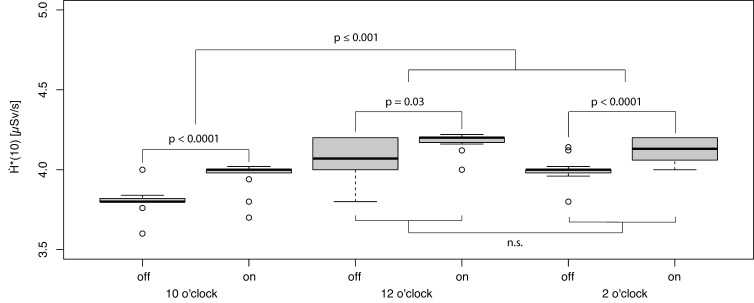
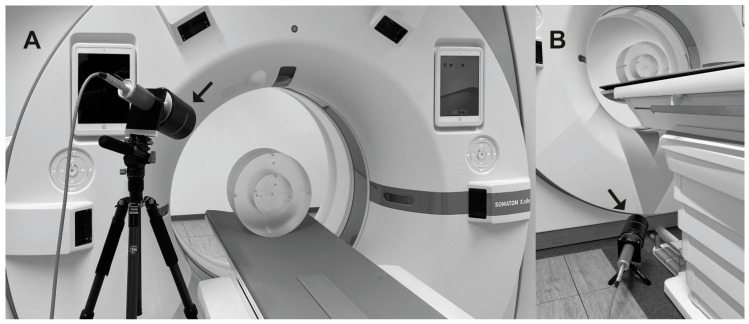
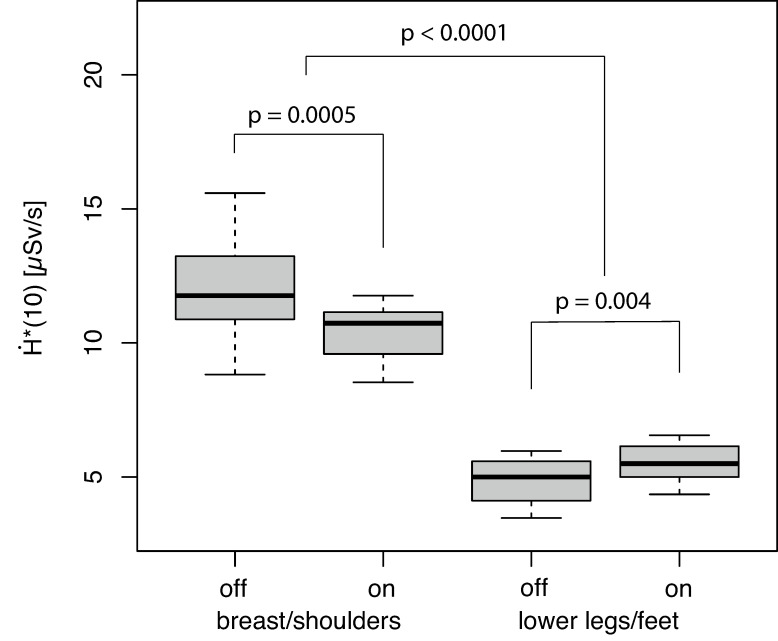
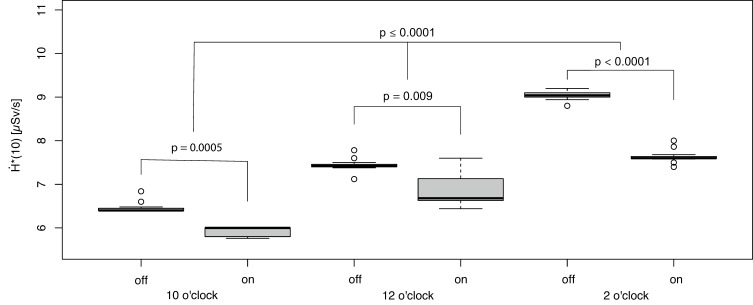
Dose optimization in computed tomography (CT) is crucial, especially in CT fluoroscopy (fluoro-CT) used for real-time navigation, affecting both patient and operator safety. This study evaluated the impact of spectral X-ray filtering using a tin filter (Sn filter), and a method called partial-angle computed tomography (PACT), which involves segmentally switching off the X-ray tube current at the ambient dose rate H˙(10) at the interventional radiologist's (IR) position. Measurements were taken at two body regions (upper body: head/neck; lower body: lower legs/feet) using a 120 kV X-ray tube voltage, 3 × 5.0 mm CT collimation, 0.5 s rotation speed, and X-ray tube currents of 43 Eff.mAs (without Sn filter) and 165 Eff.mAs (with Sn filter). The study found significant dose reductions in both body regions when using the Sn filter and PACT together. For instance, in the upper body region, the combination protocol reduced H˙(10) from 11.8 µSv/s to 6.1 µSv/s ( < 0.0001) compared to the protocol without using these features. Around 8% of the reduction (about 0.5 µSv/s) is attributed to the Sn filter ( = 0.0005). This approach demonstrates that using the Sn filter along with PACT effectively minimizes radiation exposure for the IR, particularly protecting areas like the head/neck, which can only be insufficiently covered by (standard) radiation protection material.
计算机断层扫描(CT)中的剂量优化至关重要,尤其是在用于实时导航的CT透视(荧光CT)中,这会影响患者和操作人员的安全。本研究评估了使用锡滤过器(Sn滤过器)进行光谱X射线滤过以及一种称为部分角度计算机断层扫描(PACT)的方法的影响,该方法涉及在介入放射科医生(IR)位置的环境剂量率H˙(10)下分段关闭X射线管电流。使用120 kV X射线管电压、3×5.0 mm CT准直、0.5 s旋转速度以及43等效毫安秒(无Sn滤过器)和165等效毫安秒(有Sn滤过器)的X射线管电流,在两个身体部位(上半身:头部/颈部;下半身:小腿/足部)进行测量。研究发现,同时使用Sn滤过器和PACT时,两个身体部位的剂量均显著降低。例如,在上半身区域,与未使用这些功能的方案相比,联合方案将H˙(10)从11.8 µSv/s降低至6.1 µSv/s(<0.0001)。约8%的降低(约0.5 µSv/s)归因于Sn滤过器(=0.0005)。这种方法表明,将Sn滤过器与PACT一起使用可有效降低IR的辐射暴露,特别是对头/颈部等(标准)辐射防护材料覆盖不足的区域起到保护作用。