Ferrante Rossella, Tumini Stefano, Saltarelli Maria Alessandra, Di Rado Sara, Scorrano Vincenzo, Tommolini Maria Lucia, Zucchelli Mirco, Lauriola Federico, Lisi Gabriele, Lauriti Giuseppe, Marino Nino, Stuppia Liborio, Rossi Claudia, Bucci Ines
Center for Advanced Studies and Technology (CAST), "G. d'Annunzio" University of Chieti-Pescara, 66100 Chieti, Italy.
Department of Maternal and Child Health, UOSD Regional Center of Pediatric Diabetology, Chieti Hospital, 66100 Chieti, Italy.
Biomedicines. 2024 Aug 2;12(8):1742. doi: 10.3390/biomedicines12081742.
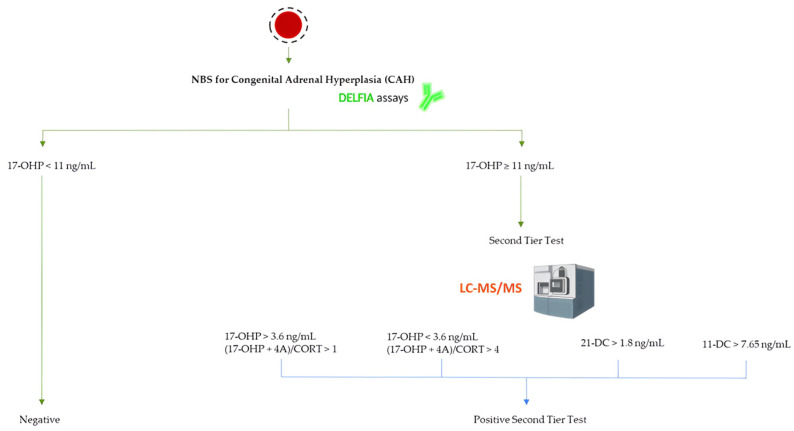
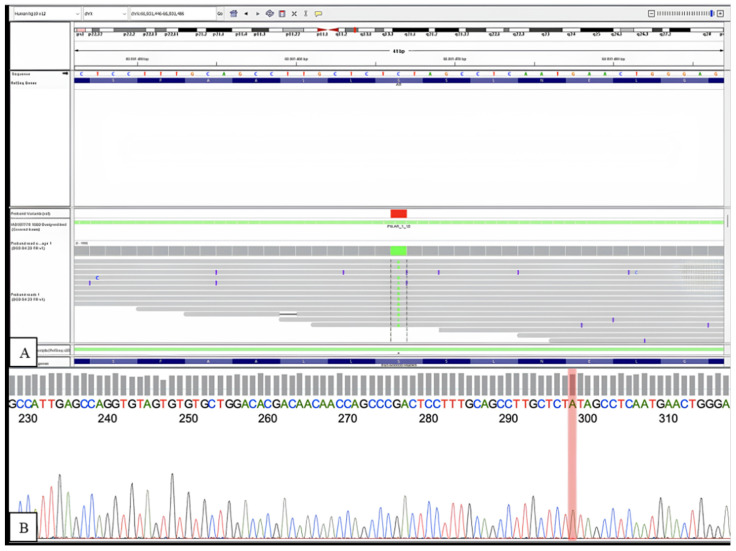
Androgen insensitivity syndrome (AIS) is one of the most common Disorders of Sexual Differentiation (DSDs). AIS is characterized by an X-linked recessive inheritance pattern associated with variants in the androgen receptor (AR) gene that affects the masculinization process in individuals with XY karyotype. Here, we report a neonatal case of a very early diagnosis of complete AIS due to a novel variant in the AR gene. In the present case, after the clinical evaluation, the infant has undergone the following tests: biochemical analyses, including newborn screening workflow, karyotype analysis, and Next-Generation Sequencing (NGS) panel of 50 genes involved in DSDs. The NGS analysis identified a missense variant, c.2108C>A, in the AR gene. According to a cytogenetic analysis, the patient presented a 46, XY karyotype, thus the resulting hemizygote for the AR gene variant. The variant is not currently described in the literature nor in the ClinVar database. However, according to computational models, the variant could have a pathogenetic effect. This clinical case reveals a novel variant of the AR gene with a possible pathogenetic effect associated with AIS and highlights the importance of a multidisciplinary approach for the timely diagnosis and appropriate follow-up of the patient.
雄激素不敏感综合征(AIS)是最常见的性分化障碍(DSD)之一。AIS的特征是X连锁隐性遗传模式,与雄激素受体(AR)基因的变异有关,该变异会影响XY核型个体的男性化过程。在此,我们报告一例因AR基因的新型变异而在新生儿期被非常早期诊断出的完全性AIS病例。在本病例中,经过临床评估后,该婴儿接受了以下检查:生化分析,包括新生儿筛查流程、核型分析以及涉及DSD的50个基因的下一代测序(NGS)检测板。NGS分析在AR基因中鉴定出一个错义变异,c.2108C>A。根据细胞遗传学分析,患者呈现46, XY核型,因此是AR基因变异的半合子。该变异目前在文献和ClinVar数据库中均未被描述。然而,根据计算模型,该变异可能具有致病作用。这一临床病例揭示了AR基因的一种新型变异,其可能与AIS存在致病关联,并强调了多学科方法对于患者及时诊断和适当随访的重要性。