Tagliaferri Luca, Sciurti Elisabetta, Fionda Bruno, Loperfido Antonella, Lancellotta Valentina, Placidi Elisa, Parrilla Claudio, La Milia Maria Concetta, Rosa Enrico, Rigante Mario, De Angeli Martina, Cornacchione Patrizia, Galli Jacopo, Bussu Francesco, Gambacorta Maria Antonietta
UOC Degenze di Radioterapia Oncologica, Dipartimento di Diagnostica per Immagini e Radioterapia Oncologica, Fondazione Policlinico Universitario A. Gemelli IRCCS, 00168 Rome, Italy.
Istituto di Radiologia, Università Cattolica del Sacro Cuore, 00168 Rome, Italy.
J Clin Med. 2024 Aug 9;13(16):4683. doi: 10.3390/jcm13164683.
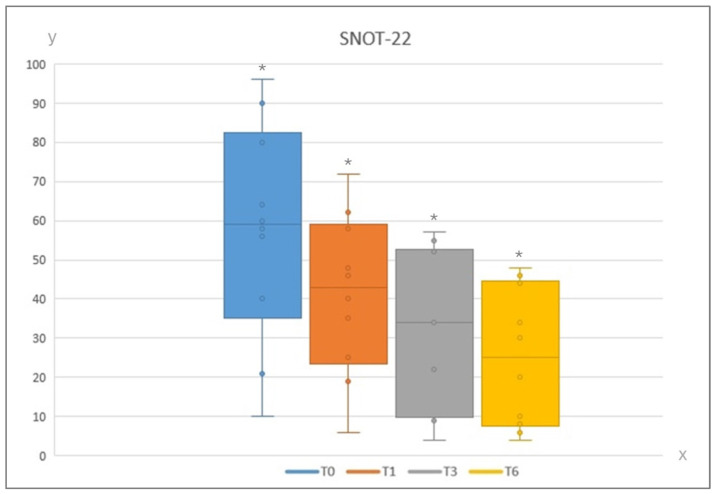
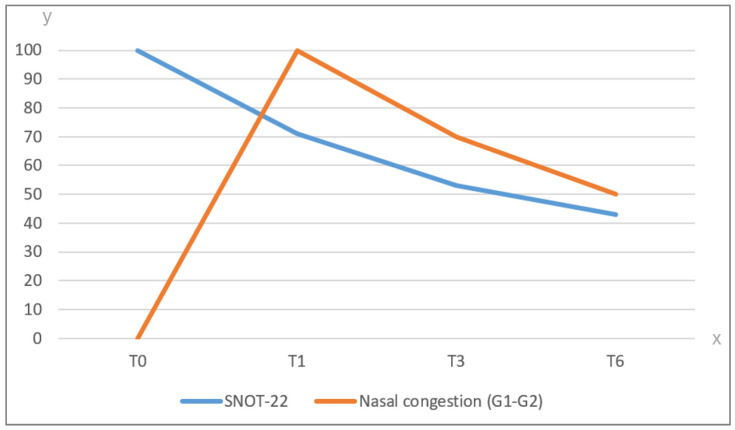
The aim of this paper is to evaluate the impact on the quality of life of the treatment of nasal vestibule tumors by interventional radiotherapy (IRT-brachytherapy) through a patient reported outcome questionnaire. We prospectively collected data about patients undergoing IRT according to our institutional schedule of 44 Gy delivered in 14 fractions twice a day. We recorded both acute toxicity data, using the Common Terminology Criteria for Adverse Events (CTCAE) version 5.0, and quality of life data, using the 22-item Sino-Nasal Outcome Test (SNOT-22) at baseline (T0), at 1 month (T1), at 3 months (T3), and at 6 months (T6). We enrolled 10 consecutive patients treated between February 2023 and October 2023. The decrease in terms of SNOT-22 mean value was statistically significant from T0 and T6 with a -value < 0.001. A noteworthy clinical finding is that quality of life improved regardless of the occurrence of G1-G2 side effects. Using SNOT-22 on patients with nasal vestibule carcinoma treated with IRT has shown an improvement in quality of life that is not strictly dependent on the occurrence of expected G1-G2 side effects.
本文旨在通过患者报告结局问卷评估介入放疗(IRT-近距离放疗)治疗鼻前庭肿瘤对生活质量的影响。我们按照机构方案前瞻性收集了接受IRT治疗的患者数据,即每天两次,每次14分次,共44 Gy。我们使用第5.0版不良事件通用术语标准(CTCAE)记录急性毒性数据,并在基线(T0)、1个月(T1)、3个月(T3)和6个月(T6)时使用22项鼻-鼻窦结局测试(SNOT-22)记录生活质量数据。我们纳入了2023年2月至2023年10月期间连续治疗的10例患者。SNOT-22平均值从T0到T6有显著下降,P值<0.001。一个值得注意的临床发现是,无论是否发生G1-G2级副作用,生活质量均有所改善。对接受IRT治疗的鼻前庭癌患者使用SNOT-22表明,生活质量的改善并不严格依赖于预期的G1-G2级副作用的发生。